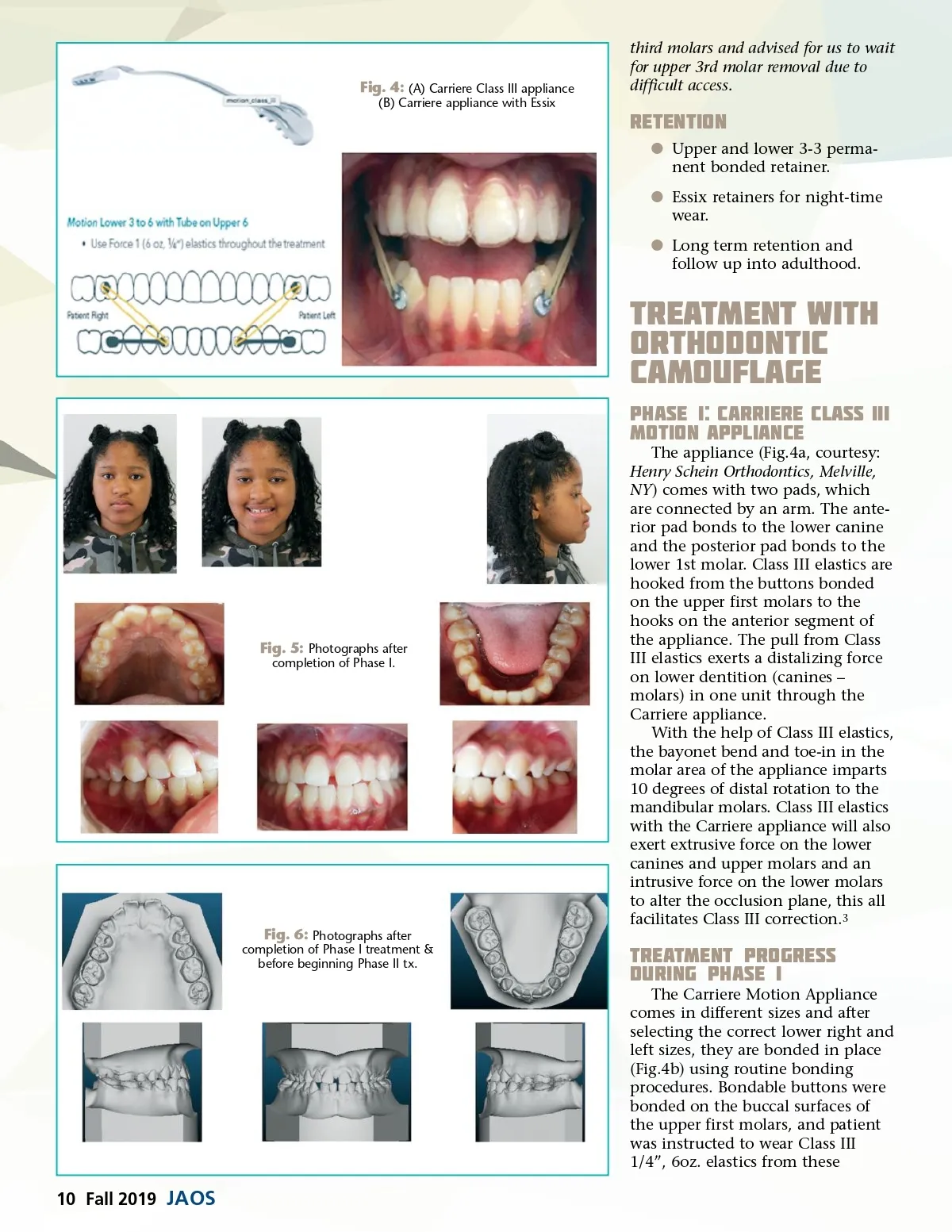
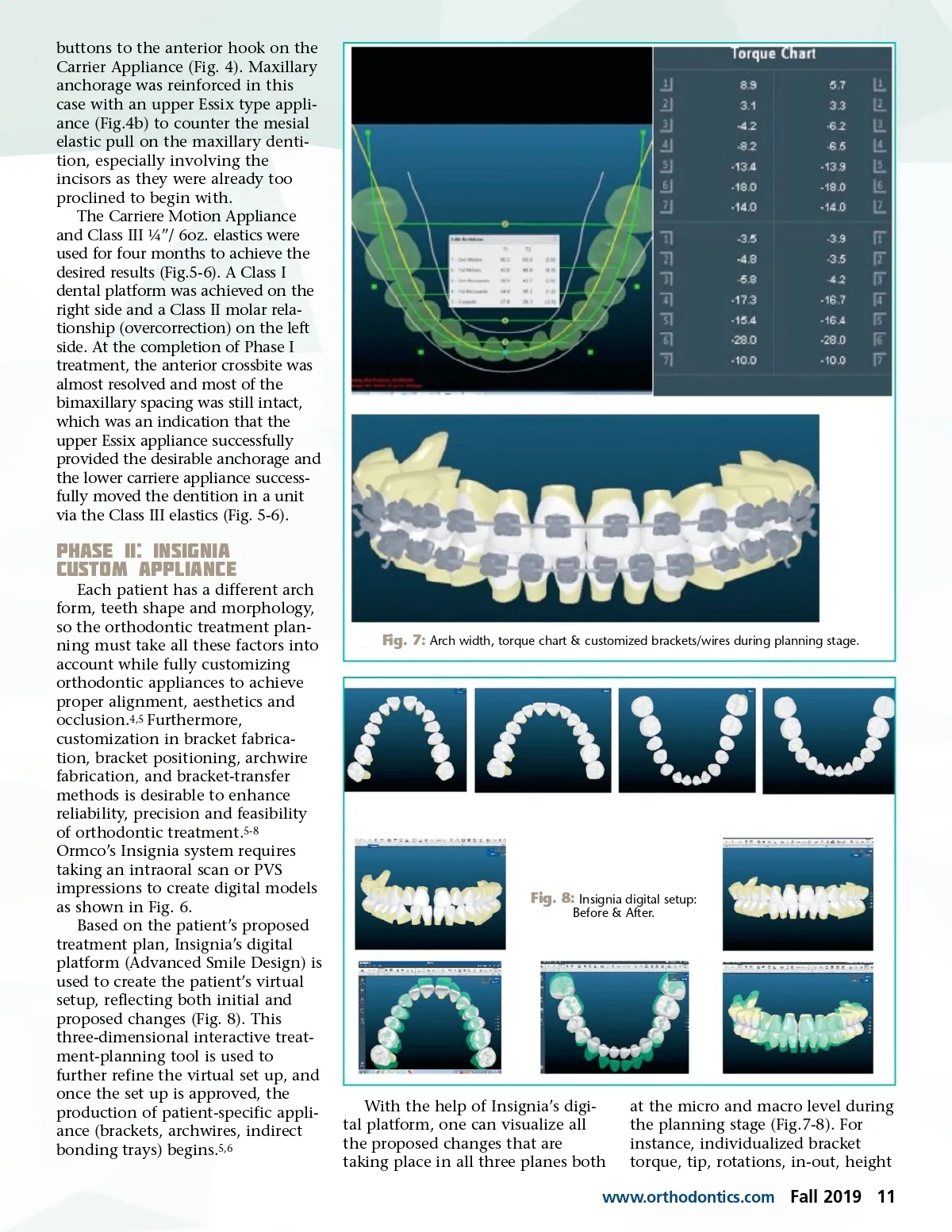
Fig. 4: (A) Carriere Class III appliance (B) Carriere appliance with Essix third molars and advised for us to wait for upper 3rd molar removal due to difficult access. Retention b Upper and lower 3-3 perma-nent bonded retainer. b Essix retainers for night-time wear. b Long term retention and follow up into adulthood. Treatment with Orthodontic Camouflage Phase I: Carriere Class III Motion Appliance The appliance (Fig.4a, courtesy: Henry Schein Orthodontics, Melville, NY ) comes with two pads, which are connected by an arm. The ante-rior pad bonds to the lower canine and the posterior pad bonds to the lower 1st molar. Class III elastics are hooked from the buttons bonded on the upper first molars to the hooks on the anterior segment of the appliance. The pull from Class III elastics exerts a distalizing force on lower dentition (canines – molars) in one unit through the Carriere appliance. With the help of Class III elastics, the bayonet bend and toe-in in the molar area of the appliance imparts 10 degrees of distal rotation to the mandibular molars. Class III elastics with the Carriere appliance will also exert extrusive force on the lower canines and upper molars and an intrusive force on the lower molars to alter the occlusion plane, this all facilitates Class III correction. 3 Fig. 5: Photographs after completion of Phase I. Fig. 6: Photographs after completion of Phase I treatment & before beginning Phase II tx. Treatment Progress during Phase I The Carriere Motion Appliance comes in different sizes and after selecting the correct lower right and left sizes, they are bonded in place (Fig.4b) using routine bonding procedures. Bondable buttons were bonded on the buccal surfaces of the upper first molars, and patient was instructed to wear Class III 1/4”, 6oz. elastics from these 10 Fall 2019 JAOS
Journal of the American Orthodontic Society Fall 2019: Page 10