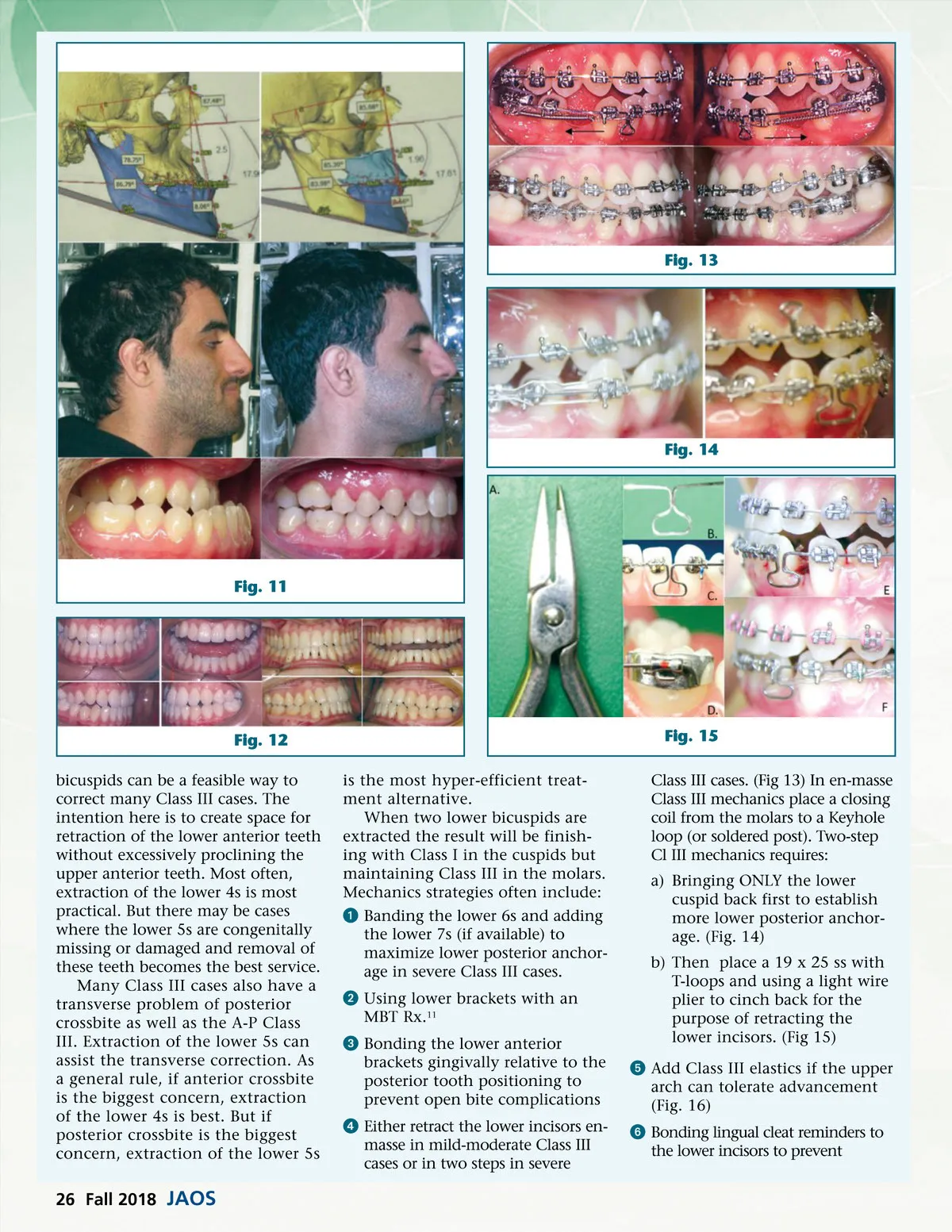
Fig. 13 Fig. 14 Fig. 11 Fig. 12 bicuspids can be a feasible way to correct many Class III cases. The intention here is to create space for retraction of the lower anterior teeth without excessively proclining the upper anterior teeth. Most often, extraction of the lower 4s is most practical. But there may be cases where the lower 5s are congenitally missing or damaged and removal of these teeth becomes the best service. Many Class III cases also have a transverse problem of posterior crossbite as well as the A-P Class III. Extraction of the lower 5s can assist the transverse correction. As a general rule, if anterior crossbite is the biggest concern, extraction of the lower 4s is best. But if posterior crossbite is the biggest concern, extraction of the lower 5s is the most hyper-efficient treat-ment alternative. When two lower bicuspids are extracted the result will be finish-ing with Class I in the cuspids but maintaining Class III in the molars. Mechanics strategies often include: ᕡ Banding the lower 6s and adding the lower 7s (if available) to maximize lower posterior anchor-age in severe Class III cases. ᕢ Using lower brackets with an MBT Rx. 11 ᕣ Bonding the lower anterior brackets gingivally relative to the posterior tooth positioning to prevent open bite complications ᕤ Either retract the lower incisors en-masse in mild-moderate Class III cases or in two steps in severe Fig. 15 Class III cases. (Fig 13) In en-masse Class III mechanics place a closing coil from the molars to a Keyhole loop (or soldered post). Two-step Cl III mechanics requires: a) Bringing ONLY the lower cuspid back first to establish more lower posterior anchor-age. (Fig. 14) b) Then place a 19 x 25 ss with T-loops and using a light wire plier to cinch back for the purpose of retracting the lower incisors. (Fig 15) ᕥ Add Class III elastics if the upper arch can tolerate advancement (Fig. 16) ᕦ Bonding lingual cleat reminders to the lower incisors to prevent 26 Fall 2018 JAOS
Journal of the American Orthodontic Society Fall 2018: Page 26