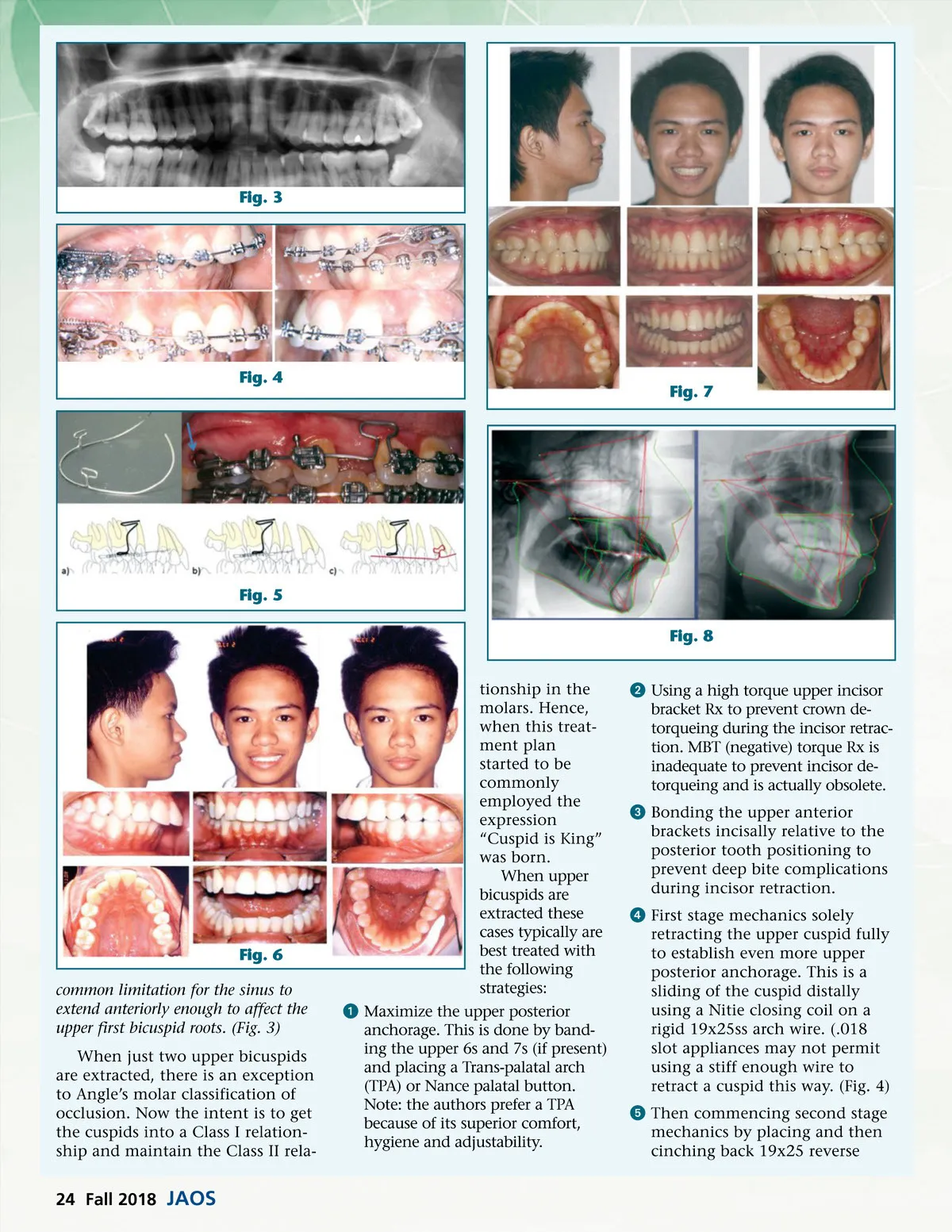
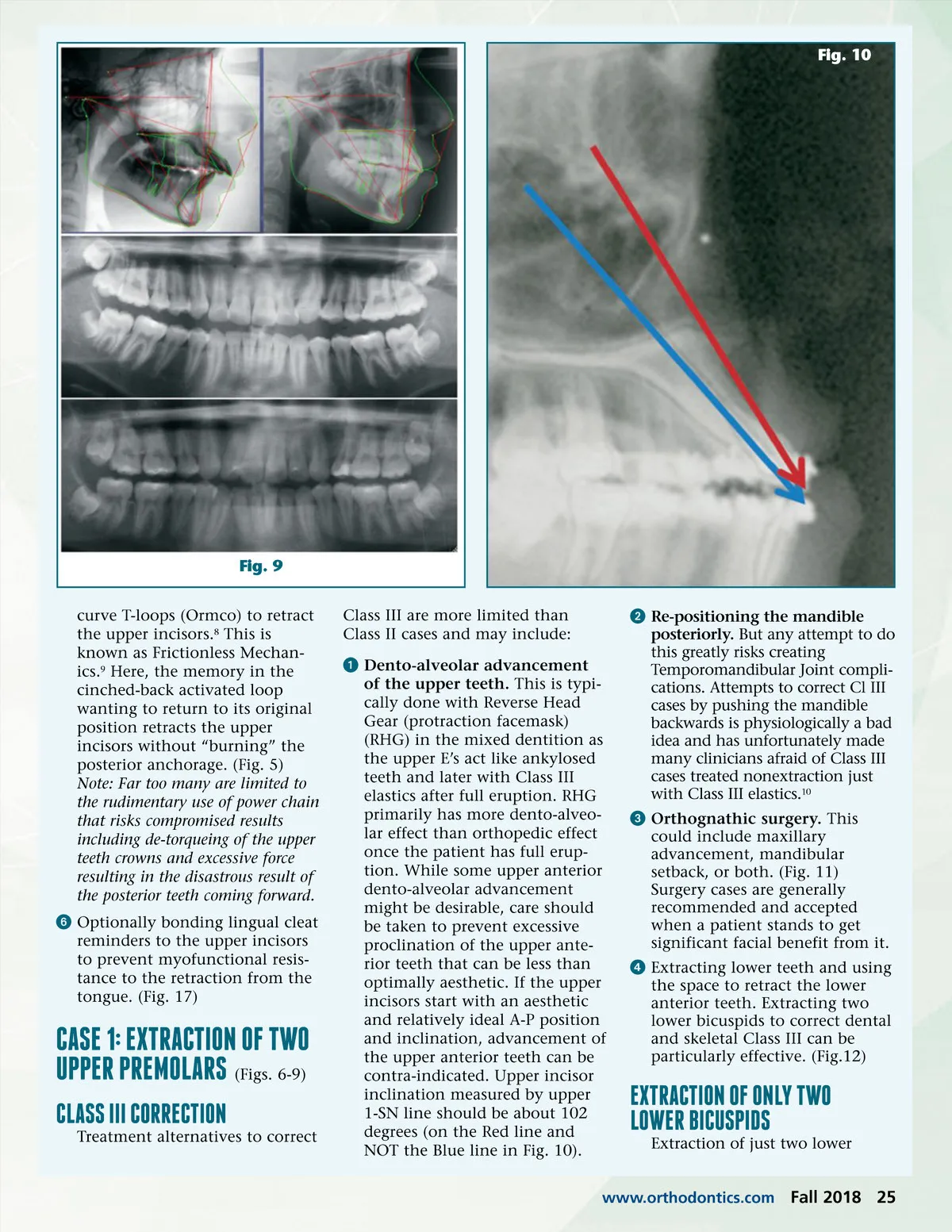
Fig. 3 Fig. 4 Fig. 7 Fig. 5 Fig. 8 tionship in the molars. Hence, when this treat-ment plan started to be commonly employed the expression “Cuspid is King” was born. When upper bicuspids are extracted these cases typically are best treated with the following strategies: ᕡ Maximize the upper posterior anchorage. This is done by band-ing the upper 6s and 7s (if present) and placing a Trans-palatal arch (TPA) or Nance palatal button. Note: the authors prefer a TPA because of its superior comfort, hygiene and adjustability. ᕢ Using a high torque upper incisor bracket Rx to prevent crown de-torqueing during the incisor retrac-tion. MBT (negative) torque Rx is inadequate to prevent incisor de-torqueing and is actually obsolete. ᕣ Bonding the upper anterior brackets incisally relative to the posterior tooth positioning to prevent deep bite complications during incisor retraction. ᕤ First stage mechanics solely retracting the upper cuspid fully to establish even more upper posterior anchorage. This is a sliding of the cuspid distally using a Nitie closing coil on a rigid 19x25ss arch wire. (.018 slot appliances may not permit using a stiff enough wire to retract a cuspid this way. (Fig. 4) ᕥ Then commencing second stage mechanics by placing and then cinching back 19x25 reverse Fig. 6 common limitation for the sinus to extend anteriorly enough to affect the upper first bicuspid roots. (Fig. 3) When just two upper bicuspids are extracted, there is an exception to Angle’s molar classification of occlusion. Now the intent is to get the cuspids into a Class I relation-ship and maintain the Class II rela-24 Fall 2018 JAOS
Journal of the American Orthodontic Society Fall 2018: Page 24