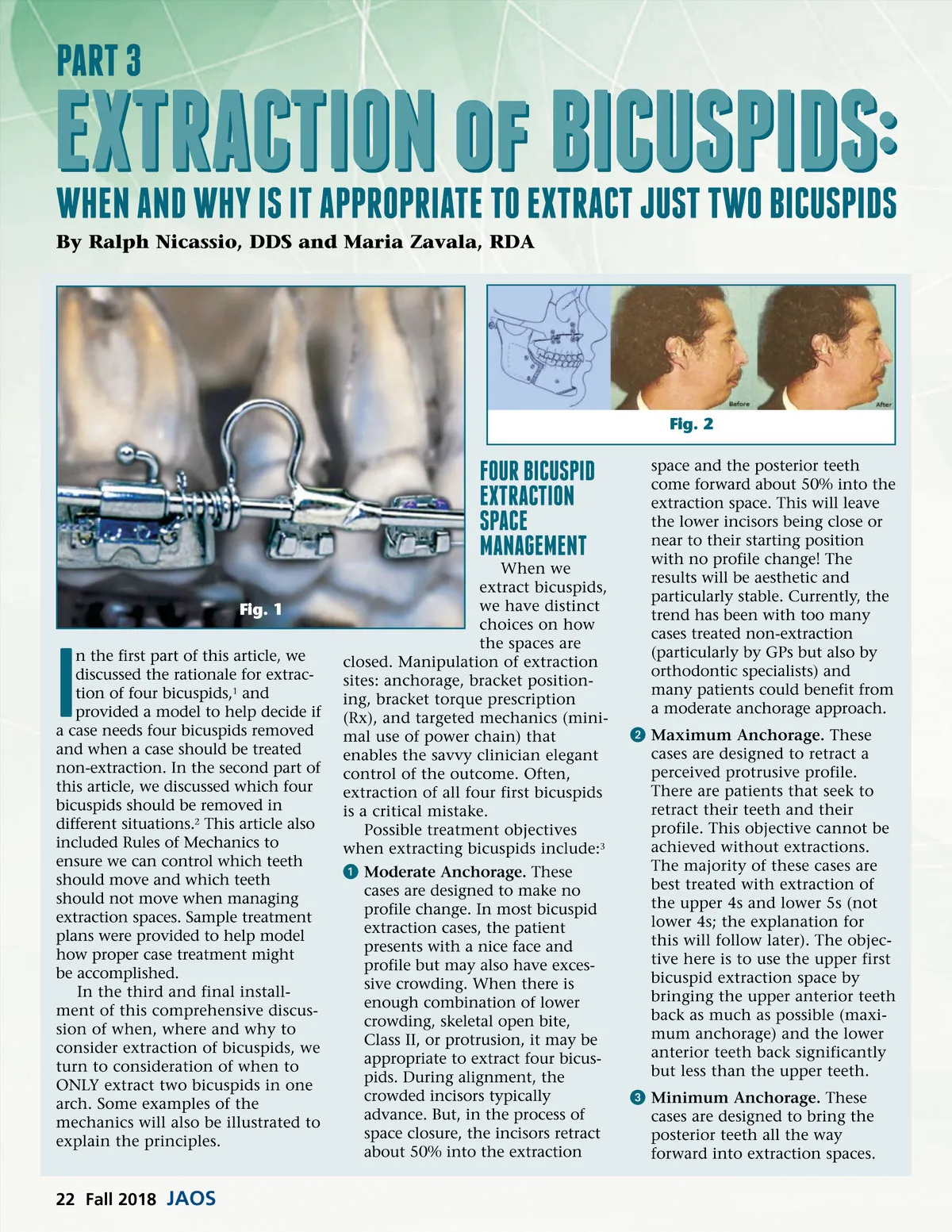
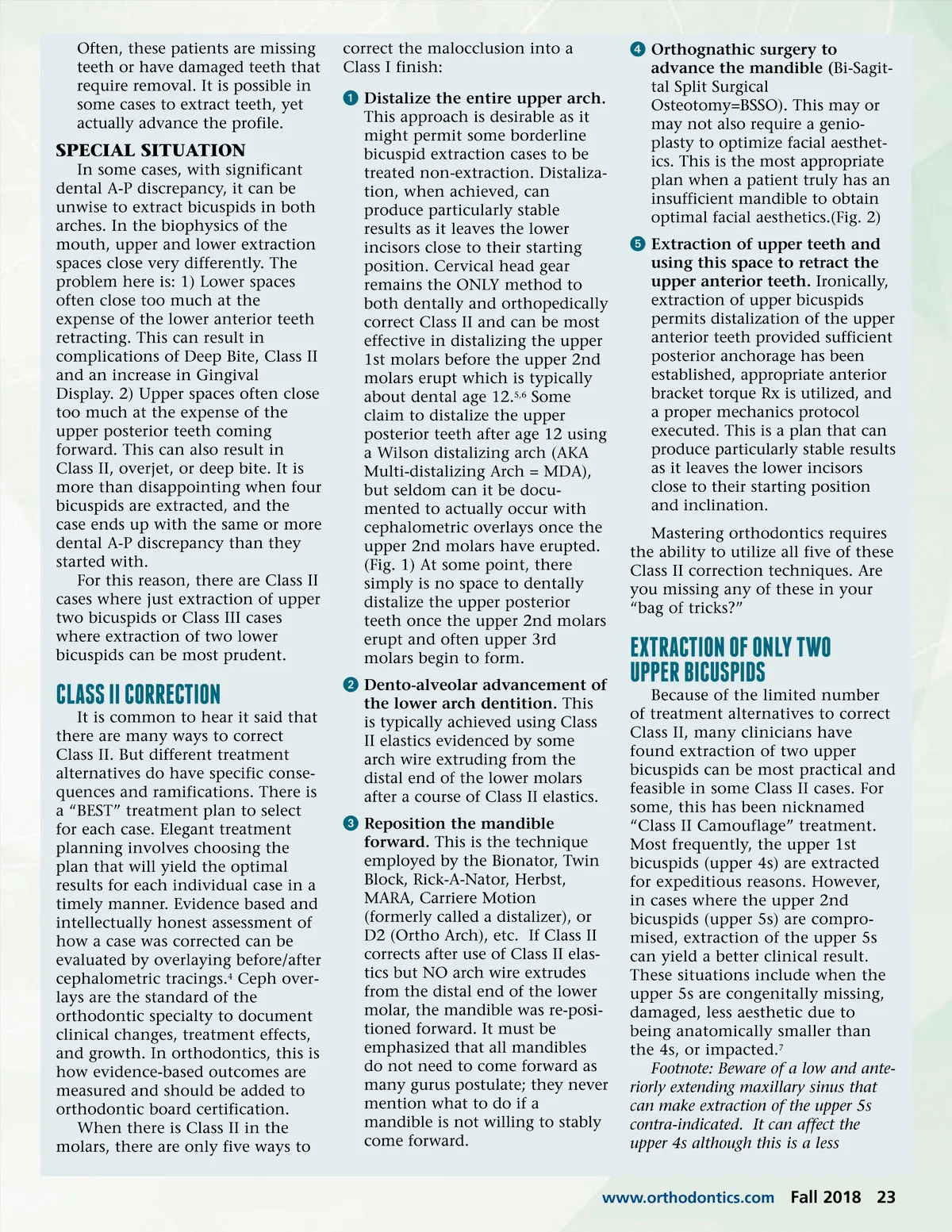
EXTRACTION of BICUSPIDS: WhEN AND Why IS IT APPROPRIATE TO EXTRACT JUST TWO BICUSPIDS By Ralph Nicassio, DDS and Maria Zavala, RDA Fig. 2 PART 3 FOUR BICUSPID EXTRACTION SPACE MANAgEMENT Fig. 1 n the first part of this article, we discussed the rationale for extrac-tion of four bicuspids, 1 and provided a model to help decide if a case needs four bicuspids removed and when a case should be treated non-extraction. In the second part of this article, we discussed which four bicuspids should be removed in different situations. 2 This article also included Rules of Mechanics to ensure we can control which teeth should move and which teeth should not move when managing extraction spaces. Sample treatment plans were provided to help model how proper case treatment might be accomplished. In the third and final install-ment of this comprehensive discus-sion of when, where and why to consider extraction of bicuspids, we turn to consideration of when to ONLY extract two bicuspids in one arch. Some examples of the mechanics will also be illustrated to explain the principles. When we extract bicuspids, we have distinct choices on how the spaces are closed. Manipulation of extraction sites: anchorage, bracket position-ing, bracket torque prescription (Rx), and targeted mechanics (mini-mal use of power chain) that enables the savvy clinician elegant control of the outcome. Often, extraction of all four first bicuspids is a critical mistake. Possible treatment objectives when extracting bicuspids include: 3 ᕡ Moderate Anchorage. These cases are designed to make no profile change. In most bicuspid extraction cases, the patient presents with a nice face and profile but may also have exces-sive crowding. When there is enough combination of lower crowding, skeletal open bite, Class II, or protrusion, it may be appropriate to extract four bicus-pids. During alignment, the crowded incisors typically advance. But, in the process of space closure, the incisors retract about 50% into the extraction I space and the posterior teeth come forward about 50% into the extraction space. This will leave the lower incisors being close or near to their starting position with no profile change! The results will be aesthetic and particularly stable. Currently, the trend has been with too many cases treated non-extraction (particularly by GPs but also by orthodontic specialists) and many patients could benefit from a moderate anchorage approach. ᕢ Maximum Anchorage. These cases are designed to retract a perceived protrusive profile. There are patients that seek to retract their teeth and their profile. This objective cannot be achieved without extractions. The majority of these cases are best treated with extraction of the upper 4s and lower 5s (not lower 4s; the explanation for this will follow later). The objec-tive here is to use the upper first bicuspid extraction space by bringing the upper anterior teeth back as much as possible (maxi-mum anchorage) and the lower anterior teeth back significantly but less than the upper teeth. ᕣ Minimum Anchorage. These cases are designed to bring the posterior teeth all the way forward into extraction spaces. 22 Fall 2018 JAOS
Journal of the American Orthodontic Society Fall 2018: Page 22