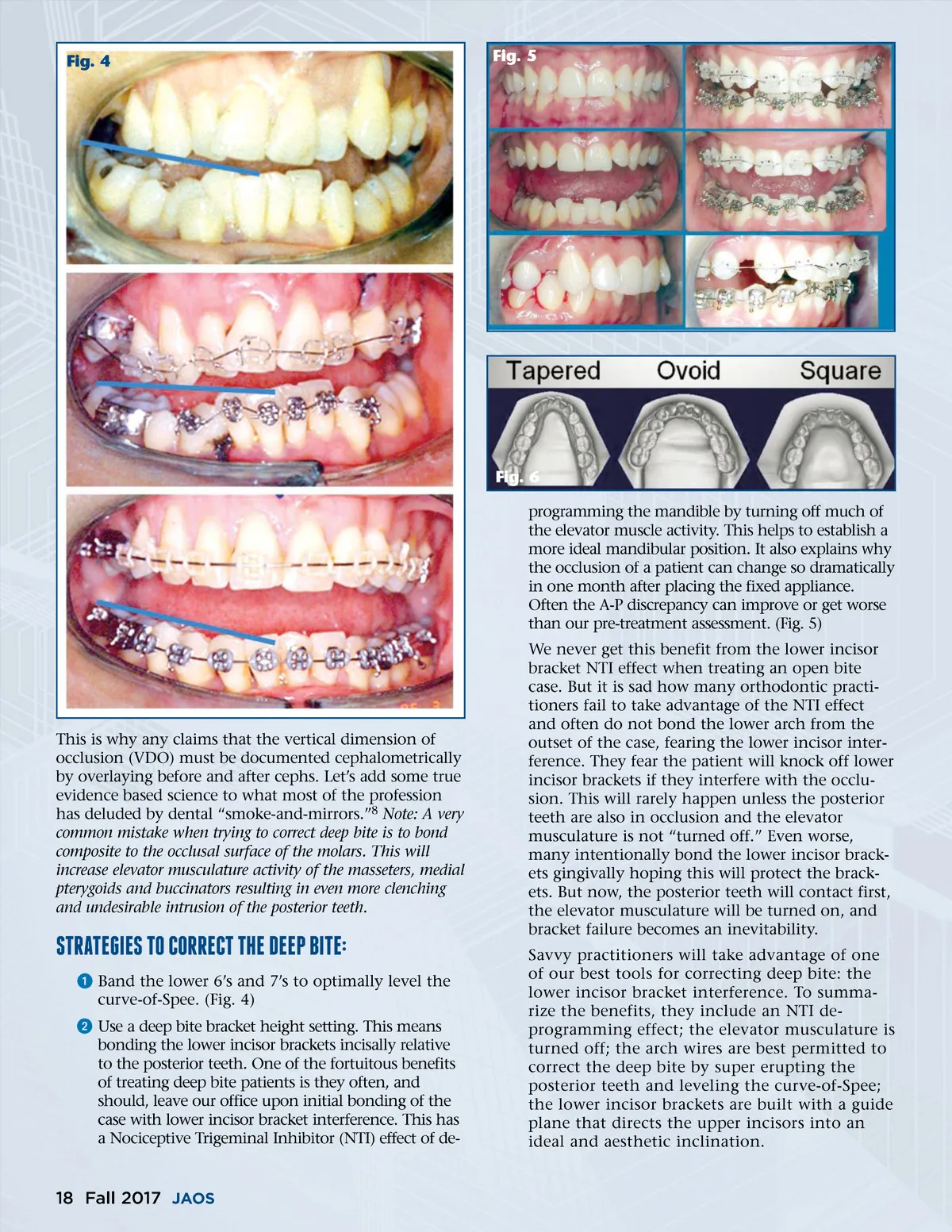
Fig. 7 Fig. 9 Fig. 10 Fig. 8 Fig. 11 ᕥ If deep bite persists consider bonding bite guards (Bite Guides, Ortho Arch) to the lingual of the upper centrals to further turn off the elevator musculature. 9 (Fig. 8) ᕦ Intrusion of upper anterior teeth to correct deep bite. Class II elastics can have the negative effects of causing a clockwise change in the occlusal plane (when you hear an orthodontist say “control the vertical” they are referring to refraining from using excessive amounts of Class II elastics that increase gingival display. By using bone screw anchorage 4-5mm distal and apical to the final cuspid positions, we can correct deep bite without the use of Class II elastics that might otherwise increase gingival display by extruding the lower molars and upper incisors. (Fig. 9-11) www.orthodontics.com ᕣ Use a tapered lower arch form relative to the upper. (Fig. 6) A discussion of wire shapes is beyond the scope of this article; but most clinicians make the serious mistake of using the same arch form on every patient they treat. Mandibles are the deter-mining arch and they can be in ovoid, tapered or square shapes. ᕤ Add some Class II elastics. (Fig. 7) Please remem-ber that in any case where we anticipate advanc-ing the lower incisors due to alignment of lower crowding, leveling the curve-of-Spee or using Class II elastics, it is important to use lower incisor brackets with an MBT prescription to prevent excessive lower incisor proclination. Fall 2017 19
Journal of the American Orthodontic Society Fall 2017: Page 19