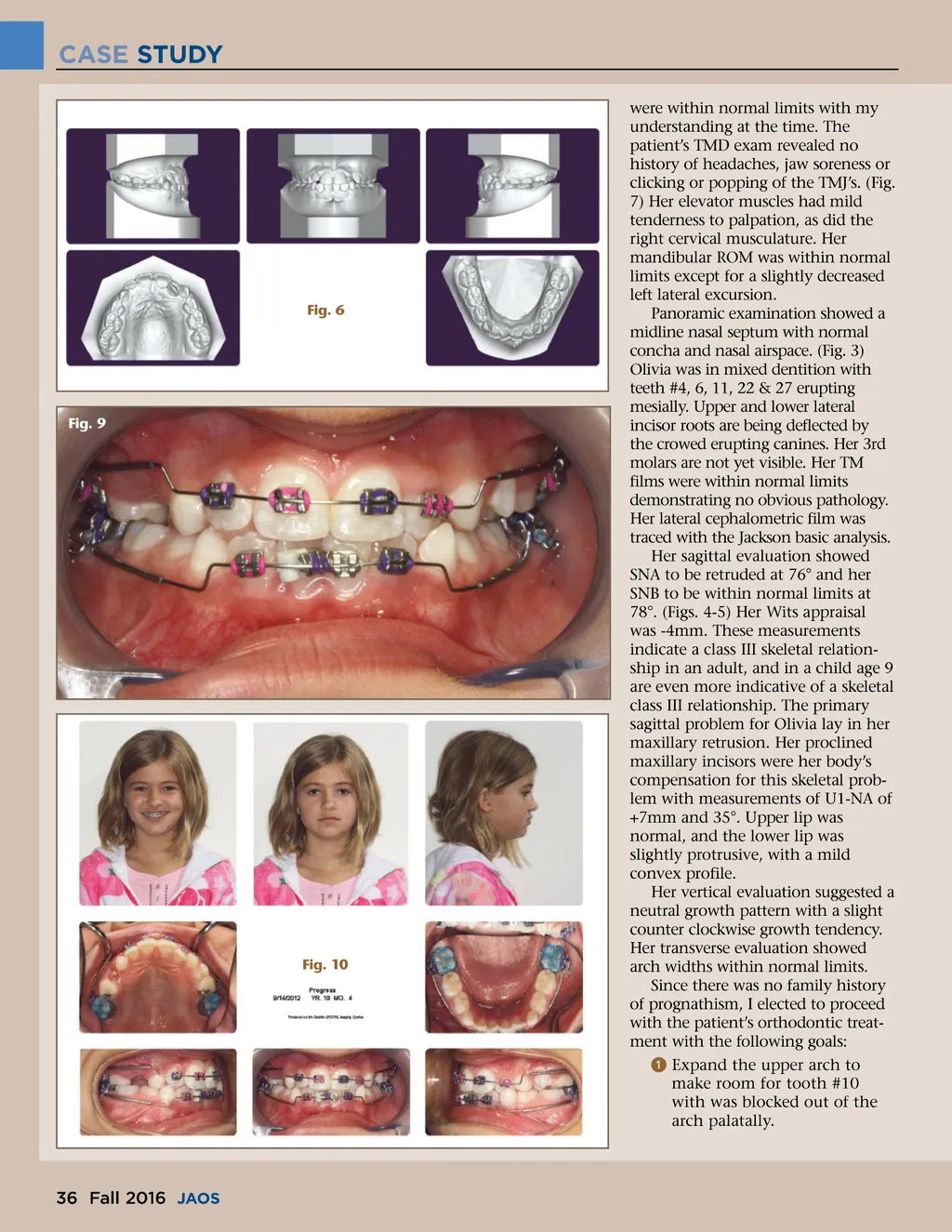
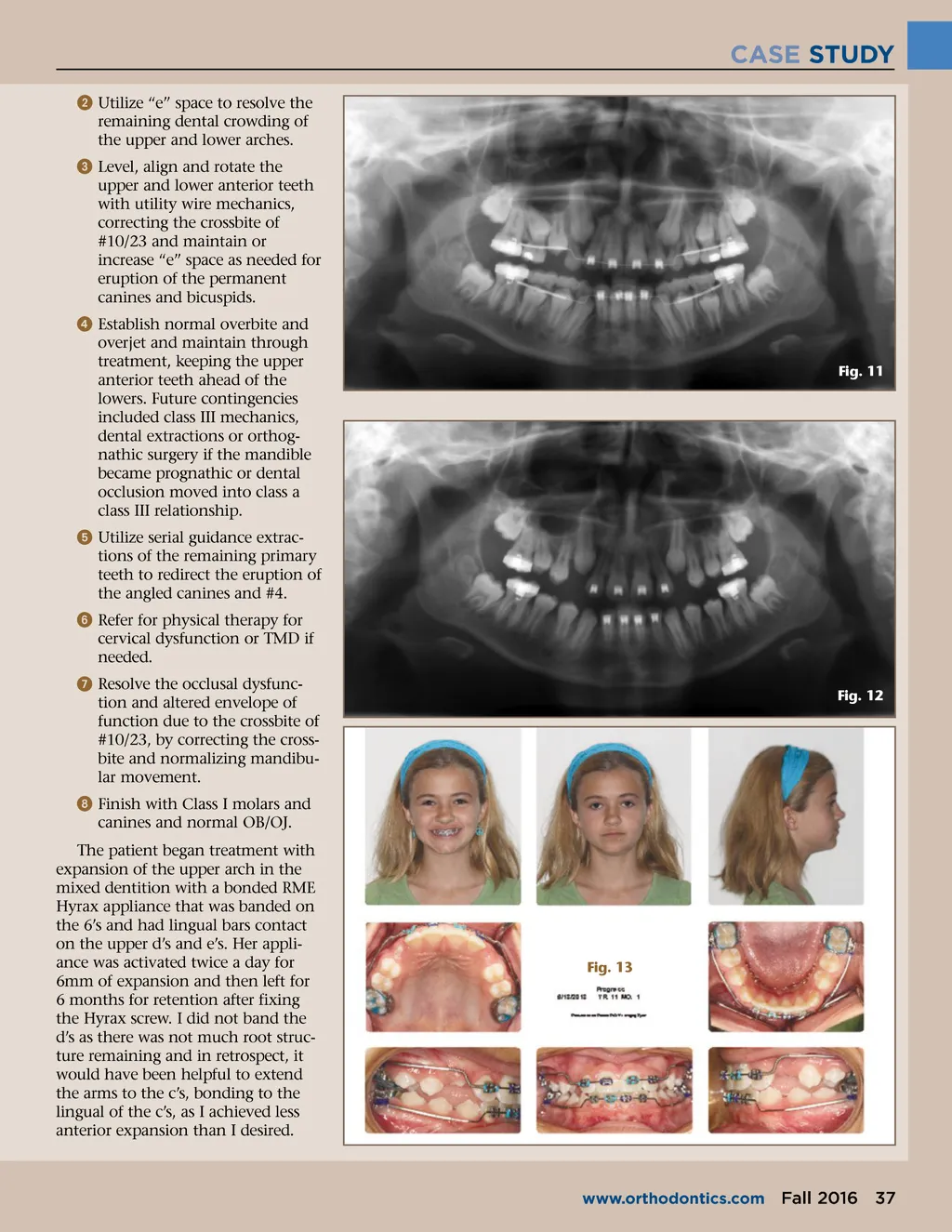
CASE STUDY ᕢ Utilize “e” space to resolve the remaining dental crowding of the upper and lower arches. ᕣ Level, align and rotate the upper and lower anterior teeth with utility wire mechanics, correcting the crossbite of #10/23 and maintain or increase “e” space as needed for eruption of the permanent canines and bicuspids. ᕤ Establish normal overbite and overjet and maintain through treatment, keeping the upper anterior teeth ahead of the lowers. Future contingencies included class III mechanics, dental extractions or orthog-nathic surgery if the mandible became prognathic or dental occlusion moved into class a class III relationship. ᕥ Utilize serial guidance extrac-tions of the remaining primary teeth to redirect the eruption of the angled canines and #4. ᕦ Refer for physical therapy for cervical dysfunction or TMD if needed. ᕧ Resolve the occlusal dysfunc-tion and altered envelope of function due to the crossbite of #10/23, by correcting the cross-bite and normalizing mandibu-lar movement. ᕨ Finish with Class I molars and canines and normal OB/OJ. The patient began treatment with expansion of the upper arch in the mixed dentition with a bonded RME Hyrax appliance that was banded on the 6’s and had lingual bars contact on the upper d’s and e’s. Her appli-ance was activated twice a day for 6mm of expansion and then left for 6 months for retention after fixing the Hyrax screw. I did not band the d’s as there was not much root struc-ture remaining and in retrospect, it would have been helpful to extend the arms to the c’s, bonding to the lingual of the c’s, as I achieved less anterior expansion than I desired. Fig. 12 Fig. 11 Fig. 13 www.orthodontics.com Fall 2016 37
Journal of the American Orthodontic Society Fall 2016: Page 37