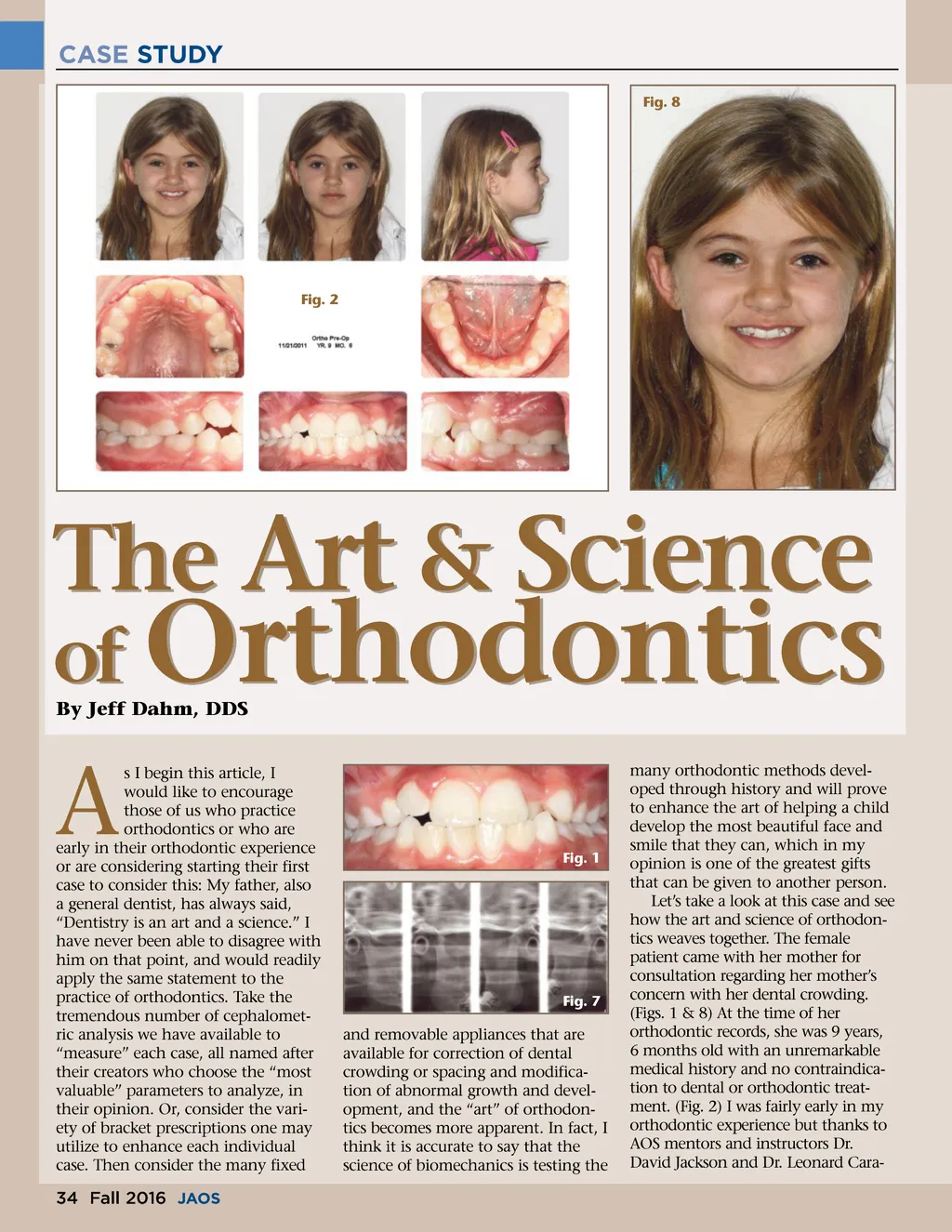
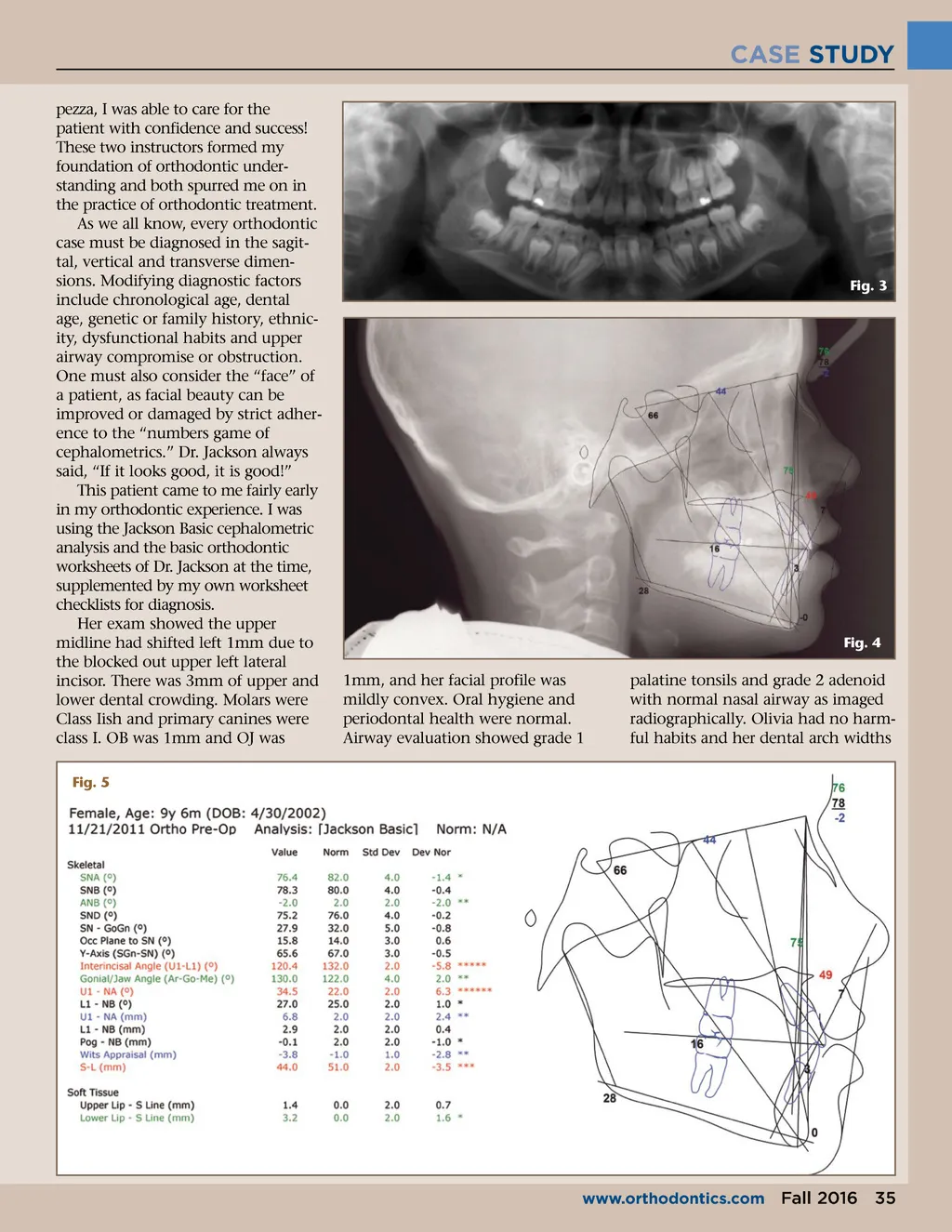
CASE STUDY Fig. 8 Fig. 2 The Art & Science By Jeff Dahm, DDS of Orthodontics A s I begin this article, I would like to encourage those of us who practice orthodontics or who are early in their orthodontic experience or are considering starting their first case to consider this: My father, also a general dentist, has always said, “Dentistry is an art and a science.” I have never been able to disagree with him on that point, and would readily apply the same statement to the practice of orthodontics. Take the tremendous number of cephalomet-ric analysis we have available to “measure” each case, all named after their creators who choose the “most valuable” parameters to analyze, in their opinion. Or, consider the vari-ety of bracket prescriptions one may utilize to enhance each individual case. Then consider the many fixed Fig. 1 Fig. 7 and removable appliances that are available for correction of dental crowding or spacing and modifica-tion of abnormal growth and devel-opment, and the “art” of orthodon-tics becomes more apparent. In fact, I think it is accurate to say that the science of biomechanics is testing the many orthodontic methods devel-oped through history and will prove to enhance the art of helping a child develop the most beautiful face and smile that they can, which in my opinion is one of the greatest gifts that can be given to another person. Let’s take a look at this case and see how the art and science of orthodon-tics weaves together. The female patient came with her mother for consultation regarding her mother’s concern with her dental crowding. (Figs. 1 & 8) At the time of her orthodontic records, she was 9 years, 6 months old with an unremarkable medical history and no contraindica-tion to dental or orthodontic treat-ment. (Fig. 2) I was fairly early in my orthodontic experience but thanks to AOS mentors and instructors Dr. David Jackson and Dr. Leonard Cara-34 Fall 2016 JAOS
Journal of the American Orthodontic Society Fall 2016: Page 34