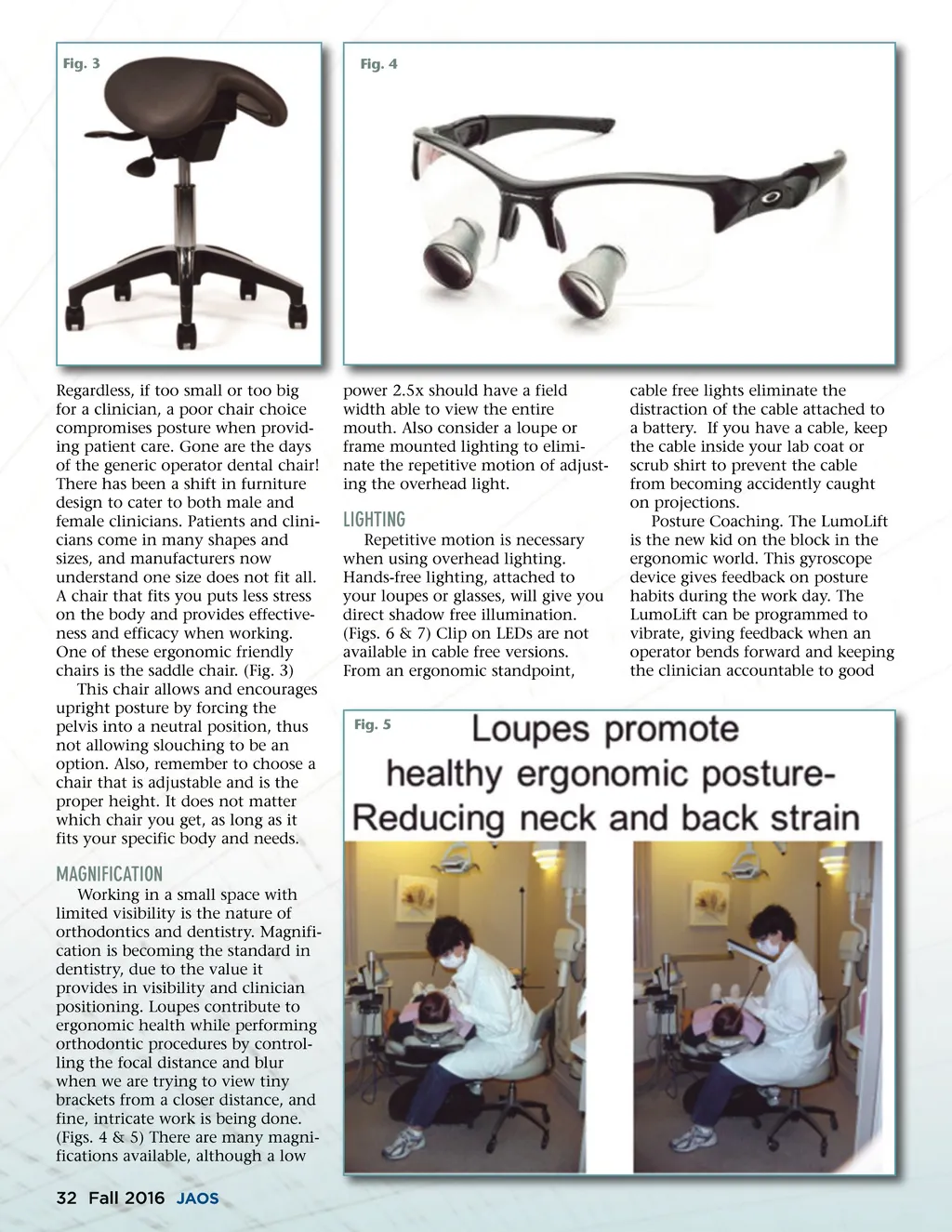
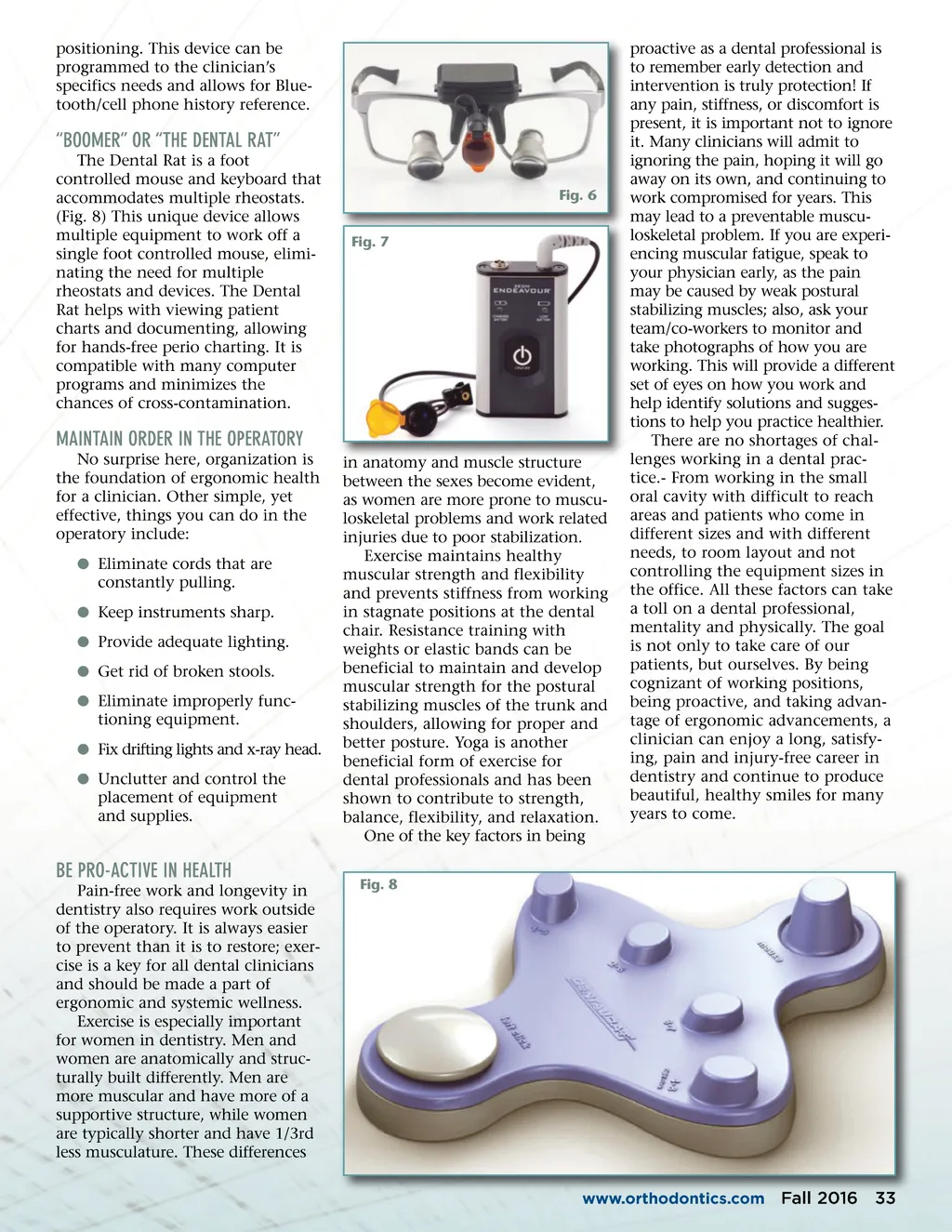
Fig. 3 Fig. 4 Regardless, if too small or too big for a clinician, a poor chair choice compromises posture when provid-ing patient care. Gone are the days of the generic operator dental chair! There has been a shift in furniture design to cater to both male and female clinicians. Patients and clini-cians come in many shapes and sizes, and manufacturers now understand one size does not fit all. A chair that fits you puts less stress on the body and provides effective-ness and efficacy when working. One of these ergonomic friendly chairs is the saddle chair. (Fig. 3) This chair allows and encourages upright posture by forcing the pelvis into a neutral position, thus not allowing slouching to be an option. Also, remember to choose a chair that is adjustable and is the proper height. It does not matter which chair you get, as long as it fits your specific body and needs. power 2.5x should have a field width able to view the entire mouth. Also consider a loupe or frame mounted lighting to elimi-nate the repetitive motion of adjust-ing the overhead light. LIGHTING Repetitive motion is necessary when using overhead lighting. Hands-free lighting, attached to your loupes or glasses, will give you direct shadow free illumination. (Figs. 6 & 7) Clip on LEDs are not available in cable free versions. From an ergonomic standpoint, cable free lights eliminate the distraction of the cable attached to a battery. If you have a cable, keep the cable inside your lab coat or scrub shirt to prevent the cable from becoming accidently caught on projections. Posture Coaching. The LumoLift is the new kid on the block in the ergonomic world. This gyroscope device gives feedback on posture habits during the work day. The LumoLift can be programmed to vibrate, giving feedback when an operator bends forward and keeping the clinician accountable to good Fig. 5 MAGNIFICATION Working in a small space with limited visibility is the nature of orthodontics and dentistry. Magnifi-cation is becoming the standard in dentistry, due to the value it provides in visibility and clinician positioning. Loupes contribute to ergonomic health while performing orthodontic procedures by control-ling the focal distance and blur when we are trying to view tiny brackets from a closer distance, and fine, intricate work is being done. (Figs. 4 & 5) There are many magni-fications available, although a low 32 Fall 2016 JAOS
Journal of the American Orthodontic Society Fall 2016: Page 32