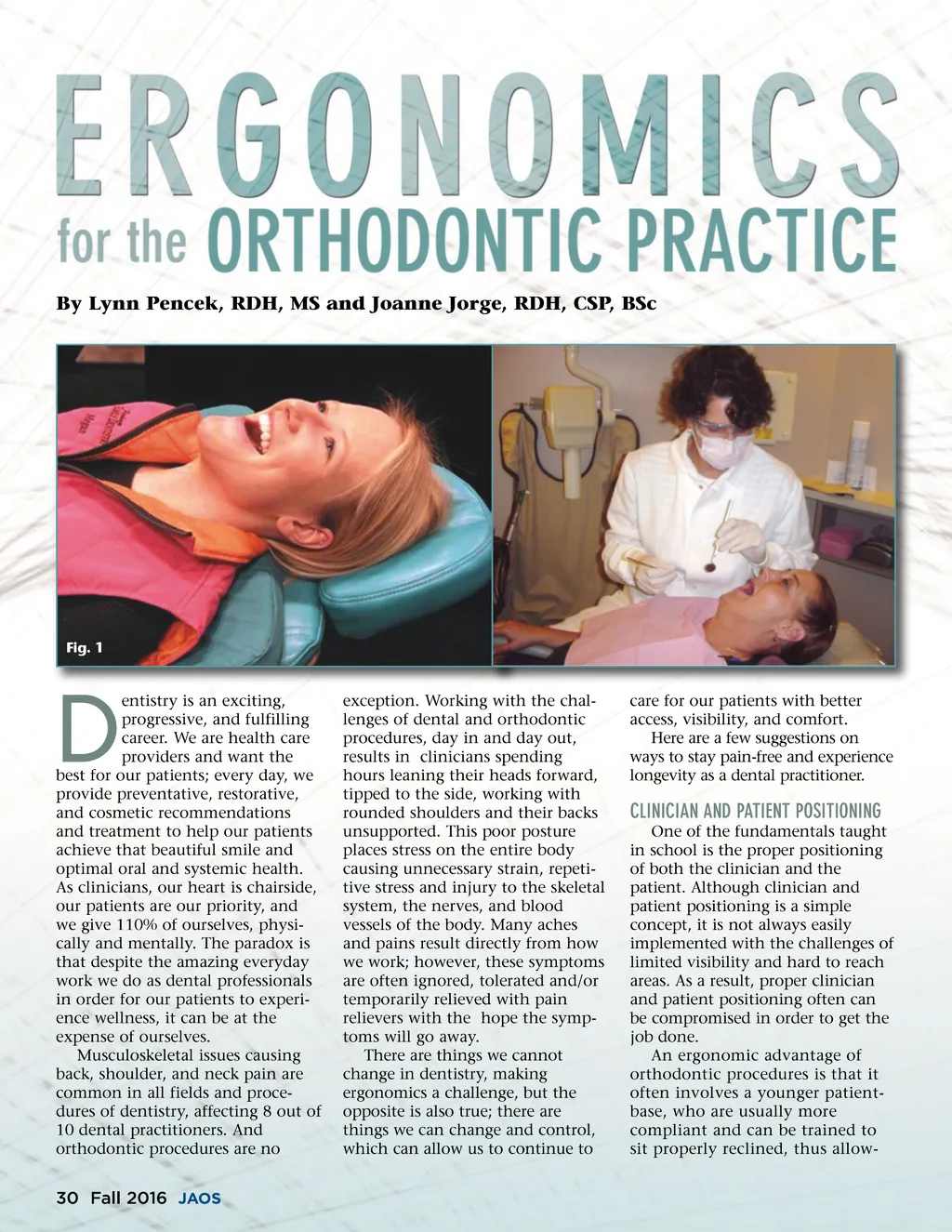
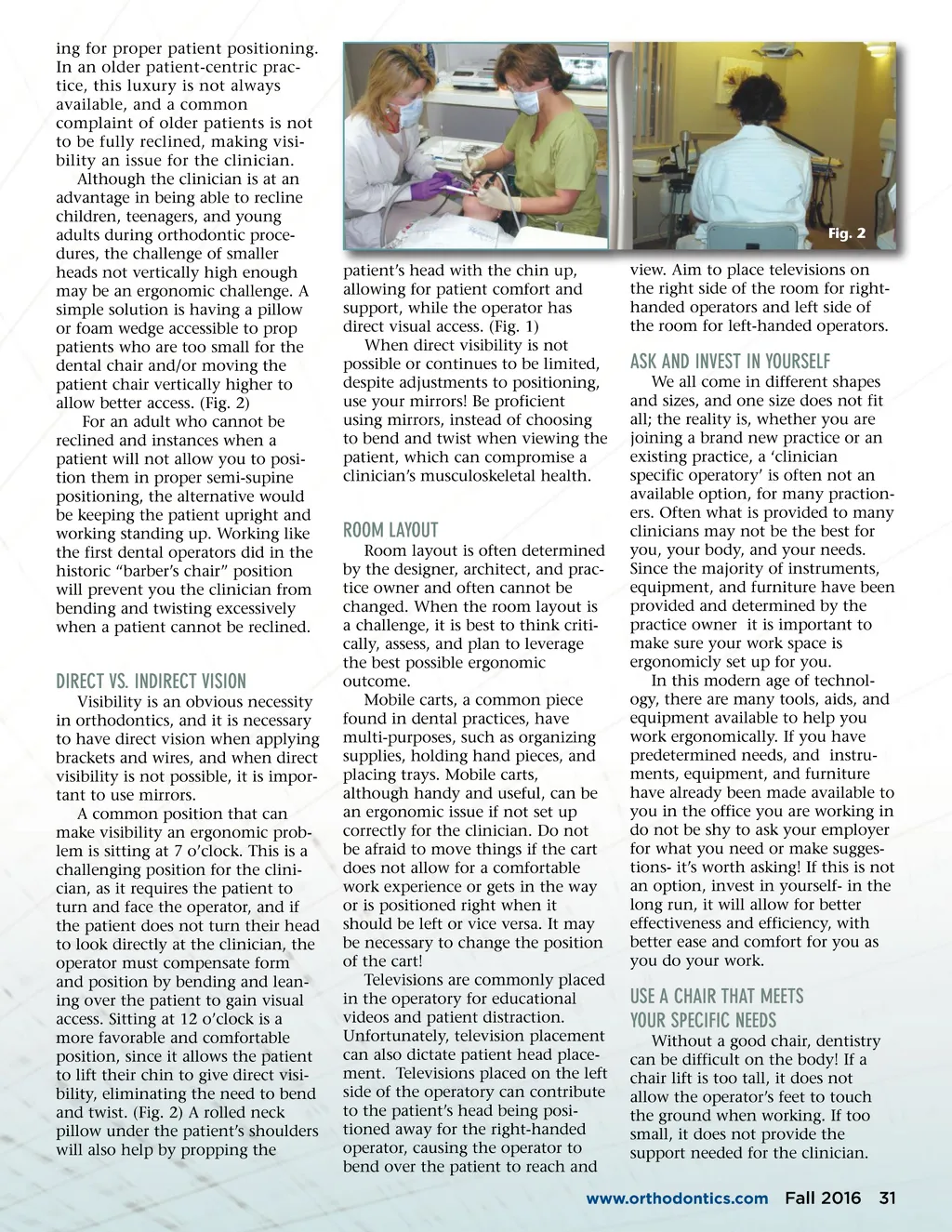
ing for proper patient positioning. In an older patient-centric prac-tice, this luxury is not always available, and a common complaint of older patients is not to be fully reclined, making visi-bility an issue for the clinician. Although the clinician is at an advantage in being able to recline children, teenagers, and young adults during orthodontic proce-dures, the challenge of smaller heads not vertically high enough may be an ergonomic challenge. A simple solution is having a pillow or foam wedge accessible to prop patients who are too small for the dental chair and/or moving the patient chair vertically higher to allow better access. (Fig. 2) For an adult who cannot be reclined and instances when a patient will not allow you to posi-tion them in proper semi-supine positioning, the alternative would be keeping the patient upright and working standing up. Working like the first dental operators did in the historic “barber’s chair” position will prevent you the clinician from bending and twisting excessively when a patient cannot be reclined. Fig. 2 patient’s head with the chin up, allowing for patient comfort and support, while the operator has direct visual access. (Fig. 1) When direct visibility is not possible or continues to be limited, despite adjustments to positioning, use your mirrors! Be proficient using mirrors, instead of choosing to bend and twist when viewing the patient, which can compromise a clinician’s musculoskeletal health. view. Aim to place televisions on the right side of the room for right-handed operators and left side of the room for left-handed operators. ASK AND INVEST IN YOURSELF We all come in different shapes and sizes, and one size does not fit all; the reality is, whether you are joining a brand new practice or an existing practice, a ‘clinician specific operatory’ is often not an available option, for many praction-ers. Often what is provided to many clinicians may not be the best for you, your body, and your needs. Since the majority of instruments, equipment, and furniture have been provided and determined by the practice owner it is important to make sure your work space is ergonomicly set up for you. In this modern age of technol-ogy, there are many tools, aids, and equipment available to help you work ergonomically. If you have predetermined needs, and instru-ments, equipment, and furniture have already been made available to you in the office you are working in do not be shy to ask your employer for what you need or make sugges-tions-it’s worth asking! If this is not an option, invest in yourself-in the long run, it will allow for better effectiveness and efficiency, with better ease and comfort for you as you do your work. ROOM LAYOUT Room layout is often determined by the designer, architect, and prac-tice owner and often cannot be changed. When the room layout is a challenge, it is best to think criti-cally, assess, and plan to leverage the best possible ergonomic outcome. Mobile carts, a common piece found in dental practices, have multi-purposes, such as organizing supplies, holding hand pieces, and placing trays. Mobile carts, although handy and useful, can be an ergonomic issue if not set up correctly for the clinician. Do not be afraid to move things if the cart does not allow for a comfortable work experience or gets in the way or is positioned right when it should be left or vice versa. It may be necessary to change the position of the cart! Televisions are commonly placed in the operatory for educational videos and patient distraction. Unfortunately, television placement can also dictate patient head place-ment. Televisions placed on the left side of the operatory can contribute to the patient’s head being posi-tioned away for the right-handed operator, causing the operator to bend over the patient to reach and DIRECT VS. INDIRECT VISION Visibility is an obvious necessity in orthodontics, and it is necessary to have direct vision when applying brackets and wires, and when direct visibility is not possible, it is impor-tant to use mirrors. A common position that can make visibility an ergonomic prob-lem is sitting at 7 o’clock. This is a challenging position for the clini-cian, as it requires the patient to turn and face the operator, and if the patient does not turn their head to look directly at the clinician, the operator must compensate form and position by bending and lean-ing over the patient to gain visual access. Sitting at 12 o’clock is a more favorable and comfortable position, since it allows the patient to lift their chin to give direct visi-bility, eliminating the need to bend and twist. (Fig. 2) A rolled neck pillow under the patient’s shoulders will also help by propping the USE A CHAIR THAT MEETS YOUR SPECIFIC NEEDS Without a good chair, dentistry can be difficult on the body! If a chair lift is too tall, it does not allow the operator’s feet to touch the ground when working. If too small, it does not provide the support needed for the clinician. www.orthodontics.com Fall 2016 31
Journal of the American Orthodontic Society Fall 2016: Page 31