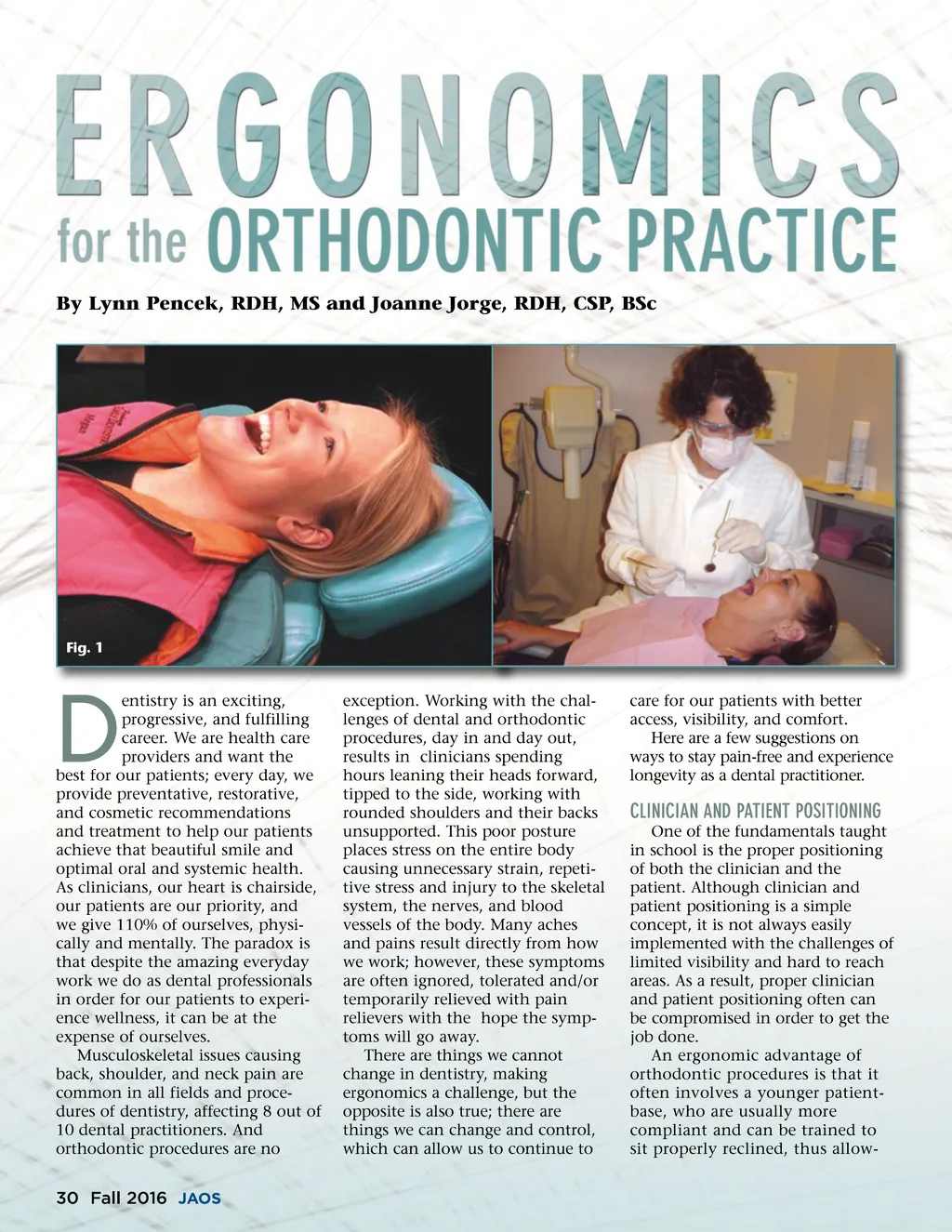
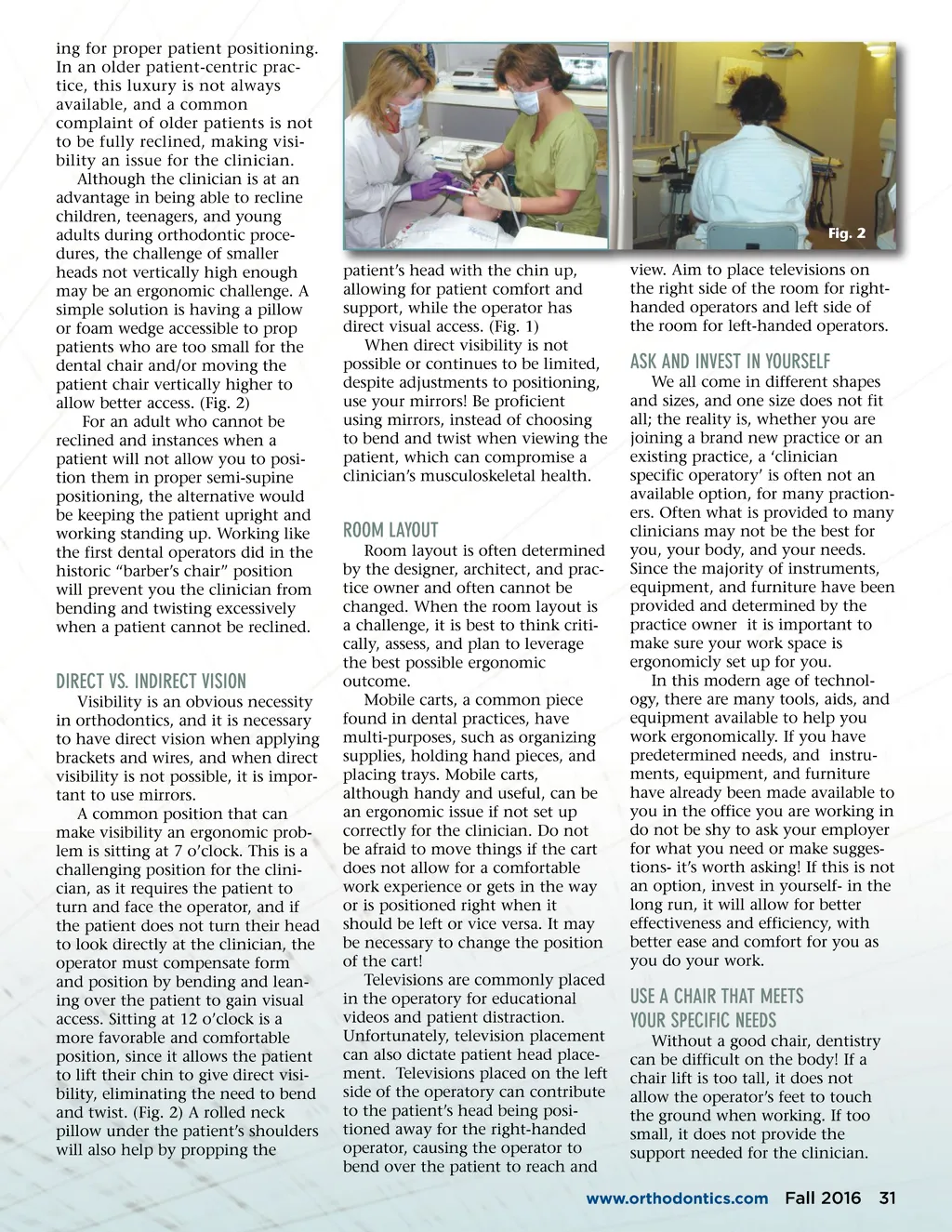
By Lynn Pencek, RDH, MS and Joanne Jorge, RDH, CSP, BSc Fig. 1 entistry is an exciting, progressive, and fulfilling career. We are health care providers and want the best for our patients; every day, we provide preventative, restorative, and cosmetic recommendations and treatment to help our patients achieve that beautiful smile and optimal oral and systemic health. As clinicians, our heart is chairside, our patients are our priority, and we give 110% of ourselves, physi-cally and mentally. The paradox is that despite the amazing everyday work we do as dental professionals in order for our patients to experi-ence wellness, it can be at the expense of ourselves. Musculoskeletal issues causing back, shoulder, and neck pain are common in all fields and proce-dures of dentistry, affecting 8 out of 10 dental practitioners. And orthodontic procedures are no D exception. Working with the chal-lenges of dental and orthodontic procedures, day in and day out, results in clinicians spending hours leaning their heads forward, tipped to the side, working with rounded shoulders and their backs unsupported. This poor posture places stress on the entire body causing unnecessary strain, repeti-tive stress and injury to the skeletal system, the nerves, and blood vessels of the body. Many aches and pains result directly from how we work; however, these symptoms are often ignored, tolerated and/or temporarily relieved with pain relievers with the hope the symp-toms will go away. There are things we cannot change in dentistry, making ergonomics a challenge, but the opposite is also true; there are things we can change and control, which can allow us to continue to care for our patients with better access, visibility, and comfort. Here are a few suggestions on ways to stay pain-free and experience longevity as a dental practitioner. CLINICIAN AND PATIENT POSITIONING One of the fundamentals taught in school is the proper positioning of both the clinician and the patient. Although clinician and patient positioning is a simple concept, it is not always easily implemented with the challenges of limited visibility and hard to reach areas. As a result, proper clinician and patient positioning often can be compromised in order to get the job done. An ergonomic advantage of orthodontic procedures is that it often involves a younger patient-base, who are usually more compliant and can be trained to sit properly reclined, thus allow-30 Fall 2016 JAOS
Journal of the American Orthodontic Society Fall 2016: Page 30