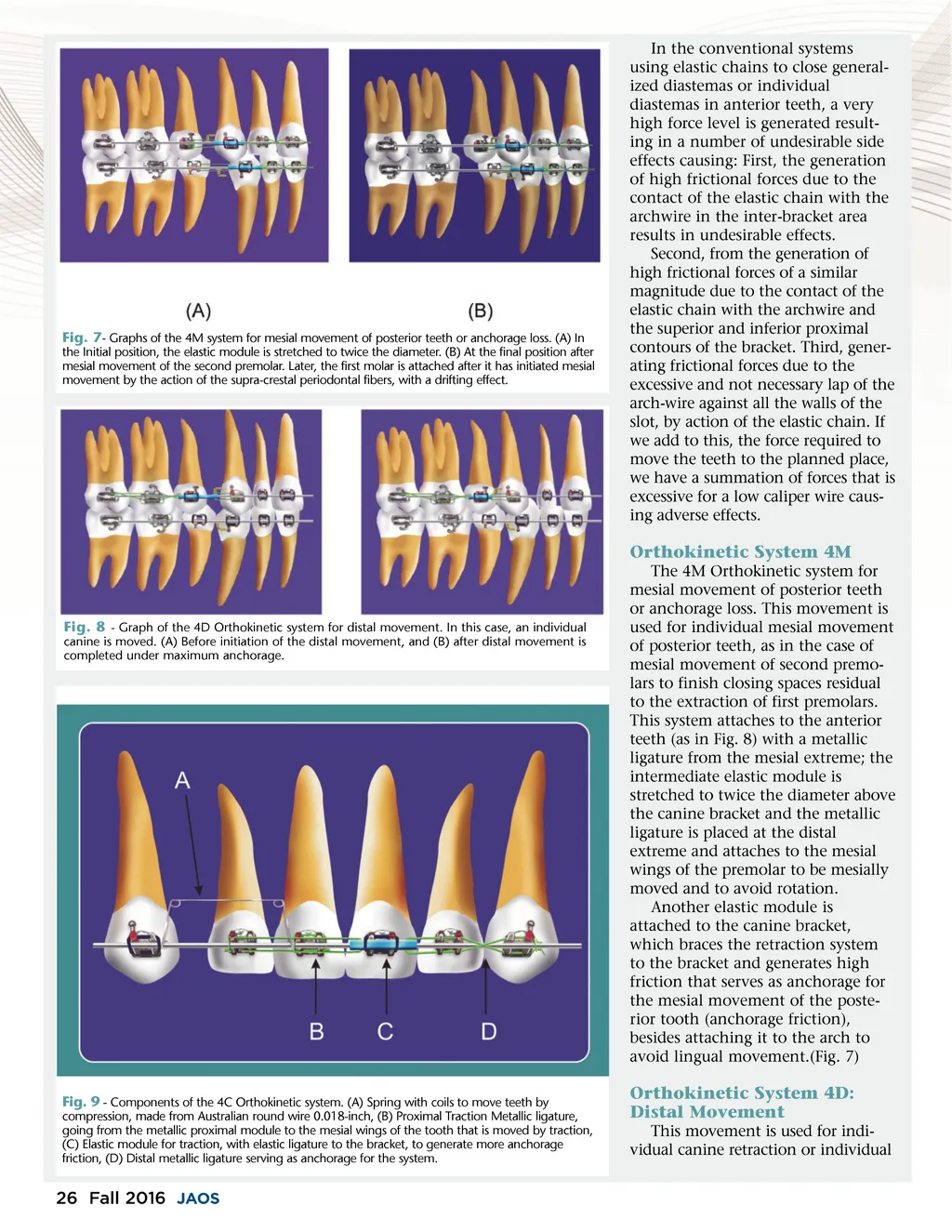
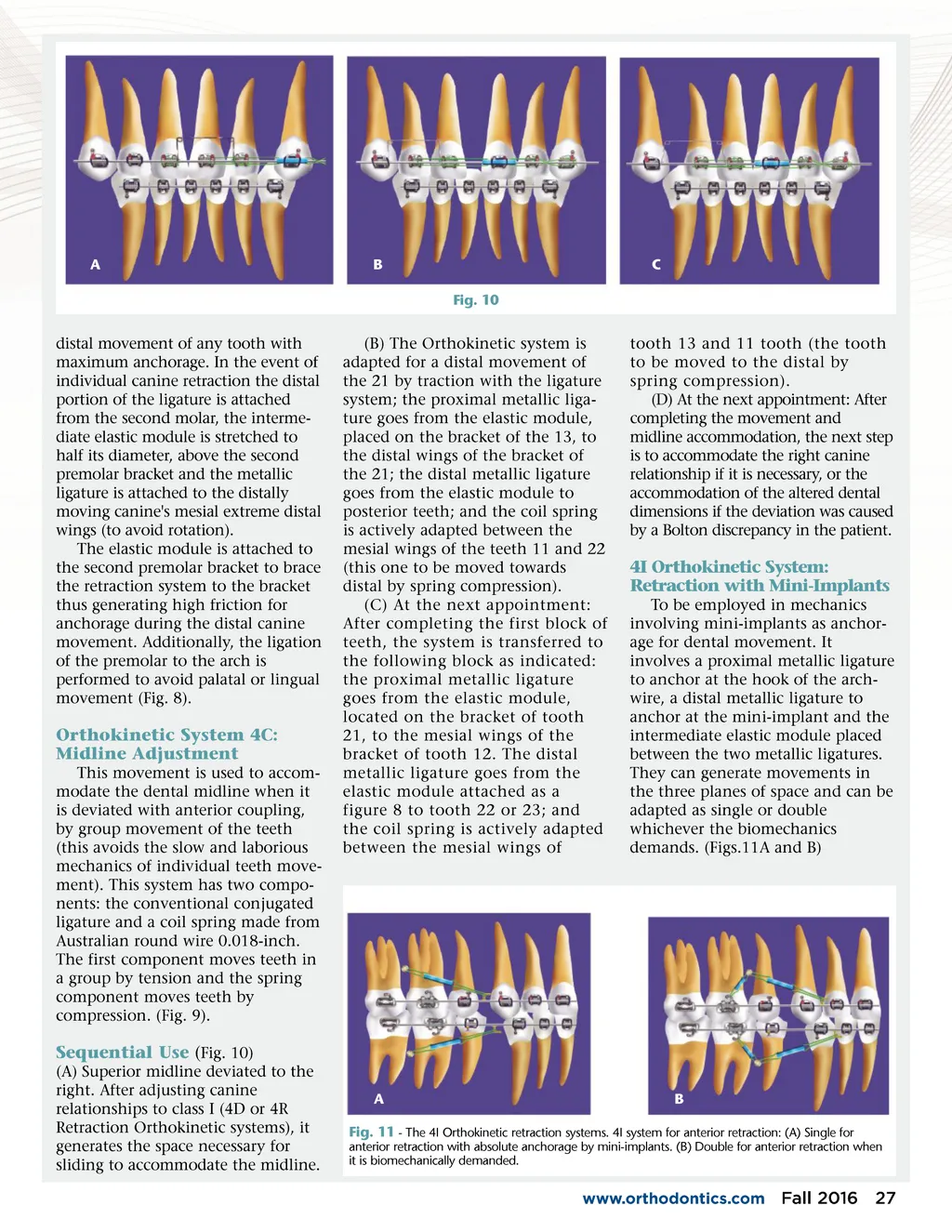
AB Fig. 10 C distal movement of any tooth with maximum anchorage. In the event of individual canine retraction the distal portion of the ligature is attached from the second molar, the interme-diate elastic module is stretched to half its diameter, above the second premolar bracket and the metallic ligature is attached to the distally moving canine's mesial extreme distal wings (to avoid rotation). The elastic module is attached to the second premolar bracket to brace the retraction system to the bracket thus generating high friction for anchorage during the distal canine movement. Additionally, the ligation of the premolar to the arch is performed to avoid palatal or lingual movement (Fig. 8). Orthokinetic System 4C: Midline Adjustment This movement is used to accom-modate the dental midline when it is deviated with anterior coupling, by group movement of the teeth (this avoids the slow and laborious mechanics of individual teeth move-ment). This system has two compo-nents: the conventional conjugated ligature and a coil spring made from Australian round wire 0.018-inch. The first component moves teeth in a group by tension and the spring component moves teeth by compression. (Fig. 9). (B) The Orthokinetic system is adapted for a distal movement of the 21 by traction with the ligature system; the proximal metallic liga-ture goes from the elastic module, placed on the bracket of the 13, to the distal wings of the bracket of the 21; the distal metallic ligature goes from the elastic module to posterior teeth; and the coil spring is actively adapted between the mesial wings of the teeth 11 and 22 (this one to be moved towards distal by spring compression). (C) At the next appointment: After completing the first block of teeth, the system is transferred to the following block as indicated: the proximal metallic ligature goes from the elastic module, located on the bracket of tooth 21, to the mesial wings of the bracket of tooth 12. The distal metallic ligature goes from the elastic module attached as a figure 8 to tooth 22 or 23; and the coil spring is actively adapted between the mesial wings of tooth 13 and 11 tooth (the tooth to be moved to the distal by spring compression). (D) At the next appointment: After completing the movement and midline accommodation, the next step is to accommodate the right canine relationship if it is necessary, or the accommodation of the altered dental dimensions if the deviation was caused by a Bolton discrepancy in the patient. 4I Orthokinetic System: Retraction with Mini-Implants To be employed in mechanics involving mini-implants as anchor-age for dental movement. It involves a proximal metallic ligature to anchor at the hook of the arch-wire, a distal metallic ligature to anchor at the mini-implant and the intermediate elastic module placed between the two metallic ligatures. They can generate movements in the three planes of space and can be adapted as single or double whichever the biomechanics demands. (Figs.11A and B) Sequential Use ( Fig. 10) (A) Superior midline deviated to the right. After adjusting canine relationships to class I (4D or 4R Retraction Orthokinetic systems), it generates the space necessary for sliding to accommodate the midline. AB Fig. 11 -The 4I Orthokinetic retraction systems. 4I system for anterior retraction: (A) Single for anterior retraction with absolute anchorage by mini-implants. (B) Double for anterior retraction when it is biomechanically demanded. www.orthodontics.com Fall 2016 27
Journal of the American Orthodontic Society Fall 2016: Page 27