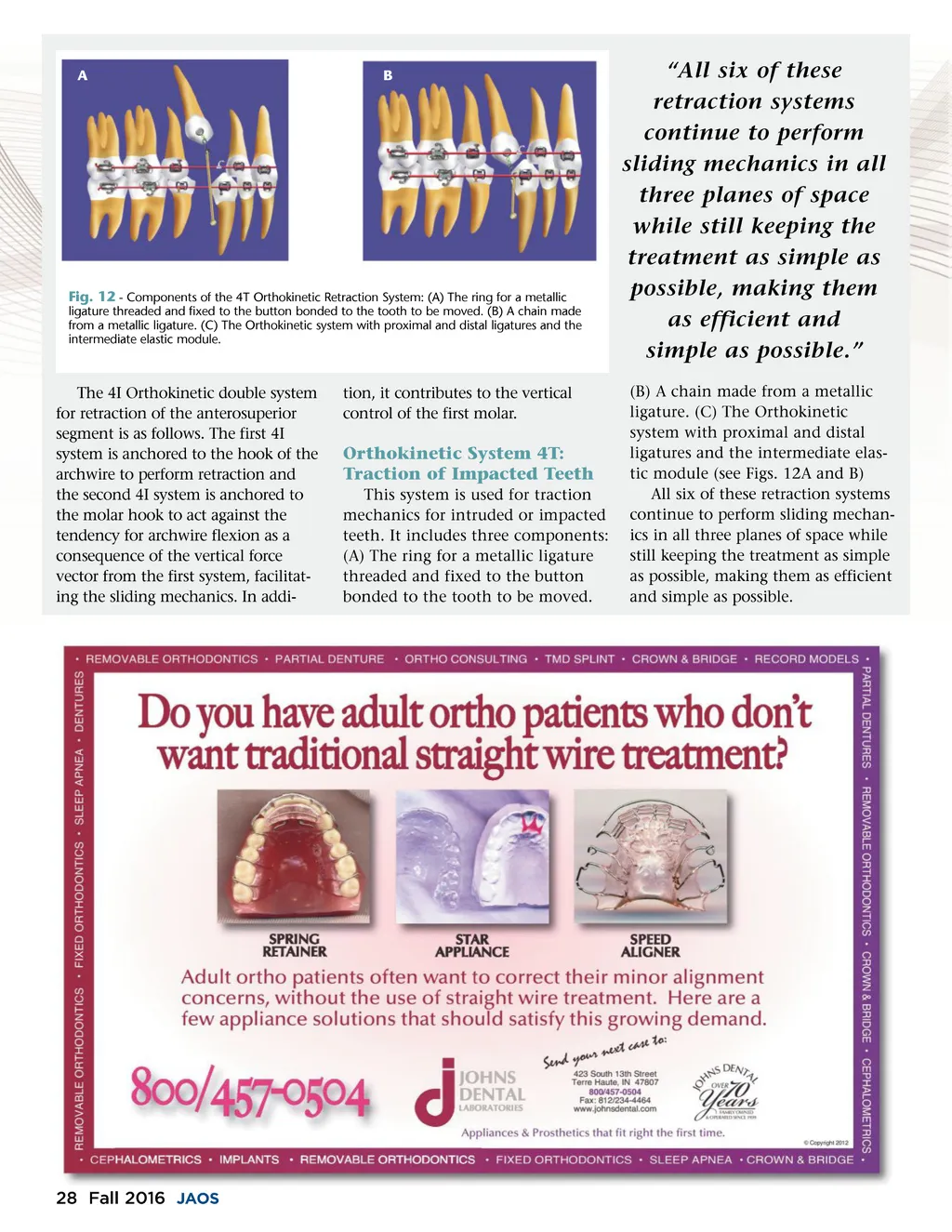
AB Fig. 12 -Components of the 4T Orthokinetic Retraction System: (A) The ring for a metallic ligature threaded and fixed to the button bonded to the tooth to be moved. (B) A chain made from a metallic ligature. (C) The Orthokinetic system with proximal and distal ligatures and the intermediate elastic module. “All six of these retraction systems continue to perform sliding mechanics in all three planes of space while still keeping the treatment as simple as possible, making them as efficient and simple as possible.” (B) A chain made from a metallic ligature. (C) The Orthokinetic system with proximal and distal ligatures and the intermediate elas-tic module (see Figs. 12A and B) All six of these retraction systems continue to perform sliding mechan-ics in all three planes of space while still keeping the treatment as simple as possible, making them as efficient and simple as possible. The 4I Orthokinetic double system for retraction of the anterosuperior segment is as follows. The first 4I system is anchored to the hook of the archwire to perform retraction and the second 4I system is anchored to the molar hook to act against the tendency for archwire flexion as a consequence of the vertical force vector from the first system, facilitat-ing the sliding mechanics. In addi-tion, it contributes to the vertical control of the first molar. Orthokinetic System 4T: Traction of Impacted Teeth This system is used for traction mechanics for intruded or impacted teeth. It includes three components: (A) The ring for a metallic ligature threaded and fixed to the button bonded to the tooth to be moved. 28 Fall 2016 JAOS
Journal of the American Orthodontic Society Fall 2016: Page 28