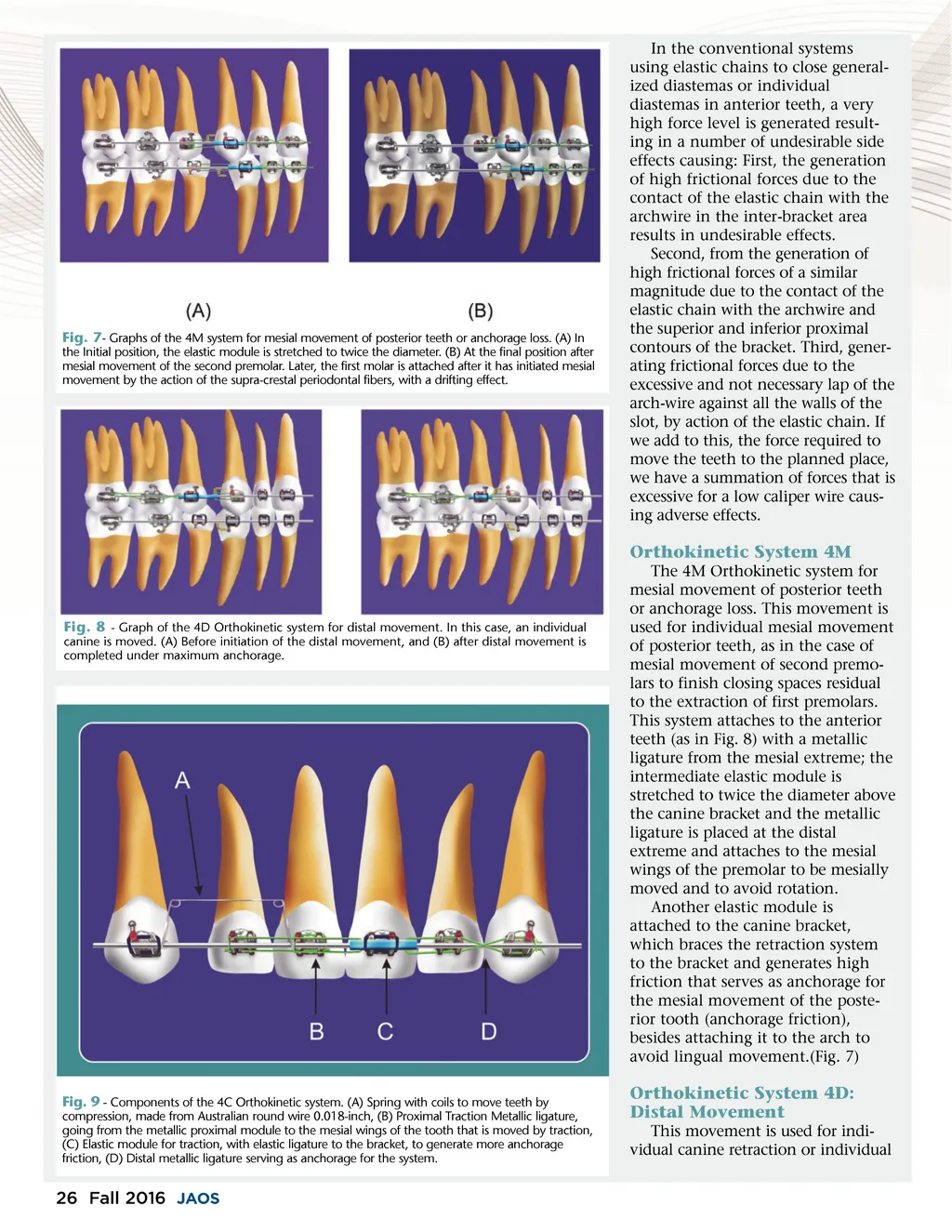
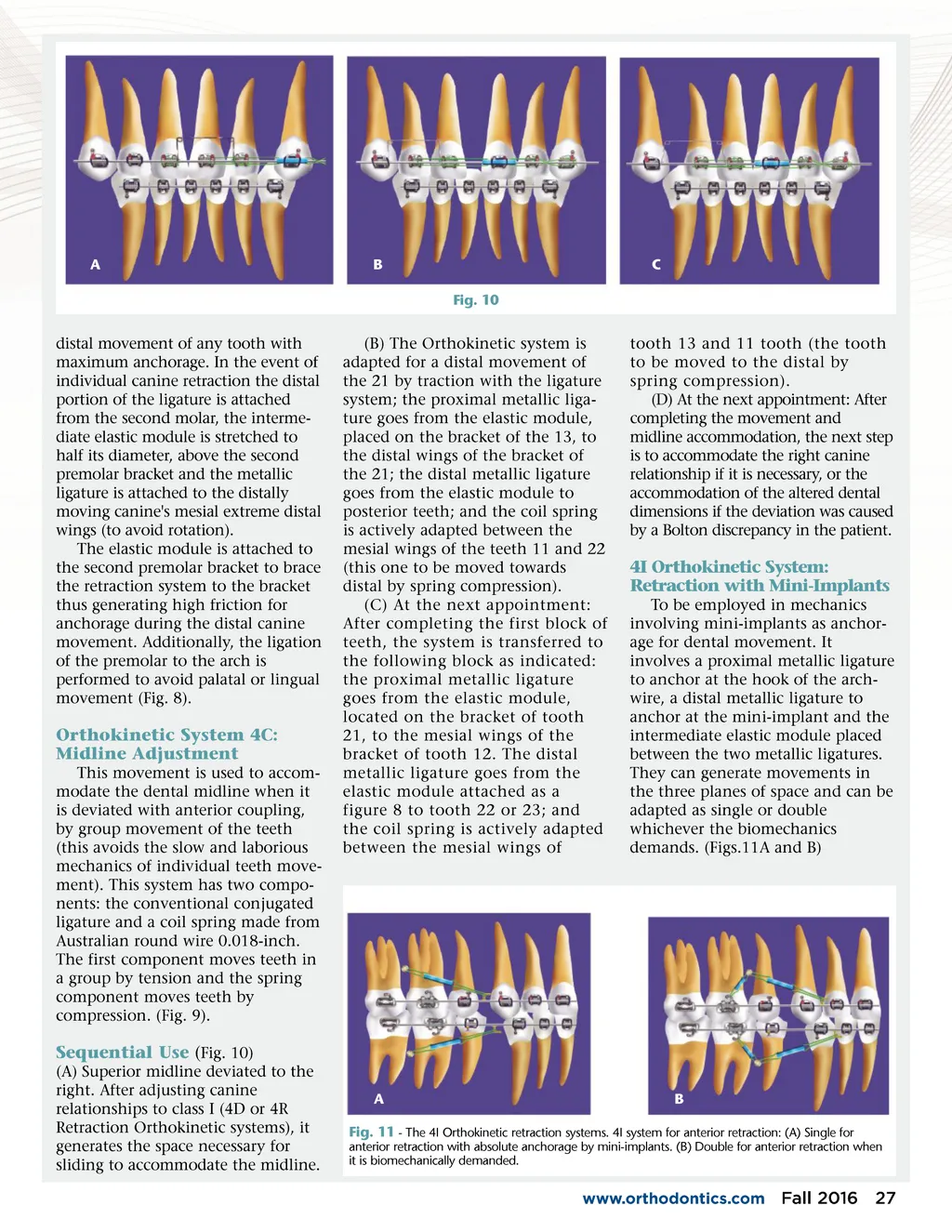
Fig. 7 -Graphs of the 4M system for mesial movement of posterior teeth or anchorage loss. (A) In the Initial position, the elastic module is stretched to twice the diameter. (B) At the final position after mesial movement of the second premolar. Later, the first molar is attached after it has initiated mesial movement by the action of the supra-crestal periodontal fibers, with a drifting effect. In the conventional systems using elastic chains to close general-ized diastemas or individual diastemas in anterior teeth, a very high force level is generated result-ing in a number of undesirable side effects causing: First, the generation of high frictional forces due to the contact of the elastic chain with the archwire in the inter-bracket area results in undesirable effects. Second, from the generation of high frictional forces of a similar magnitude due to the contact of the elastic chain with the archwire and the superior and inferior proximal contours of the bracket. Third, gener-ating frictional forces due to the excessive and not necessary lap of the arch-wire against all the walls of the slot, by action of the elastic chain. If we add to this, the force required to move the teeth to the planned place, we have a summation of forces that is excessive for a low caliper wire caus-ing adverse effects. Orthokinetic System 4M The 4M Orthokinetic system for mesial movement of posterior teeth or anchorage loss. This movement is used for individual mesial movement of posterior teeth, as in the case of mesial movement of second premo-lars to finish closing spaces residual to the extraction of first premolars. This system attaches to the anterior teeth (as in Fig. 8) with a metallic ligature from the mesial extreme; the intermediate elastic module is stretched to twice the diameter above the canine bracket and the metallic ligature is placed at the distal extreme and attaches to the mesial wings of the premolar to be mesially moved and to avoid rotation. Another elastic module is attached to the canine bracket, which braces the retraction system to the bracket and generates high friction that serves as anchorage for the mesial movement of the poste-rior tooth (anchorage friction), besides attaching it to the arch to avoid lingual movement.(Fig. 7) Fig. 8 -Graph of the 4D Orthokinetic system for distal movement. In this case, an individual canine is moved. (A) Before initiation of the distal movement, and (B) after distal movement is completed under maximum anchorage. Fig. 9 -Components of the 4C Orthokinetic system. (A) Spring with coils to move teeth by compression, made from Australian round wire 0.018-inch, (B) Proximal Traction Metallic ligature, going from the metallic proximal module to the mesial wings of the tooth that is moved by traction, (C) Elastic module for traction, with elastic ligature to the bracket, to generate more anchorage friction, (D) Distal metallic ligature serving as anchorage for the system. Orthokinetic System 4D: Distal Movement This movement is used for indi-vidual canine retraction or individual 26 Fall 2016 JAOS
Journal of the American Orthodontic Society Fall 2016: Page 26