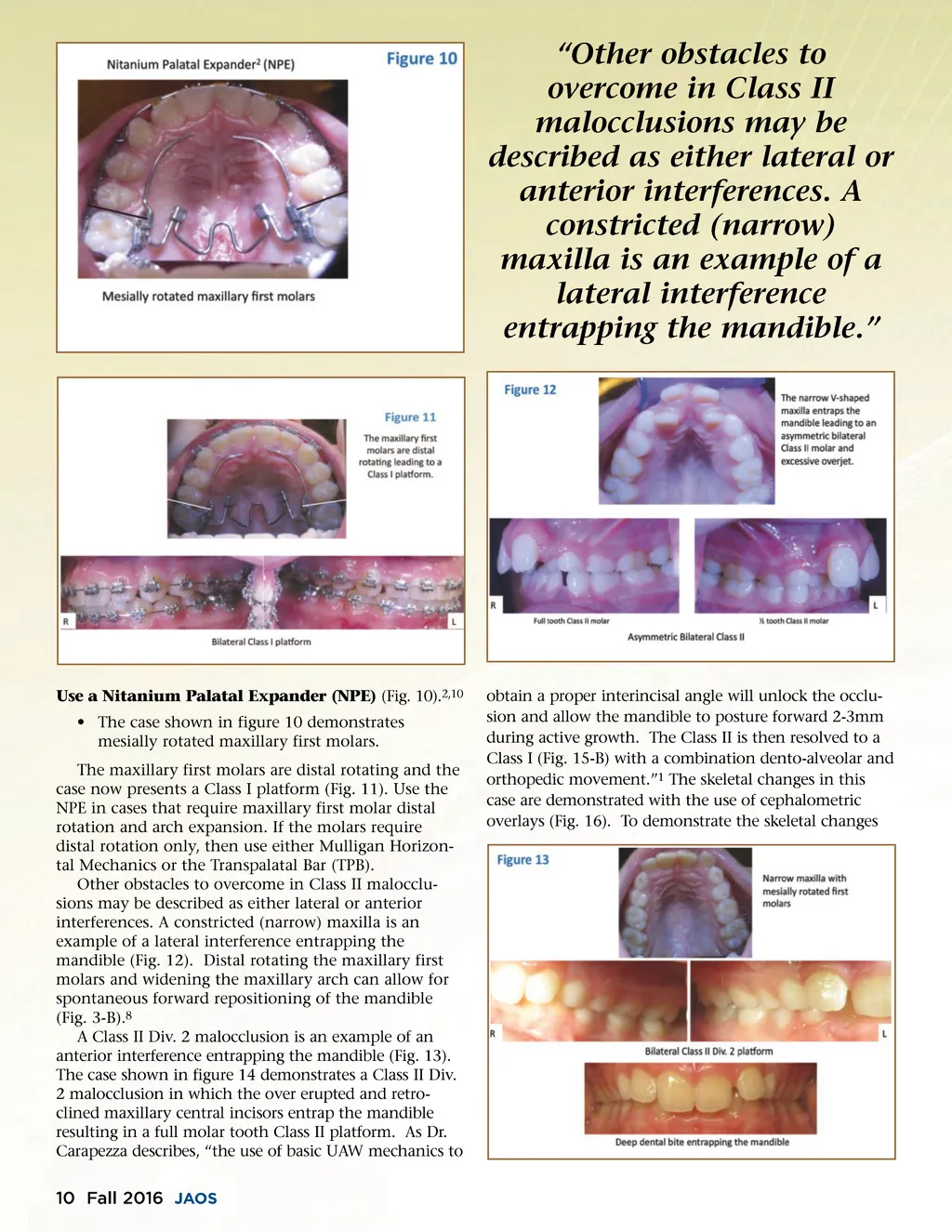
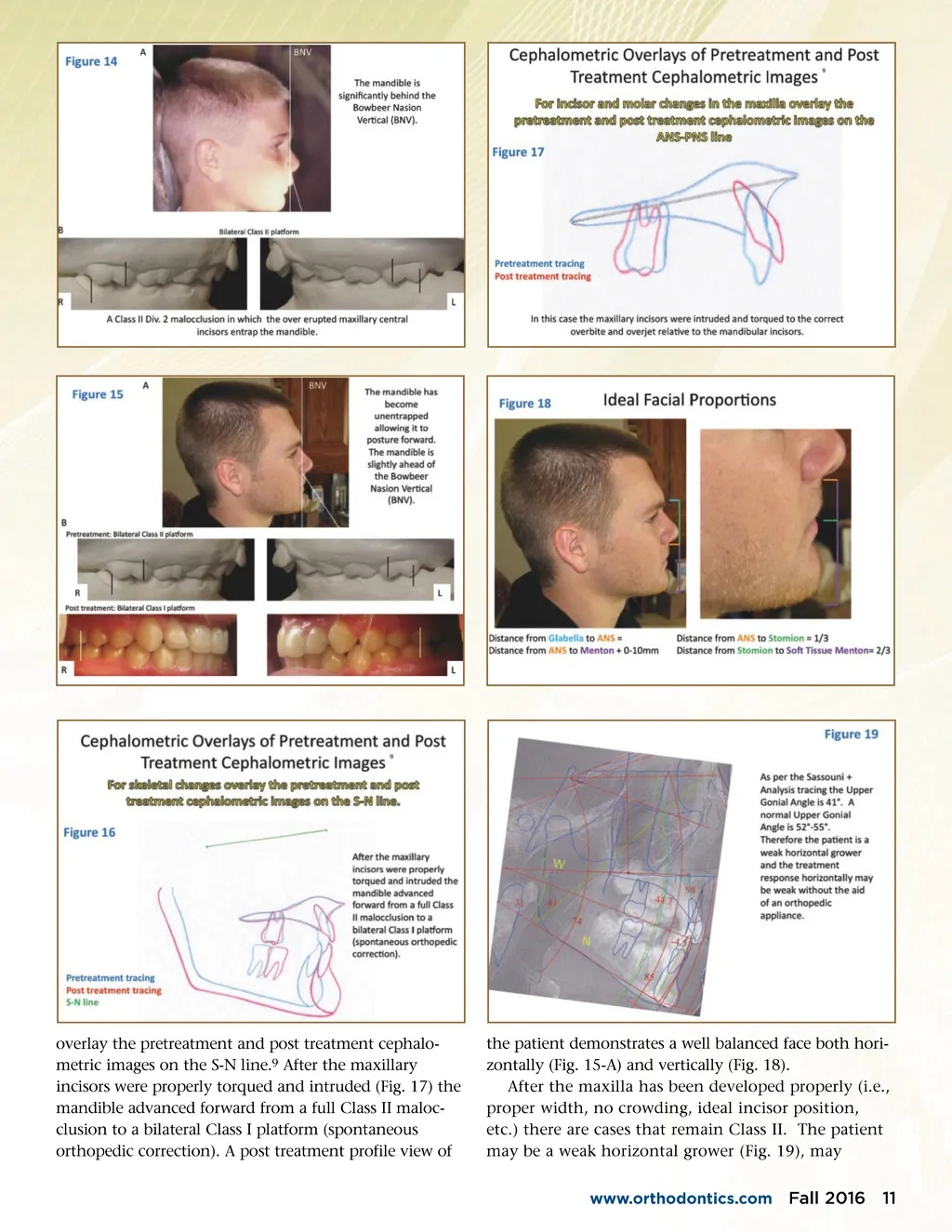
“Other obstacles to overcome in Class II malocclusions may be described as either lateral or anterior interferences. A constricted (narrow) maxilla is an example of a lateral interference entrapping the mandible.” Use a Nitanium Palatal Expander (NPE) (Fig. 10). 2,10 • The case shown in figure 10 demonstrates mesially rotated maxillary first molars. The maxillary first molars are distal rotating and the case now presents a Class I platform (Fig. 11). Use the NPE in cases that require maxillary first molar distal rotation and arch expansion. If the molars require distal rotation only, then use either Mulligan Horizon-tal Mechanics or the Transpalatal Bar (TPB). Other obstacles to overcome in Class II malocclu-sions may be described as either lateral or anterior interferences. A constricted (narrow) maxilla is an example of a lateral interference entrapping the mandible (Fig. 12). Distal rotating the maxillary first molars and widening the maxillary arch can allow for spontaneous forward repositioning of the mandible (Fig. 3-B). 8 A Class II Div. 2 malocclusion is an example of an anterior interference entrapping the mandible (Fig. 13). The case shown in figure 14 demonstrates a Class II Div. 2 malocclusion in which the over erupted and retro-clined maxillary central incisors entrap the mandible resulting in a full molar tooth Class II platform. As Dr. Carapezza describes, “the use of basic UAW mechanics to obtain a proper interincisal angle will unlock the occlu-sion and allow the mandible to posture forward 2-3mm during active growth. The Class II is then resolved to a Class I (Fig. 15-B) with a combination dento-alveolar and orthopedic movement.” 1 The skeletal changes in this case are demonstrated with the use of cephalometric overlays (Fig. 16). To demonstrate the skeletal changes 10 Fall 2016 JAOS
Journal of the American Orthodontic Society Fall 2016: Page 10