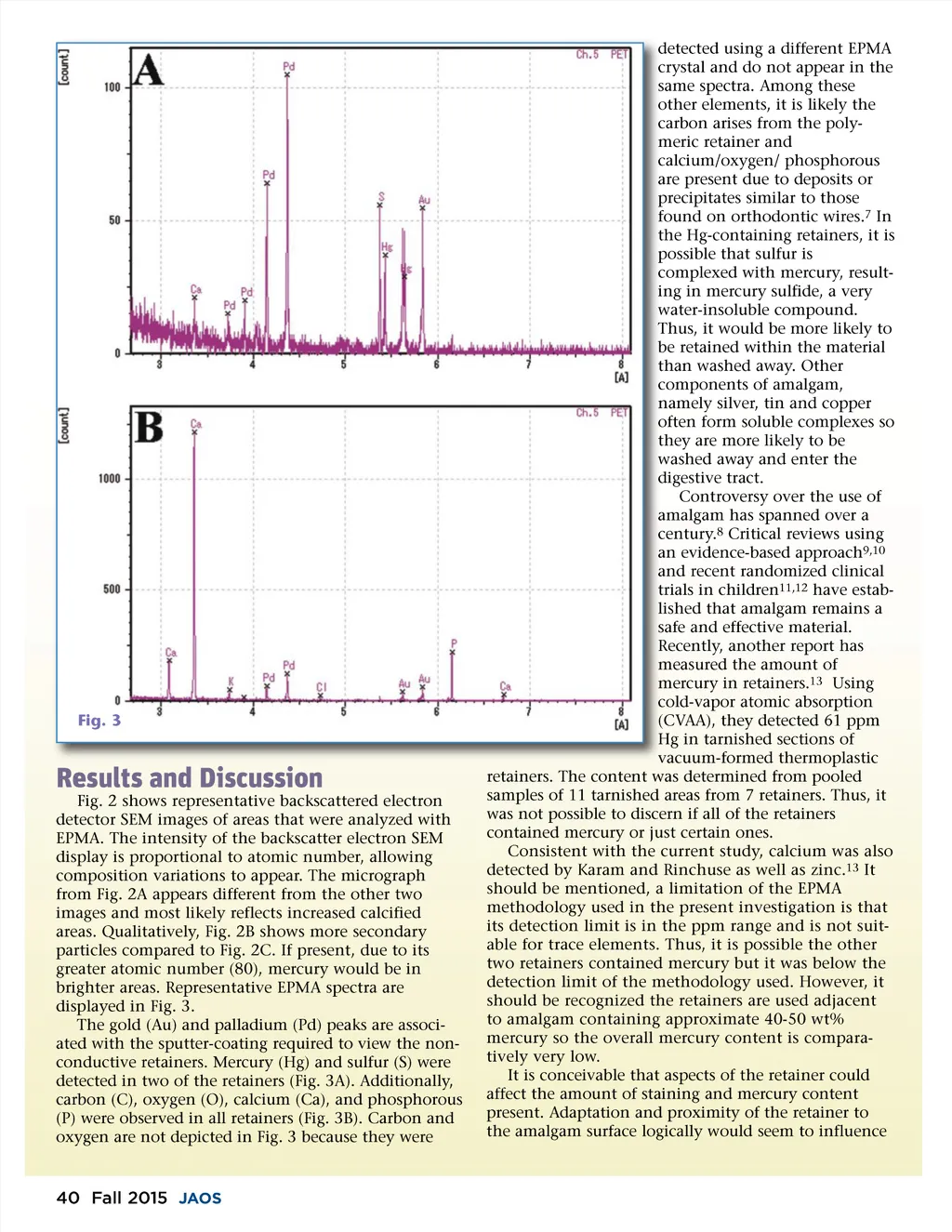
Fig. 3 Results and Discussion Fig. 2 shows representative backscattered electron detector SEM images of areas that were analyzed with EPMA. The intensity of the backscatter electron SEM display is proportional to atomic number, allowing composition variations to appear. The micrograph from Fig. 2A appears different from the other two images and most likely reflects increased calcified areas. Qualitatively, Fig. 2B shows more secondary particles compared to Fig. 2C. If present, due to its greater atomic number (80), mercury would be in brighter areas. Representative EPMA spectra are displayed in Fig. 3. The gold (Au) and palladium (Pd) peaks are associ-ated with the sputter-coating required to view the non-conductive retainers. Mercury (Hg) and sulfur (S) were detected in two of the retainers (Fig. 3A). Additionally, carbon (C), oxygen (O), calcium (Ca), and phosphorous (P) were observed in all retainers (Fig. 3B). Carbon and oxygen are not depicted in Fig. 3 because they were detected using a different EPMA crystal and do not appear in the same spectra. Among these other elements, it is likely the carbon arises from the poly-meric retainer and calcium/oxygen/ phosphorous are present due to deposits or precipitates similar to those found on orthodontic wires. 7 In the Hg-containing retainers, it is possible that sulfur is complexed with mercury, result-ing in mercury sulfide, a very water-insoluble compound. Thus, it would be more likely to be retained within the material than washed away. Other components of amalgam, namely silver, tin and copper often form soluble complexes so they are more likely to be washed away and enter the digestive tract. Controversy over the use of amalgam has spanned over a century. 8 Critical reviews using an evidence-based approach 9,10 and recent randomized clinical trials in children 11,12 have estab-lished that amalgam remains a safe and effective material. Recently, another report has measured the amount of mercury in retainers. 13 Using cold-vapor atomic absorption (CVAA), they detected 61 ppm Hg in tarnished sections of vacuum-formed thermoplastic retainers. The content was determined from pooled samples of 11 tarnished areas from 7 retainers. Thus, it was not possible to discern if all of the retainers contained mercury or just certain ones. Consistent with the current study, calcium was also detected by Karam and Rinchuse as well as zinc. 13 It should be mentioned, a limitation of the EPMA methodology used in the present investigation is that its detection limit is in the ppm range and is not suit-able for trace elements. Thus, it is possible the other two retainers contained mercury but it was below the detection limit of the methodology used. However, it should be recognized the retainers are used adjacent to amalgam containing approximate 40-50 wt% mercury so the overall mercury content is compara-tively very low. It is conceivable that aspects of the retainer could affect the amount of staining and mercury content present. Adaptation and proximity of the retainer to the amalgam surface logically would seem to influence 40 Fall 2015 JAOS
Journal of the American Orthodontic Society Fall 2015: Page 40