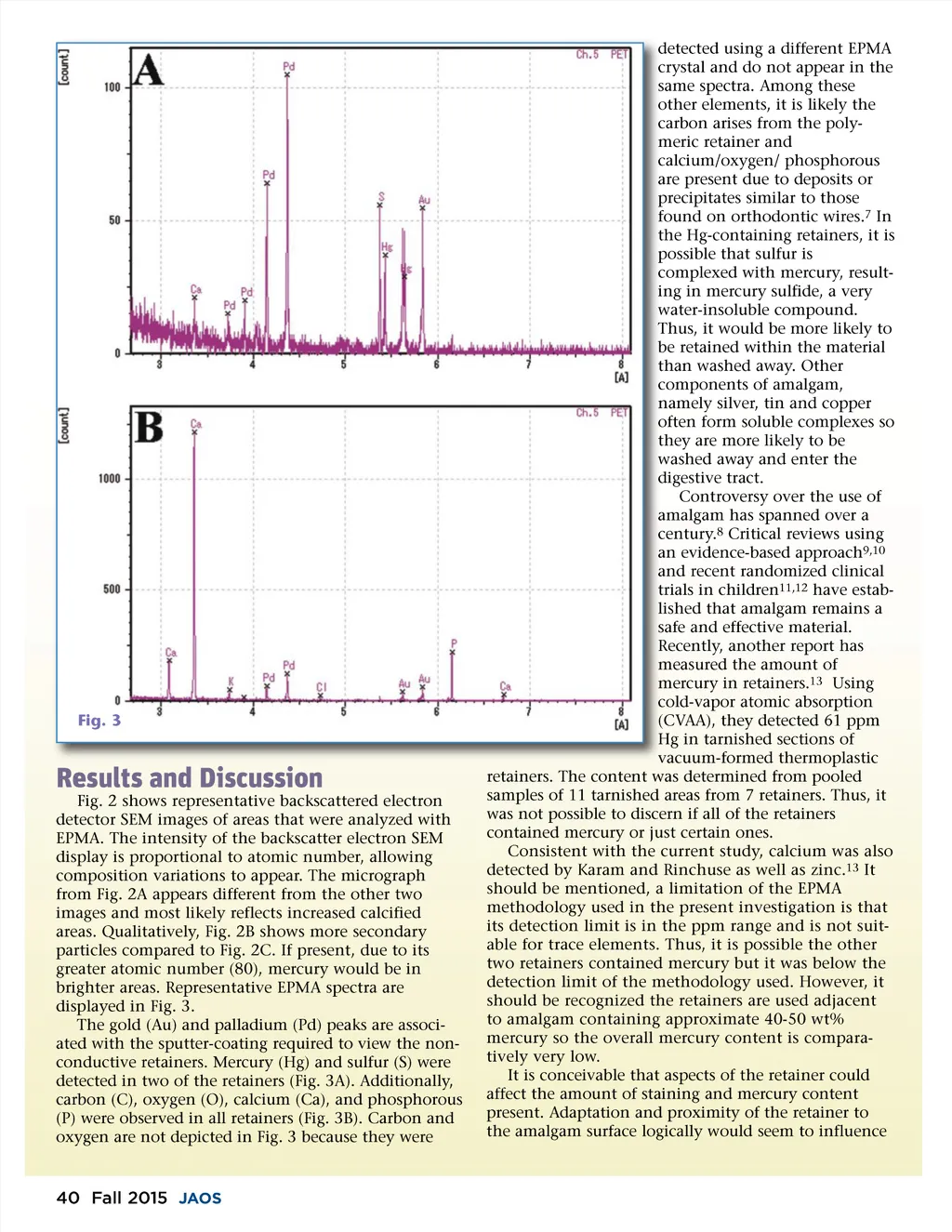
"Although the strongest evidence References in the scientific literature has 1. Rinchuse DJ, Miles PG, Sheridan JJ. Orthodontic retention and stability: a clinical perspective. J Clin Orthod. 2007;41:125-32. determined mercury from dental MC, Kluemper GT, Hartsfield JK Jr., Fardo D, Nash DA. Evalu-amalgam poses little to no risk for 2. Pratt ation of retention protocols among members of the American Association of Orthodontists in the United States. Am J Orthod the patient, and patients would Dentofacial Orthop. 2011;140:520-6. presumably be aware of their 3. Valiathan M, Hughes E. Results of a survey-based study to identify common retention practices in the United States. Am J Orthod amalgam restorations and under-Dentofacial Orthop. 2010;137:170-7. stand some release of elements 4. Barlin S, Smith R, Reed R, Sandy J, Ireland AJ. A retrospective randomized double-blind comparison study of the effectiveness of is to be expected, it is Hawley vs vacuum-formed retainers. Angle Orthod. 2011;81:404-9. conceivable that the patient or 5. Rowland H, Hichens L, Williams A, Hills D, Killingback N, Ewings P, Clark S, Ireland AJ, Sandy JR. The effectiveness of Hawley and parent/guardian of the patient vacuum-formed retainers: a single-center randomized controlled trial. Am J Orthod Dentofacial Orthop. 2007;132:730-7. may be concerned about the L, Rowland H, Williams A, Hollinghurst S, Ewings P, mercury content of their retainer." 6. Hichens Clark S, Ireland A, Sandy J. Cost-effectiveness and patient satisfac-this, as would the characteristics of any biofilm and/or fluid, most likely saliva, that would be between the retainer and amalgam surface. The corrosion of amal-gam is known to be environment dependent 14 and it is possible a crevice-like condition may exist between the retainer and amalgam, which has been shown to increase mercury dissolution in vitro. 15 Similarly, biofilms are thought to promote mercury release from amalgam. 16 However, the integrity of the tarnished layer on the surface of amalgam and any oxides formed on the amalgam may limit mercury release. 15,16 Given that only two of the retainers contained mercury as detected by EPMA, it is possible, given the wear of the appliance in Fig. 1A, the protec-tive layer was compromised and more corrosion prod-uct and/or mercury was released. Although the strongest evidence in the scientific literature has determined mercury from dental amal-gam poses little to no risk for the patient, and patients would presumably be aware of their amalgam restora-tions and understand some release of elements is to be expected, it is conceivable that the patient or parent/guardian of the patient may be concerned about the mercury content of their retainer. With this in mind, it appears that the retainer could actually serve as a harborer or sink for mercury to a minor extent, thereby limiting its absorption into the body. Similarly, as observed in this study, not all tarnished retainers will contain significant amounts of mercury. Nevertheless, regular replacement of the retainer may alleviate concern for these patients. Additionally, due to the mercury content, proper disposal of heavily tarnished retainers may be indicated to limit disposal/release into the environment. tion: Hawley and vacuum-formed retainers. Eur J Orthod. 2007;29:372-8. 7. Eliades T, Eliades G, Athanasiou AE, Bradley TG. Surface character-ization of retrieved NiTi orthodontic archwires. Eur J Orthod. 2000;22:317-26. 8. Greener EH. Amalgam--yesterday, today, and tomorrow. Oper Dent. 1979;4:24-35. 9. Dodes JE. The amalgam controversy. An evidence-based analysis. J Am Dent Assoc. 2001;132:348-56. 10. Mackert JR Jr., Berglund A. Mercury exposure from dental amal-gam fillings: absorbed dose and the potential for adverse health effects. Crit Rev Oral Biol Med. 1997;8:410-36. 11. Bellinger DC, Trachtenberg F, Barregard L, Tavares M, Cernichiari E, Daniel D, McKinlay S. Neuropsychological and renal effects of dental amalgam in children: a randomized clinical trial. J Amer Med Assoc. 2006;295:1775-83. 12. DeRouen TA, Martin MD, Leroux BG, Townes BD, Woods JS, Leitão J, Castro-Caldas A, Luis H, Bernardo M, Rosenbaum G, Martins IP. Neurobehavioral effects of dental amalgam in chil-dren: a randomized clinical trial. J Amer Med Assoc. 2006;295:1784-92. 13. Karam JR, Rinchuse DJ. Dental amalgam corrosion in vacuum-formed retainers. Orthodontics (Chic.). 2011;12:70-4. 14. Yap AU, Ng BL, Blackwood DJ. Corrosion behaviour of high copper dental amalgams. J Oral Rehabil. 2004;31:595-9. 15. Marek M. Dissolution of mercury from dental amalgam at differ-ent pH values. J Dent Res. 1997;76:1308-15. 16. Lyttle HA, Bowden GH. The level of mercury in human dental plaque and interaction in vitro between biofilms of Streptococcus mutans and dental amalgam. J Dent Res. 1993;72:1320-4. www.orthodontics.com Fall 2015 41
Journal of the American Orthodontic Society Fall 2015: Page 41