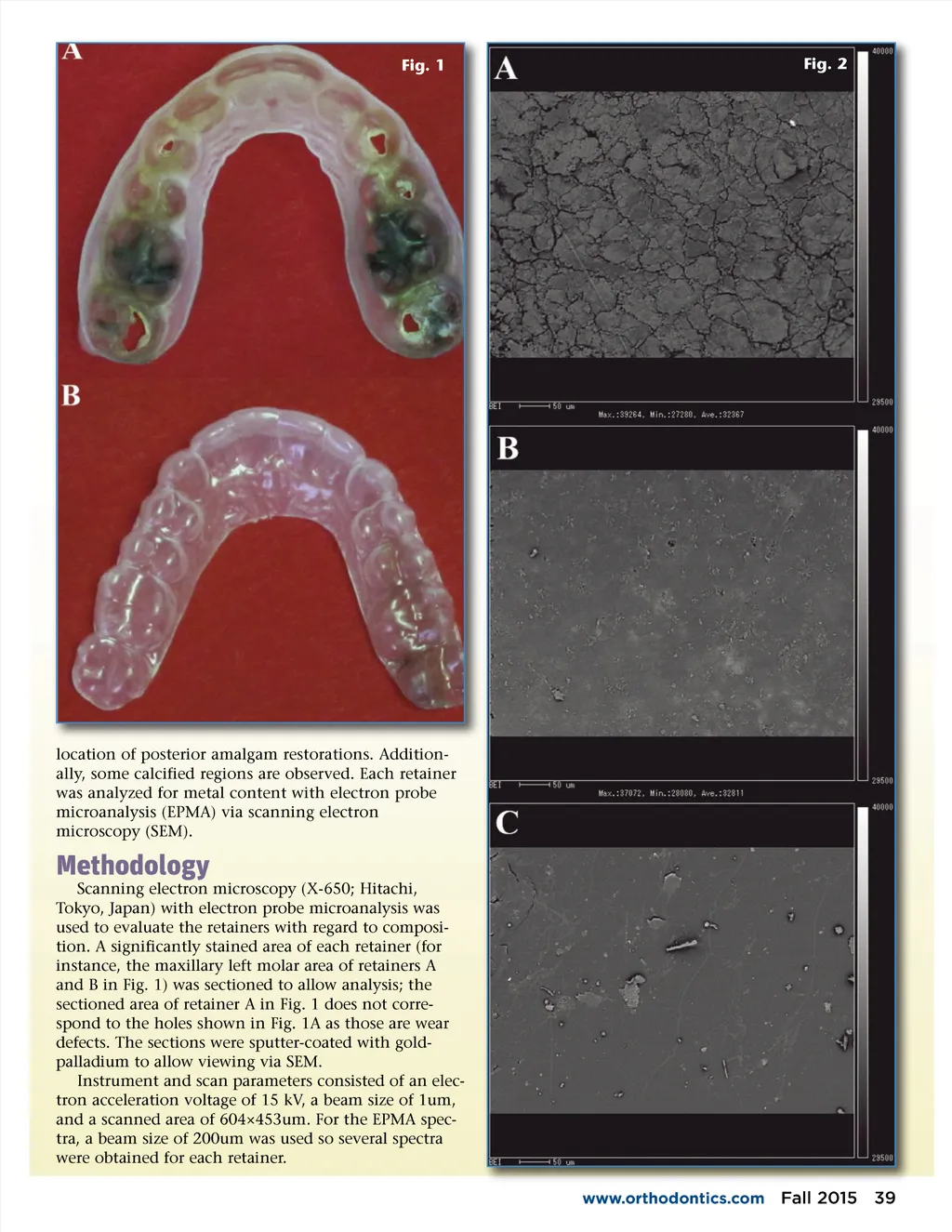
By Hugh J. Murdoch, DDS, MS; Hugh G. Murdoch, DDS; Isao Kawashima, PhD; David W. Berzins, PhD Four orthodontic retainers exhibiting metallic staining were analyzed by electron probe microanalysis (EPMA) via scanning electron microscopy (SEM). Mercury was detected in the two most heavily stained retainers but the other two had mercury levels below detection limits. To a minor extent, retainers may actually serve as a sink for mercury, thereby limiting its absorption into the body. rthodontic retainers are used to increase denti-tion stability after orthodontic treatment. Several retainers are available: fixed retainers, Hawley retainers, and clear thermoplastic or vacuum-formed retainers. 1 In an article published in 2011, Pratt et al. 2 surveyed orthodontists in the U.S. on their retention protocols. They found a shift away from Hawley retainers and toward vacuum-formed retainers and fixed retention for both arches. Currently, vacuum-formed retention is more likely in the maxillary arch but still trails Hawley retainers in use. 2,3 In terms of clinical success, vacuum-formed retainers have shown equivalent or greater success in some randomized clinical trials compared to Hawley O retainers. 4,5 Additionally, patients tend to prefer them. 6 Vacuum-formed retainers offer the advantages of ease of fabrication, low cost and good esthetics. 4,6 However, they are prone to wear, cracking and staining. 1,4 Cases Discarded vacuum-formed retainers (Essix; Dentsply Raintree Essix, Sarasota, FL) were retrieved from four patients presenting for orthodontic maintenance appointments in a private office. The retainers had been in use for 1-2 years in patients also possessing posterior amalgam restorations. Figure 1 displays the most and least stained/ tarnished retainers of the four. It is apparent that the staining corresponded to the 38 Fall 2015 JAOS
Journal of the American Orthodontic Society Fall 2015: Page 38