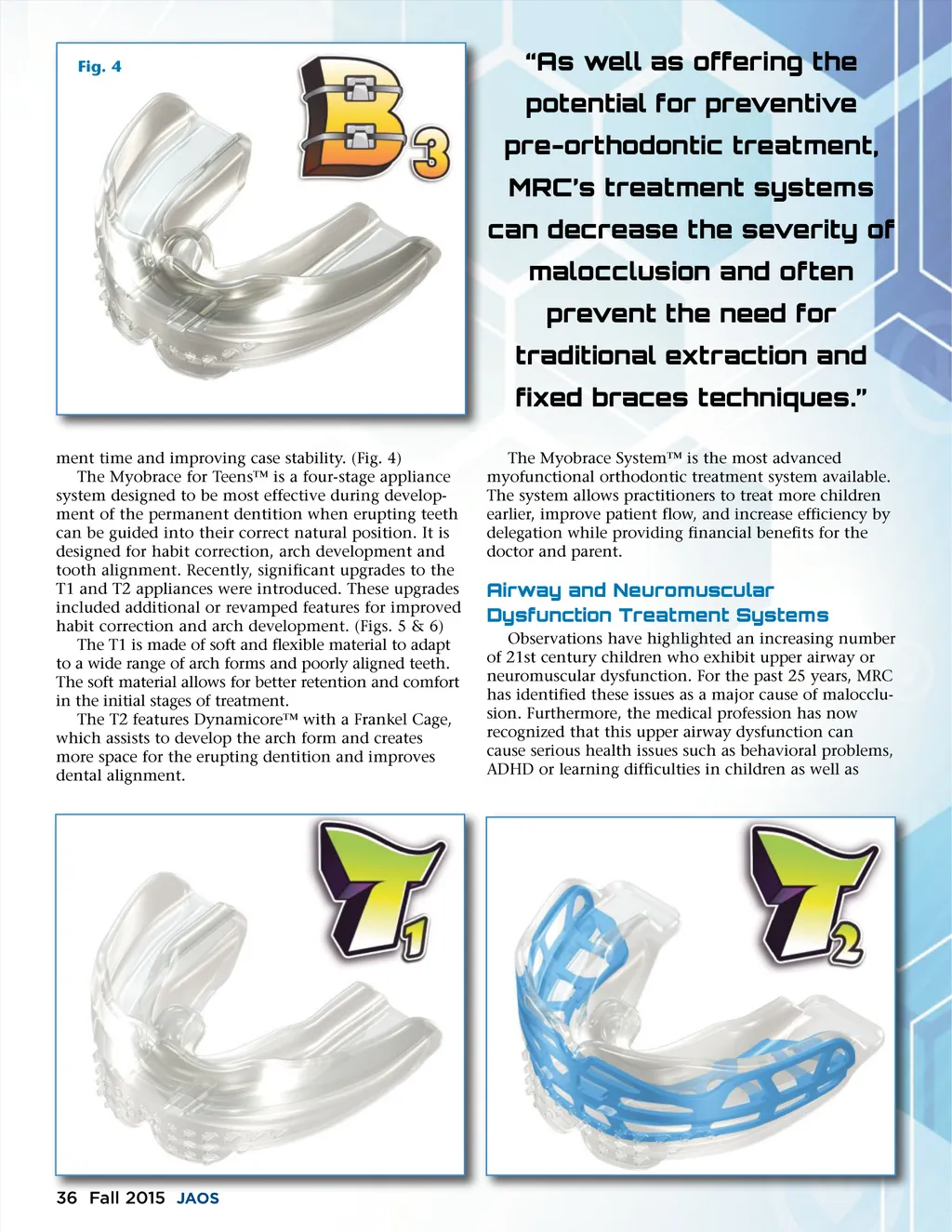
circulation or heart problems and obstructive sleep apnea in adults. MRC understands that correcting upper airway compromise and neuromuscular dysfunction assists to unlock a child’s genetic potential for natural growth and development. Put simply, a child who breathes through the nose with correct tongue posture (in the maxilla) and swallowing patterns will most likely develop properly with little need for orthodontic treat-ment. Whereas, a child who mouth breathes and cannot posture the tongue correctly in the maxilla will have an aberrant swallow as well as most likely have a malocclusion and experience other airway related health issues. As well as offering the potential for preventive pre-orthodontic treatment, MRC’s treatment systems can decrease the severity of malocclusion and often prevent the need for traditional extraction and fixed braces techniques. As a result MRC now has appliance systems, educational systems and clinical management systems available to provide the dental profession with a new dimension in profitable practice expansion. These systems address upper airway and neuromuscu-lar dysfunction and are already highly beneficial for the health and development of a growing child. Additionally, this year, MRC intends to expand the treatment to include breathing disorders in the adult population with a series of adult myofunctional sleep appliances, myOSA®. www.orthodontics.com Fall 2015 37
Journal of the American Orthodontic Society Fall 2015: Page 37