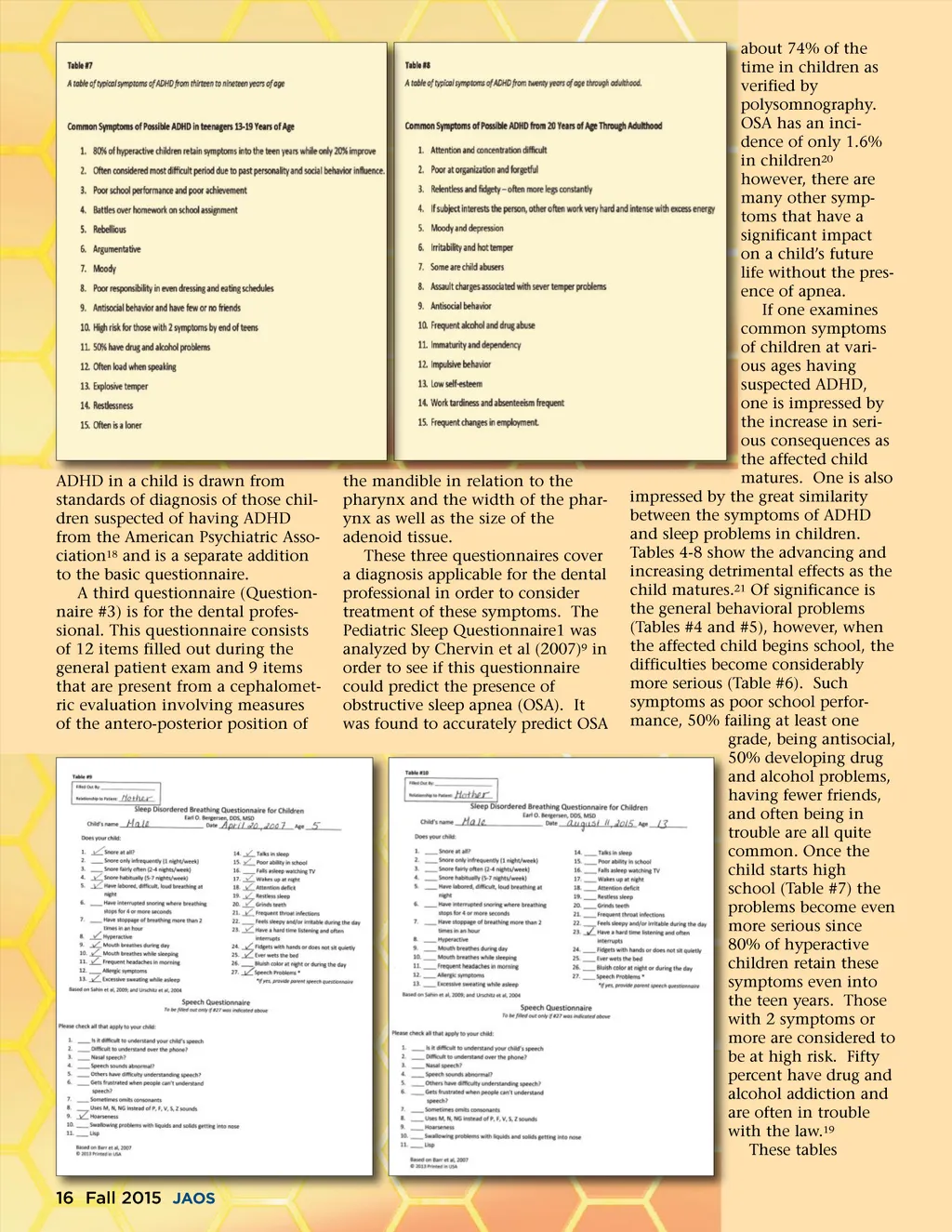
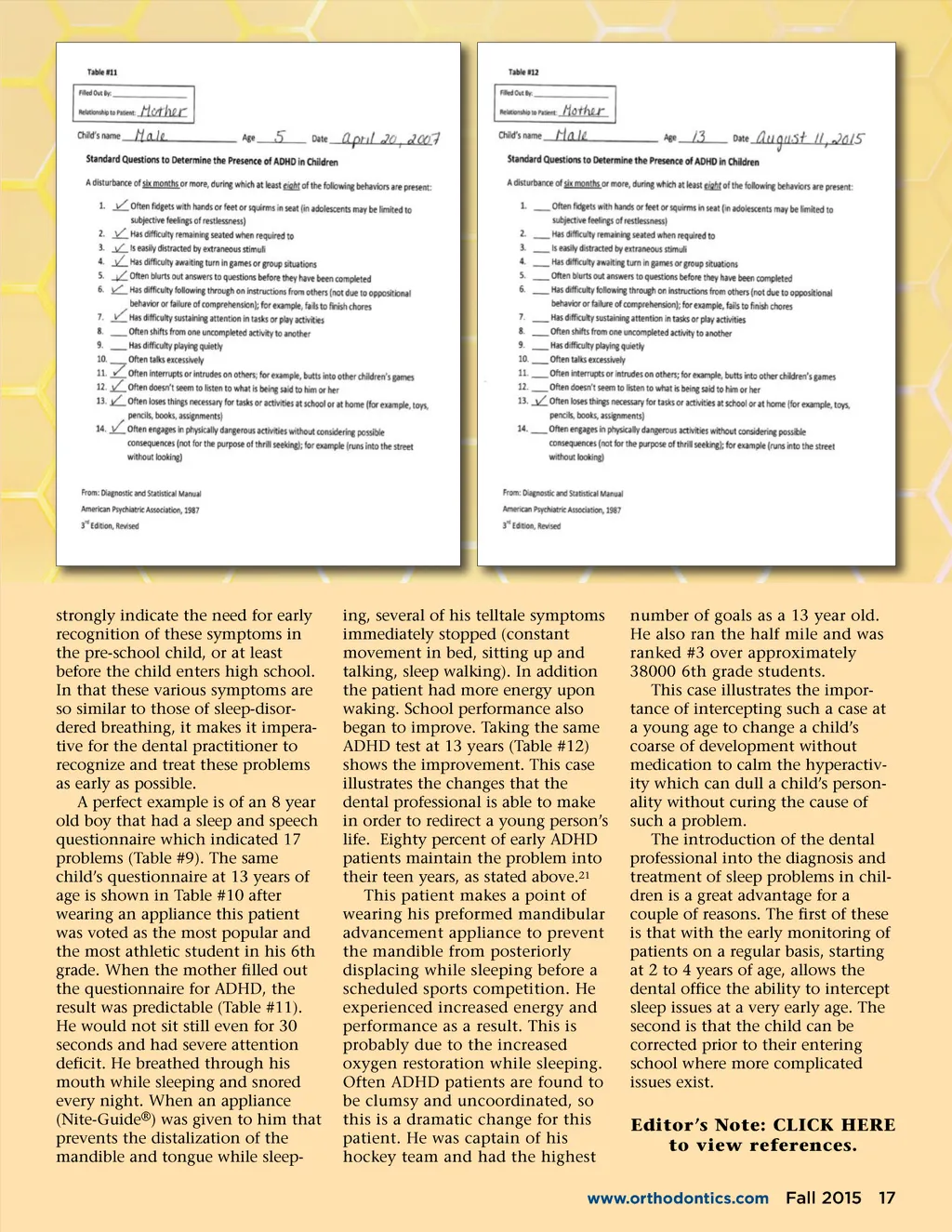
ADHD in a child is drawn from standards of diagnosis of those chil-dren suspected of having ADHD from the American Psychiatric Asso-ciation 18 and is a separate addition to the basic questionnaire. A third questionnaire (Question-naire #3) is for the dental profes-sional. This questionnaire consists of 12 items filled out during the general patient exam and 9 items that are present from a cephalomet-ric evaluation involving measures of the antero-posterior position of the mandible in relation to the pharynx and the width of the phar-ynx as well as the size of the adenoid tissue. These three questionnaires cover a diagnosis applicable for the dental professional in order to consider treatment of these symptoms. The Pediatric Sleep Questionnaire1 was analyzed by Chervin et al (2007) 9 in order to see if this questionnaire could predict the presence of obstructive sleep apnea (OSA). It was found to accurately predict OSA about 74% of the time in children as verified by polysomnography. OSA has an inci-dence of only 1.6% in children 20 however, there are many other symp-toms that have a significant impact on a child’s future life without the pres-ence of apnea. If one examines common symptoms of children at vari-ous ages having suspected ADHD, one is impressed by the increase in seri-ous consequences as the affected child matures. One is also impressed by the great similarity between the symptoms of ADHD and sleep problems in children. Tables 4-8 show the advancing and increasing detrimental effects as the child matures. 21 Of significance is the general behavioral problems (Tables #4 and #5), however, when the affected child begins school, the difficulties become considerably more serious (Table #6). Such symptoms as poor school perfor-mance, 50% failing at least one grade, being antisocial, 50% developing drug and alcohol problems, having fewer friends, and often being in trouble are all quite common. Once the child starts high school (Table #7) the problems become even more serious since 80% of hyperactive children retain these symptoms even into the teen years. Those with 2 symptoms or more are considered to be at high risk. Fifty percent have drug and alcohol addiction and are often in trouble with the law. 19 These tables 16 Fall 2015 JAOS
Journal of the American Orthodontic Society Fall 2015: Page 16