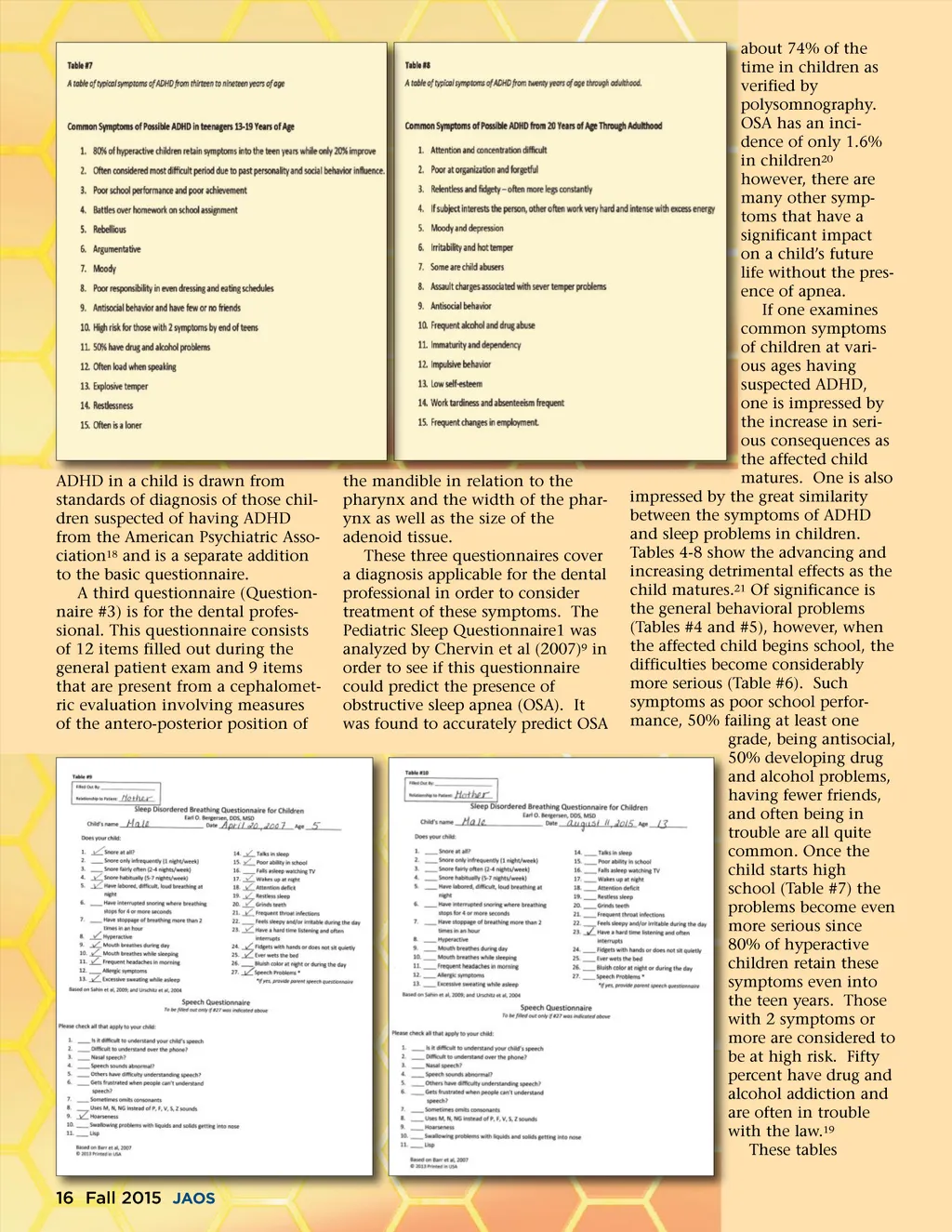
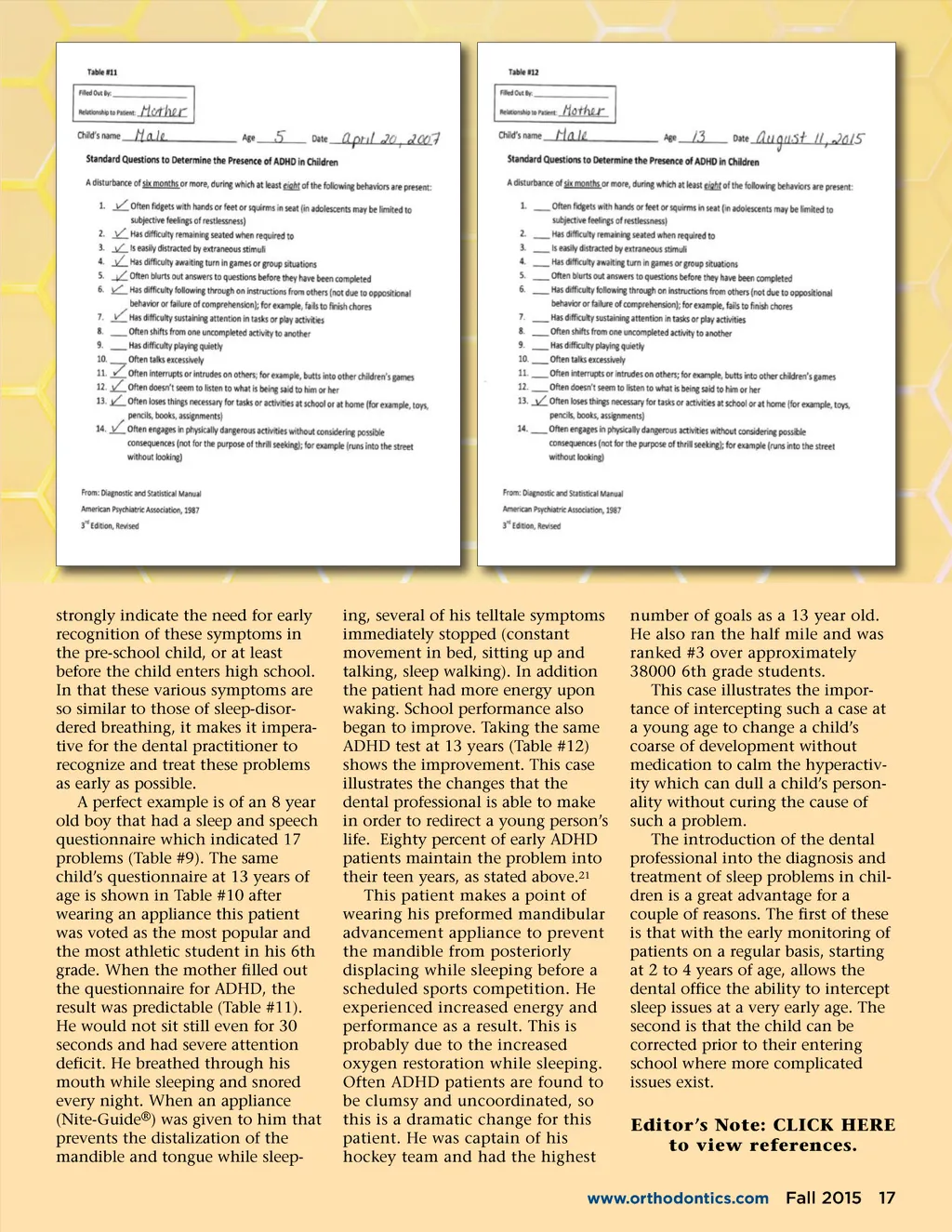
strongly indicate the need for early recognition of these symptoms in the pre-school child, or at least before the child enters high school. In that these various symptoms are so similar to those of sleep-disor-dered breathing, it makes it impera-tive for the dental practitioner to recognize and treat these problems as early as possible. A perfect example is of an 8 year old boy that had a sleep and speech questionnaire which indicated 17 problems (Table #9). The same child’s questionnaire at 13 years of age is shown in Table #10 after wearing an appliance this patient was voted as the most popular and the most athletic student in his 6th grade. When the mother filled out the questionnaire for ADHD, the result was predictable (Table #11). He would not sit still even for 30 seconds and had severe attention deficit. He breathed through his mouth while sleeping and snored every night. When an appliance (Nite-Guide ® ) was given to him that prevents the distalization of the mandible and tongue while sleep-ing, several of his telltale symptoms immediately stopped (constant movement in bed, sitting up and talking, sleep walking). In addition the patient had more energy upon waking. School performance also began to improve. Taking the same ADHD test at 13 years (Table #12) shows the improvement. This case illustrates the changes that the dental professional is able to make in order to redirect a young person’s life. Eighty percent of early ADHD patients maintain the problem into their teen years, as stated above. 21 This patient makes a point of wearing his preformed mandibular advancement appliance to prevent the mandible from posteriorly displacing while sleeping before a scheduled sports competition. He experienced increased energy and performance as a result. This is probably due to the increased oxygen restoration while sleeping. Often ADHD patients are found to be clumsy and uncoordinated, so this is a dramatic change for this patient. He was captain of his hockey team and had the highest number of goals as a 13 year old. He also ran the half mile and was ranked #3 over approximately 38000 6th grade students. This case illustrates the impor-tance of intercepting such a case at a young age to change a child’s coarse of development without medication to calm the hyperactiv-ity which can dull a child’s person-ality without curing the cause of such a problem. The introduction of the dental professional into the diagnosis and treatment of sleep problems in chil-dren is a great advantage for a couple of reasons. The first of these is that with the early monitoring of patients on a regular basis, starting at 2 to 4 years of age, allows the dental office the ability to intercept sleep issues at a very early age. The second is that the child can be corrected prior to their entering school where more complicated issues exist. Editor’s Note: CLICK HERE to view references. Fall 2015 17 www.orthodontics.com
Journal of the American Orthodontic Society Fall 2015: Page 17