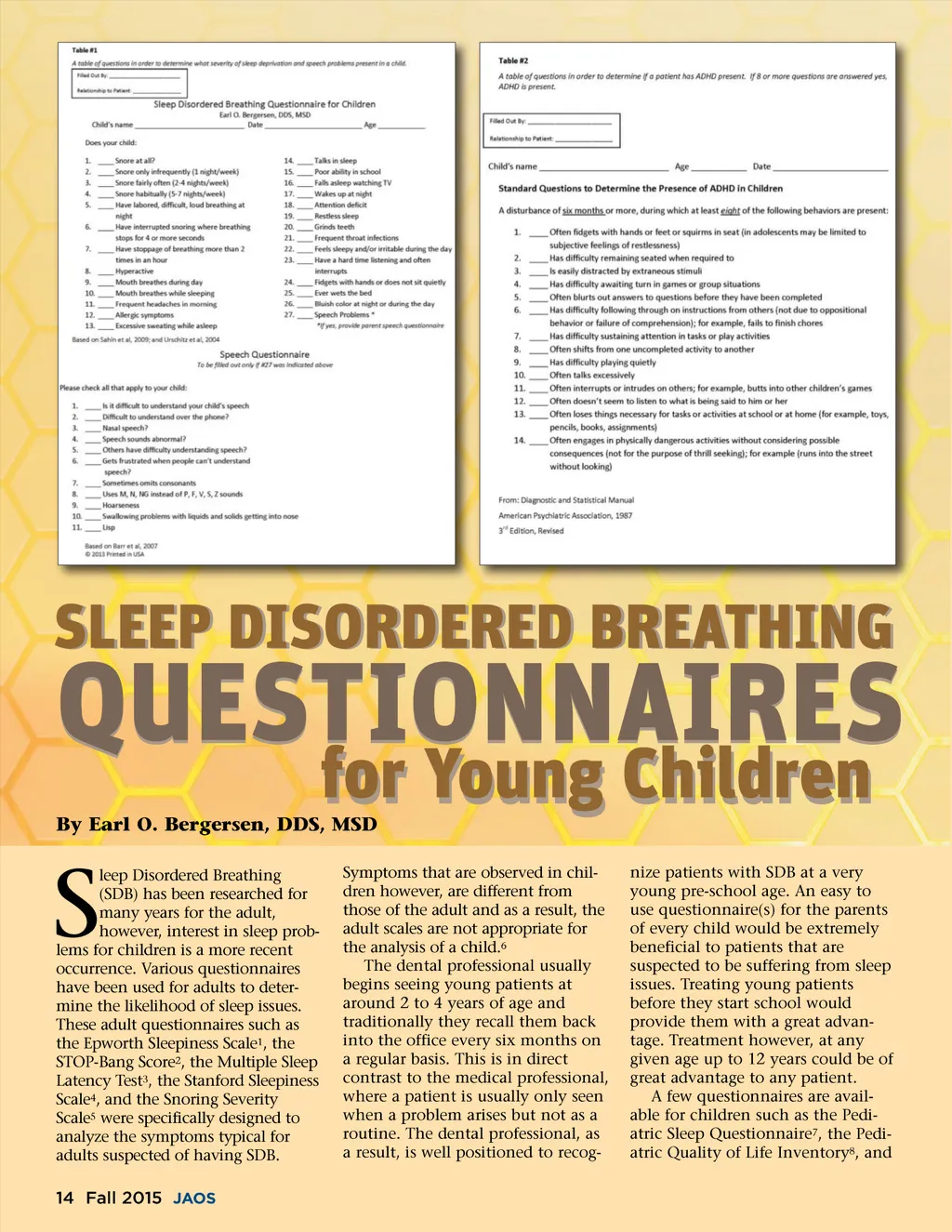
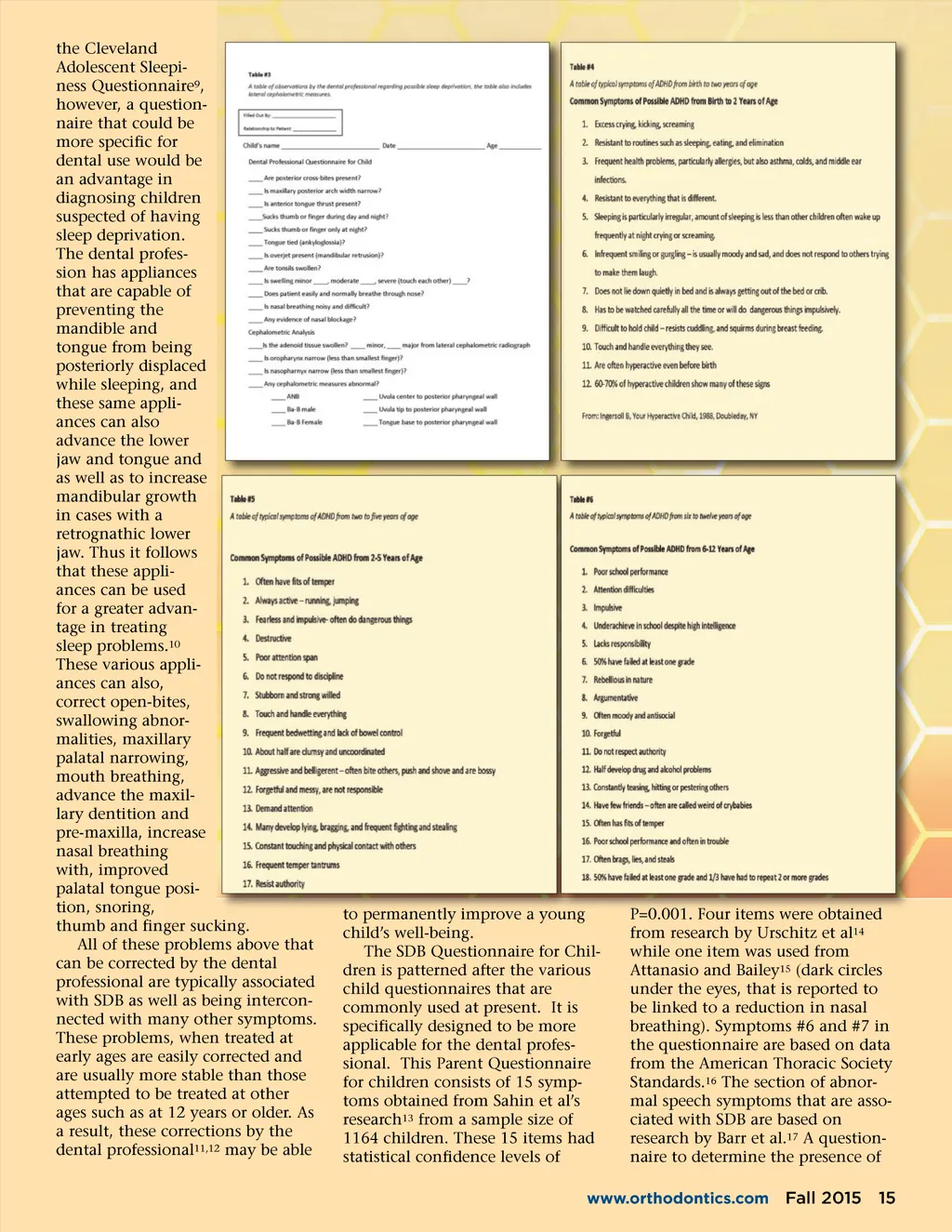
the Cleveland Adolescent Sleepi-ness Questionnaire 9 , however, a question-naire that could be more specific for dental use would be an advantage in diagnosing children suspected of having sleep deprivation. The dental profes-sion has appliances that are capable of preventing the mandible and tongue from being posteriorly displaced while sleeping, and these same appli-ances can also advance the lower jaw and tongue and as well as to increase mandibular growth in cases with a retrognathic lower jaw. Thus it follows that these appli-ances can be used for a greater advan-tage in treating sleep problems. 10 These various appli-ances can also, correct open-bites, swallowing abnor-malities, maxillary palatal narrowing, mouth breathing, advance the maxil-lary dentition and pre-maxilla, increase nasal breathing with, improved palatal tongue posi-tion, snoring, thumb and finger sucking. All of these problems above that can be corrected by the dental professional are typically associated with SDB as well as being intercon-nected with many other symptoms. These problems, when treated at early ages are easily corrected and are usually more stable than those attempted to be treated at other ages such as at 12 years or older. As a result, these corrections by the dental professional 11,12 may be able to permanently improve a young child’s well-being. The SDB Questionnaire for Chil-dren is patterned after the various child questionnaires that are commonly used at present. It is specifically designed to be more applicable for the dental profes-sional. This Parent Questionnaire for children consists of 15 symp-toms obtained from Sahin et al’s research 13 from a sample size of 1164 children. These 15 items had statistical confidence levels of P=0.001. Four items were obtained from research by Urschitz et al 14 while one item was used from Attanasio and Bailey 15 (dark circles under the eyes, that is reported to be linked to a reduction in nasal breathing). Symptoms #6 and #7 in the questionnaire are based on data from the American Thoracic Society Standards. 16 The section of abnor-mal speech symptoms that are asso-ciated with SDB are based on research by Barr et al. 17 A question-naire to determine the presence of www.orthodontics.com Fall 2015 15
Journal of the American Orthodontic Society Fall 2015: Page 15