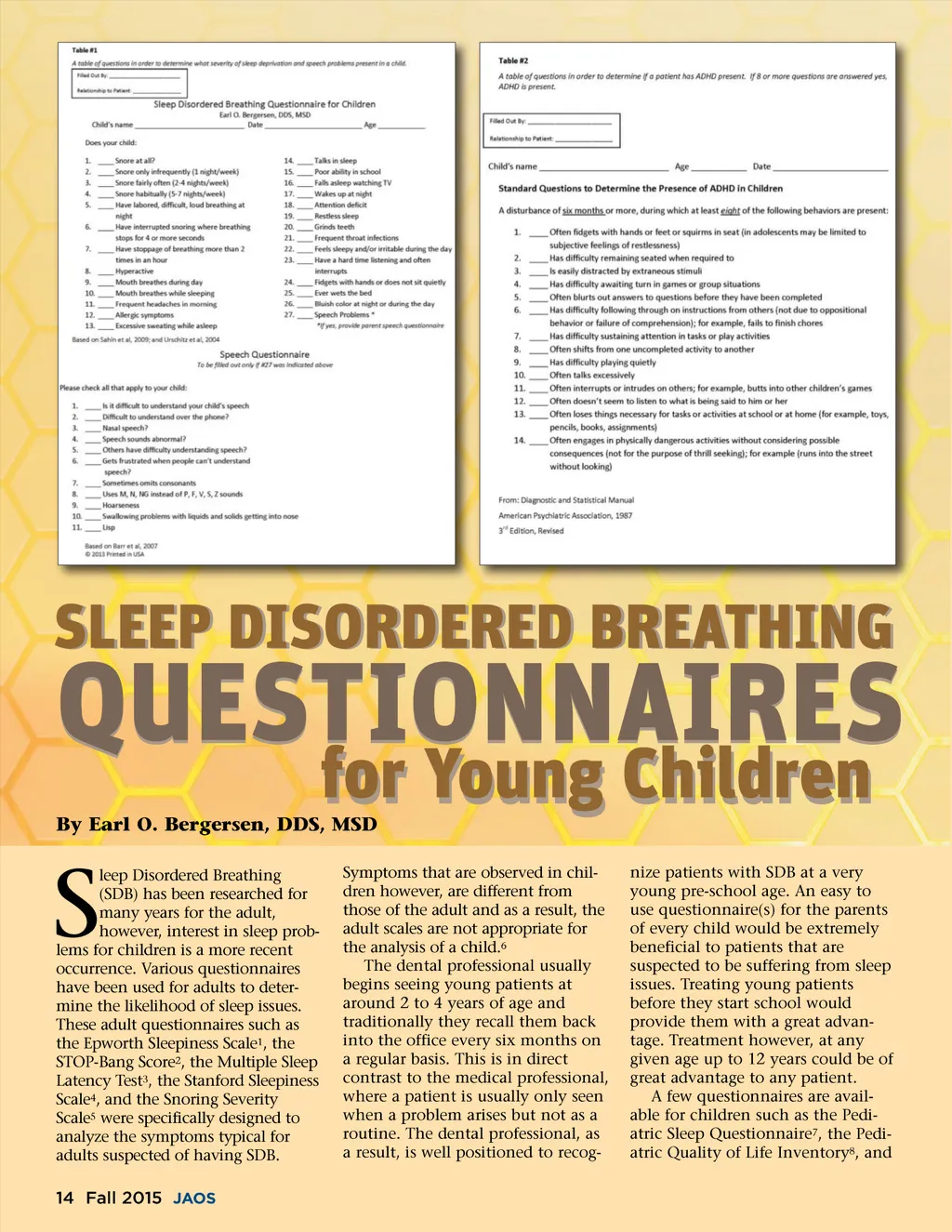
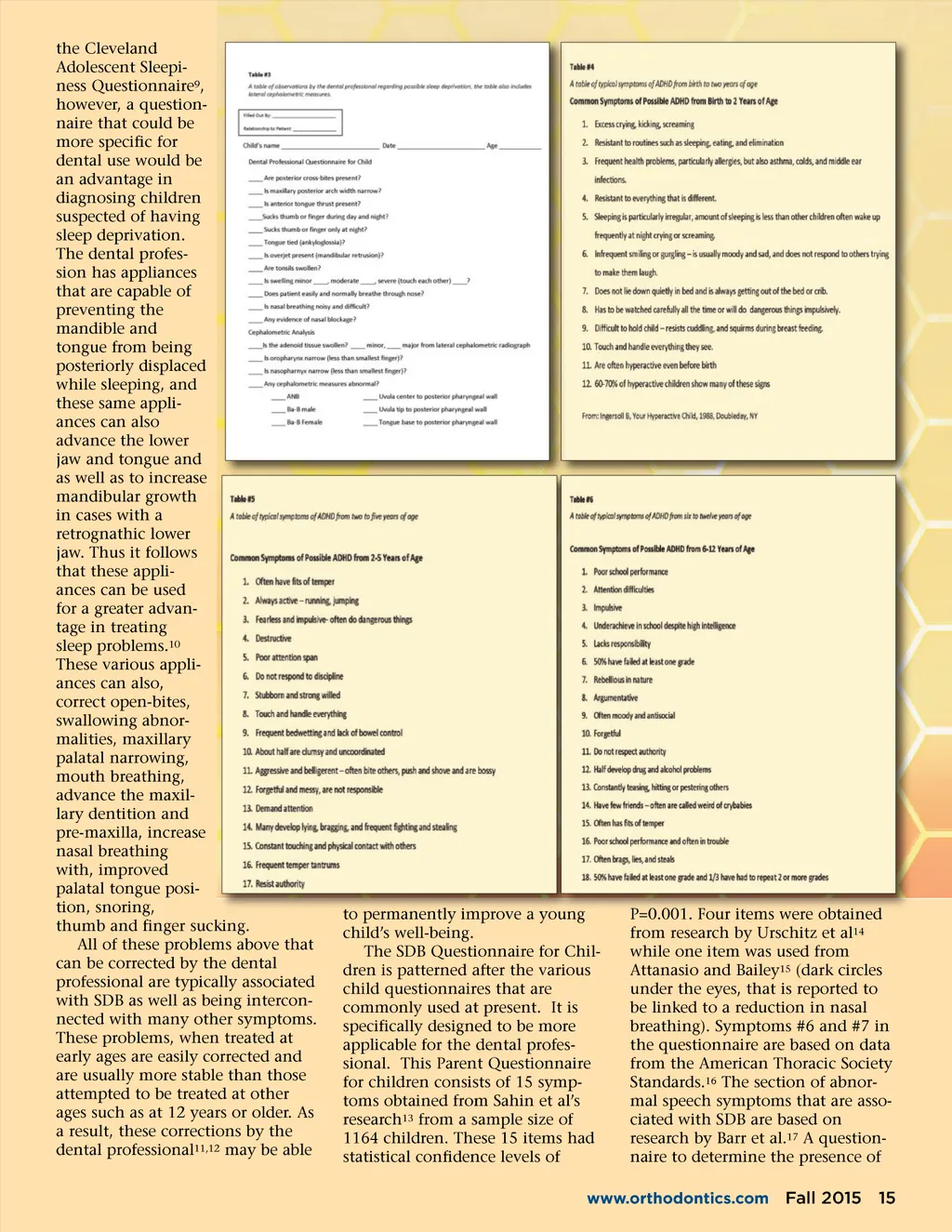
SLEEP DISORDERED BREATHING QUESTIONNAIRES for Young Children for Young Children Symptoms that are observed in chil-dren however, are different from those of the adult and as a result, the adult scales are not appropriate for the analysis of a child. 6 The dental professional usually begins seeing young patients at around 2 to 4 years of age and traditionally they recall them back into the office every six months on a regular basis. This is in direct contrast to the medical professional, where a patient is usually only seen when a problem arises but not as a routine. The dental professional, as a result, is well positioned to recog-By Earl O. Bergersen, DDS, MSD S leep Disordered Breathing (SDB) has been researched for many years for the adult, however, interest in sleep prob-lems for children is a more recent occurrence. Various questionnaires have been used for adults to deter-mine the likelihood of sleep issues. These adult questionnaires such as the Epworth Sleepiness Scale 1 , the STOP-Bang Score 2 , the Multiple Sleep Latency Test 3 , the Stanford Sleepiness Scale 4 , and the Snoring Severity Scale 5 were specifically designed to analyze the symptoms typical for adults suspected of having SDB. nize patients with SDB at a very young pre-school age. An easy to use questionnaire(s) for the parents of every child would be extremely beneficial to patients that are suspected to be suffering from sleep issues. Treating young patients before they start school would provide them with a great advan-tage. Treatment however, at any given age up to 12 years could be of great advantage to any patient. A few questionnaires are avail-able for children such as the Pedi-atric Sleep Questionnaire 7 , the Pedi-atric Quality of Life Inventory 8 , and 14 Fall 2015 JAOS
Journal of the American Orthodontic Society Fall 2015: Page 14