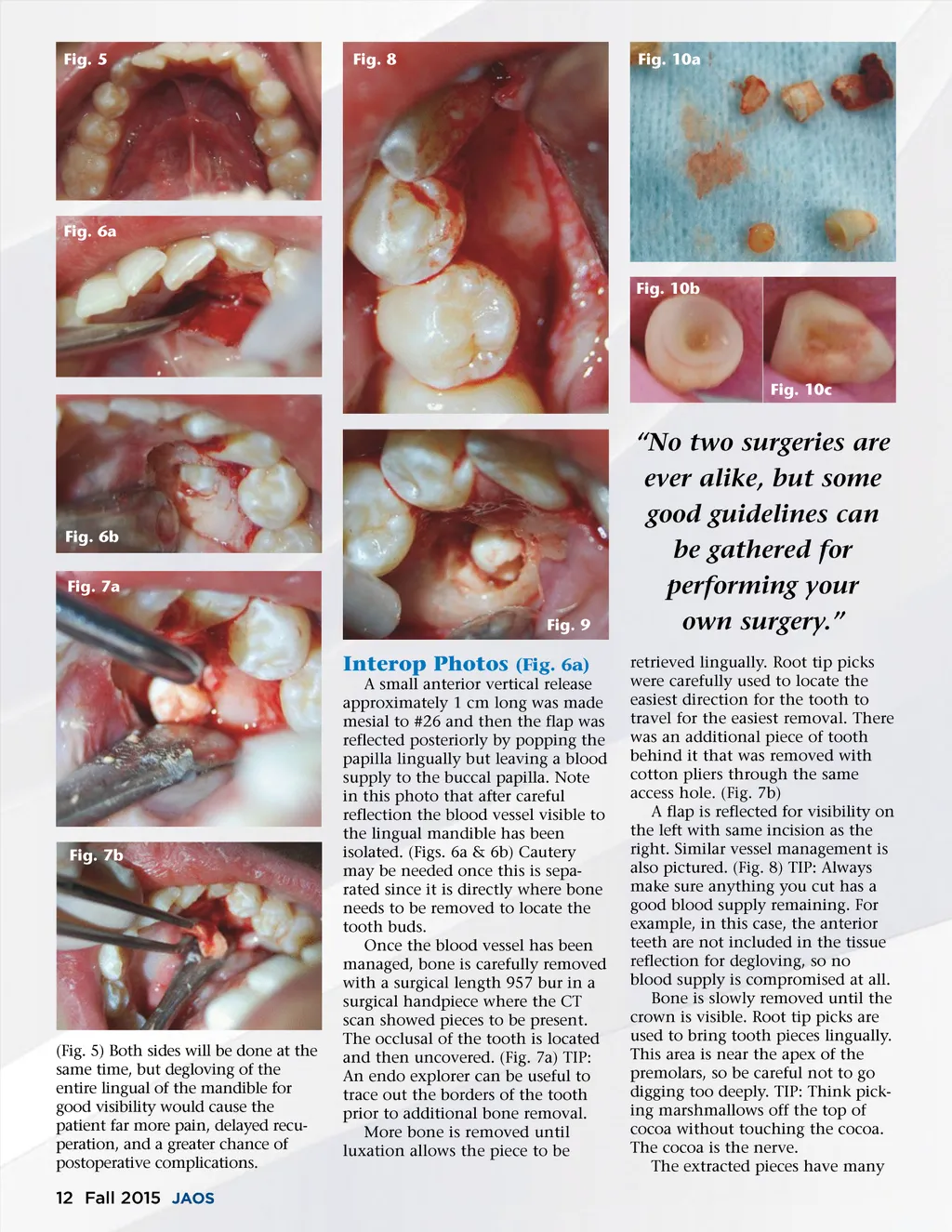
Fig. 5 Fig. 8 Fig. 10a Fig. 6a Fig. 10b Fig. 10c Fig. 6b Fig. 7a Fig. 9 “No two surgeries are ever alike, but some good guidelines can be gathered for performing your own surgery.” retrieved lingually. Root tip picks were carefully used to locate the easiest direction for the tooth to travel for the easiest removal. There was an additional piece of tooth behind it that was removed with cotton pliers through the same access hole. (Fig. 7b) A flap is reflected for visibility on the left with same incision as the right. Similar vessel management is also pictured. (Fig. 8) TIP: Always make sure anything you cut has a good blood supply remaining. For example, in this case, the anterior teeth are not included in the tissue reflection for degloving, so no blood supply is compromised at all. Bone is slowly removed until the crown is visible. Root tip picks are used to bring tooth pieces lingually. This area is near the apex of the premolars, so be careful not to go digging too deeply. TIP: Think pick-ing marshmallows off the top of cocoa without touching the cocoa. The cocoa is the nerve. The extracted pieces have many Interop Photos (Fig. 6a) A small anterior vertical release approximately 1 cm long was made mesial to #26 and then the flap was reflected posteriorly by popping the papilla lingually but leaving a blood supply to the buccal papilla. Note in this photo that after careful reflection the blood vessel visible to the lingual mandible has been isolated. (Figs. 6a & 6b) Cautery may be needed once this is sepa-rated since it is directly where bone needs to be removed to locate the tooth buds. Once the blood vessel has been managed, bone is carefully removed with a surgical length 957 bur in a surgical handpiece where the CT scan showed pieces to be present. The occlusal of the tooth is located and then uncovered. (Fig. 7a) TIP: An endo explorer can be useful to trace out the borders of the tooth prior to additional bone removal. More bone is removed until luxation allows the piece to be Fig. 7b (Fig. 5) Both sides will be done at the same time, but degloving of the entire lingual of the mandible for good visibility would cause the patient far more pain, delayed recu-peration, and a greater chance of postoperative complications. 12 Fall 2015 JAOS
Journal of the American Orthodontic Society Fall 2015: Page 12