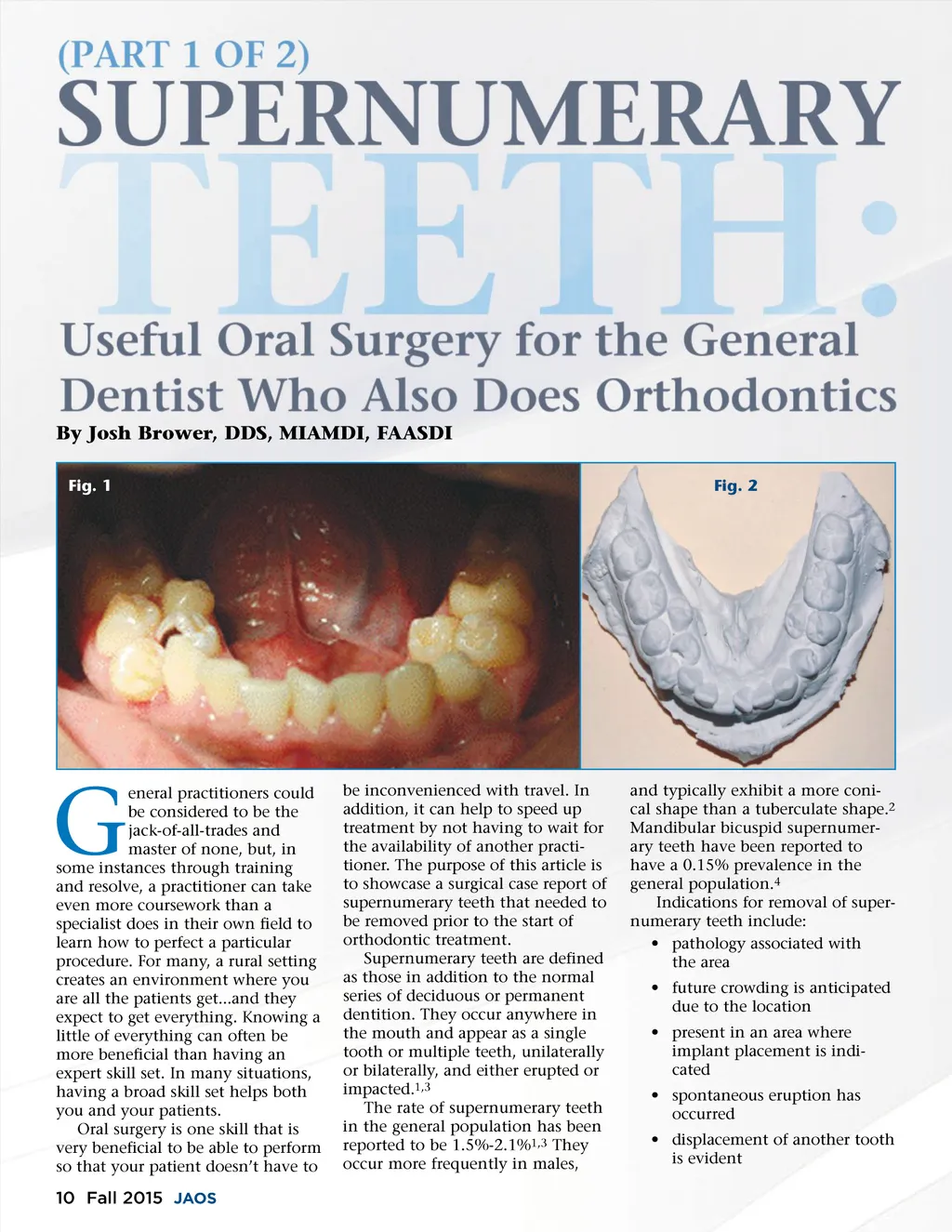
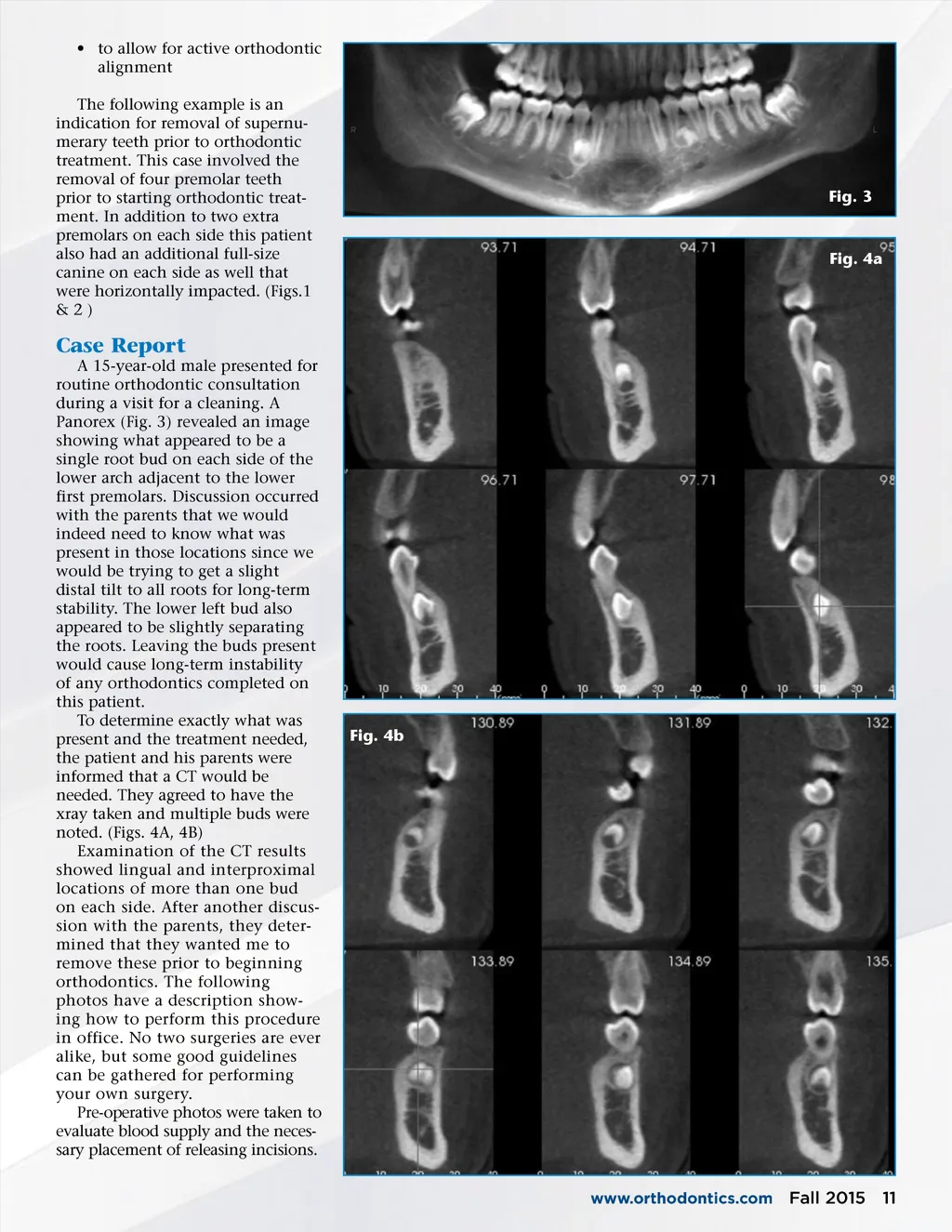
By Josh Brower, DDS, MIAMDI, FAASDI Fig. 1 Fig. 2 G eneral practitioners could be considered to be the jack-of-all-trades and master of none, but, in some instances through training and resolve, a practitioner can take even more coursework than a specialist does in their own field to learn how to perfect a particular procedure. For many, a rural setting creates an environment where you are all the patients get...and they expect to get everything. Knowing a little of everything can often be more beneficial than having an expert skill set. In many situations, having a broad skill set helps both you and your patients. Oral surgery is one skill that is very beneficial to be able to perform so that your patient doesn’t have to be inconvenienced with travel. In addition, it can help to speed up treatment by not having to wait for the availability of another practi-tioner. The purpose of this article is to showcase a surgical case report of supernumerary teeth that needed to be removed prior to the start of orthodontic treatment. Supernumerary teeth are defined as those in addition to the normal series of deciduous or permanent dentition. They occur anywhere in the mouth and appear as a single tooth or multiple teeth, unilaterally or bilaterally, and either erupted or impacted. 1,3 The rate of supernumerary teeth in the general population has been reported to be 1.5%-2.1% 1,3 They occur more frequently in males, and typically exhibit a more coni-cal shape than a tuberculate shape. 2 Mandibular bicuspid supernumer-ary teeth have been reported to have a 0.15% prevalence in the general population. 4 Indications for removal of super-numerary teeth include: • pathology associated with the area • future crowding is anticipated due to the location • present in an area where implant placement is indi-cated • spontaneous eruption has occurred • displacement of another tooth is evident 10 Fall 2015 JAOS
Journal of the American Orthodontic Society Fall 2015: Page 10