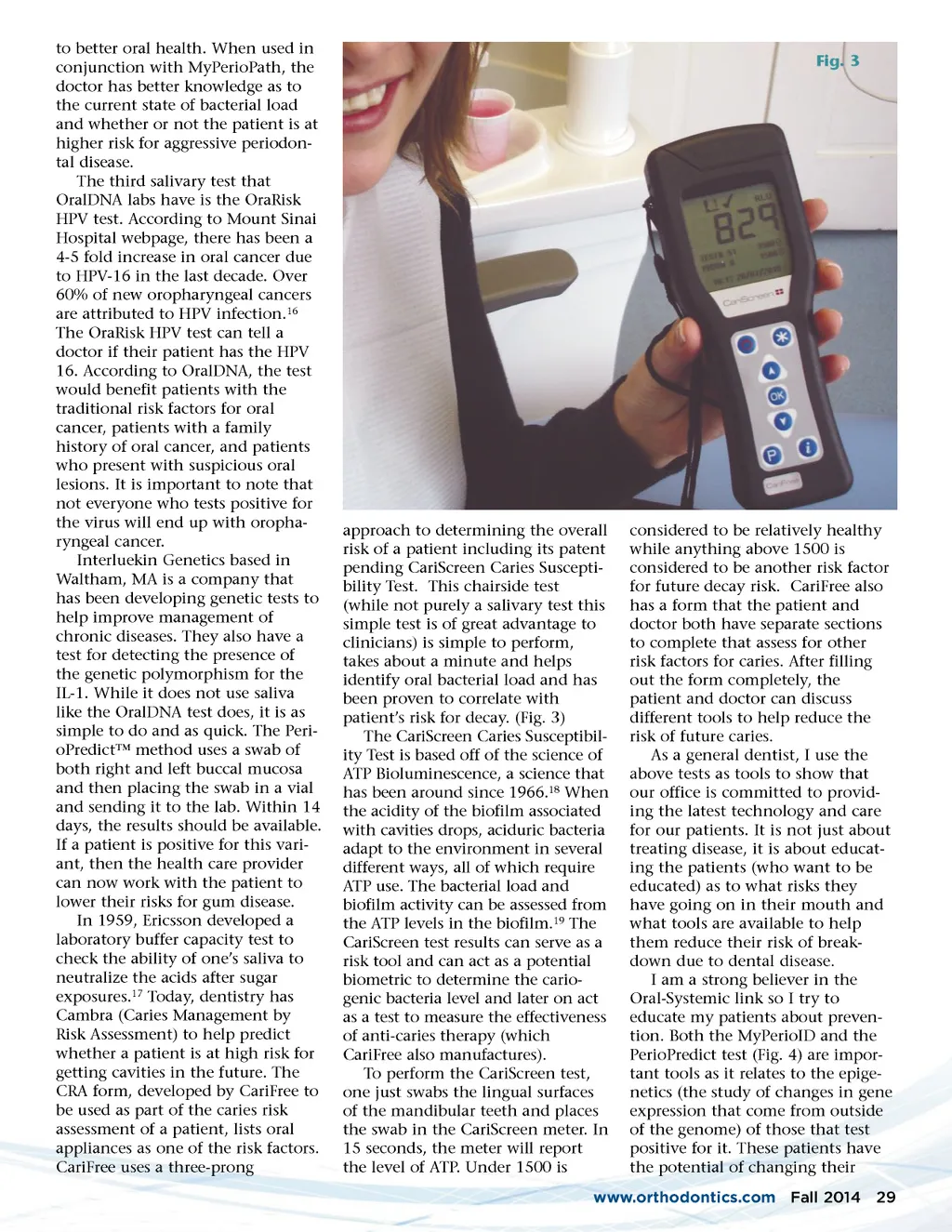
to better oral health. When used in conjunction with MyPerioPath, the doctor has better knowledge as to the current state of bacterial load and whether or not the patient is at higher risk for aggressive periodon-tal disease. The third salivary test that OralDNA labs have is the OraRisk HPV test. According to Mount Sinai Hospital webpage, there has been a 4-5 fold increase in oral cancer due to HPV-16 in the last decade. Over 60% of new oropharyngeal cancers are attributed to HPV infection. 16 The OraRisk HPV test can tell a doctor if their patient has the HPV 16. According to OralDNA, the test would benefit patients with the traditional risk factors for oral cancer, patients with a family history of oral cancer, and patients who present with suspicious oral lesions. It is important to note that not everyone who tests positive for the virus will end up with oropha-ryngeal cancer. Interluekin Genetics based in Waltham, MA is a company that has been developing genetic tests to help improve management of chronic diseases. They also have a test for detecting the presence of the genetic polymorphism for the IL-1. While it does not use saliva like the OralDNA test does, it is as simple to do and as quick. The Peri-oPredict™ method uses a swab of both right and left buccal mucosa and then placing the swab in a vial and sending it to the lab. Within 14 days, the results should be available. If a patient is positive for this vari-ant, then the health care provider can now work with the patient to lower their risks for gum disease. In 1959, Ericsson developed a laboratory buffer capacity test to check the ability of one’s saliva to neutralize the acids after sugar exposures. 17 Today, dentistry has Cambra (Caries Management by Risk Assessment) to help predict whether a patient is at high risk for getting cavities in the future. The CRA form, developed by CariFree to be used as part of the caries risk assessment of a patient, lists oral appliances as one of the risk factors. CariFree uses a three-prong Fig. 3 approach to determining the overall risk of a patient including its patent pending CariScreen Caries Suscepti-bility Test. This chairside test (while not purely a salivary test this simple test is of great advantage to clinicians) is simple to perform, takes about a minute and helps identify oral bacterial load and has been proven to correlate with patient’s risk for decay. (Fig. 3) The CariScreen Caries Susceptibil-ity Test is based off of the science of ATP Bioluminescence, a science that has been around since 1966. 18 When the acidity of the biofilm associated with cavities drops, aciduric bacteria adapt to the environment in several different ways, all of which require ATP use. The bacterial load and biofilm activity can be assessed from the ATP levels in the biofilm. 19 The CariScreen test results can serve as a risk tool and can act as a potential biometric to determine the cario-genic bacteria level and later on act as a test to measure the effectiveness of anti-caries therapy (which CariFree also manufactures). To perform the CariScreen test, one just swabs the lingual surfaces of the mandibular teeth and places the swab in the CariScreen meter. In 15 seconds, the meter will report the level of ATP. Under 1500 is considered to be relatively healthy while anything above 1500 is considered to be another risk factor for future decay risk. CariFree also has a form that the patient and doctor both have separate sections to complete that assess for other risk factors for caries. After filling out the form completely, the patient and doctor can discuss different tools to help reduce the risk of future caries. As a general dentist, I use the above tests as tools to show that our office is committed to provid-ing the latest technology and care for our patients. It is not just about treating disease, it is about educat-ing the patients (who want to be educated) as to what risks they have going on in their mouth and what tools are available to help them reduce their risk of break-down due to dental disease. I am a strong believer in the Oral-Systemic link so I try to educate my patients about preven-tion. Both the MyPerioID and the PerioPredict test (Fig. 4) are impor-tant tools as it relates to the epige-netics (the study of changes in gene expression that come from outside of the genome) of those that test positive for it. These patients have the potential of changing their www.orthodontics.com Fall 2014 29
Journal of the American Orthodontic Society Fall 2014: Page 29