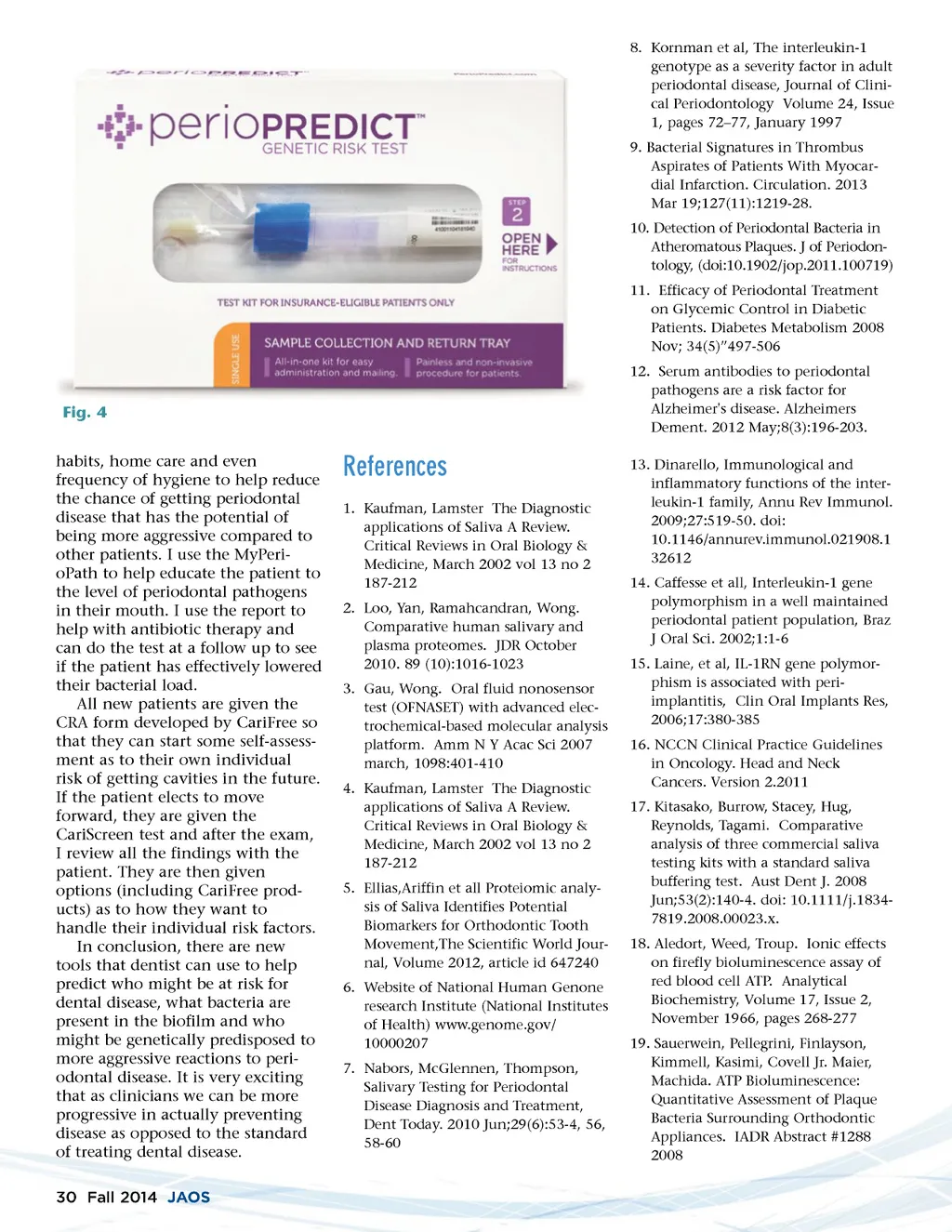
8. Kornman et al, The interleukin-1 genotype as a severity factor in adult periodontal disease, Journal of Clini-cal Periodontology Volume 24, Issue 1, pages 72–77, January 1997 9. Bacterial Signatures in Thrombus Aspirates of Patients With Myocar-dial Infarction. Circulation. 2013 Mar 19;127(11):1219-28. 10. Detection of Periodontal Bacteria in Atheromatous Plaques. J of Periodon-tology, (doi:10.1902/jop.2011.100719) 11. Efficacy of Periodontal Treatment on Glycemic Control in Diabetic Patients. Diabetes Metabolism 2008 Nov; 34(5)”497-506 12. Serum antibodies to periodontal pathogens are a risk factor for Alzheimer's disease. Alzheimers Dement. 2012 May;8(3):196-203. Fig. 4 habits, home care and even frequency of hygiene to help reduce the chance of getting periodontal disease that has the potential of being more aggressive compared to other patients. I use the MyPeri-oPath to help educate the patient to the level of periodontal pathogens in their mouth. I use the report to help with antibiotic therapy and can do the test at a follow up to see if the patient has effectively lowered their bacterial load. All new patients are given the CRA form developed by CariFree so that they can start some self-assess-ment as to their own individual risk of getting cavities in the future. If the patient elects to move forward, they are given the CariScreen test and after the exam, I review all the findings with the patient. They are then given options (including CariFree prod-ucts) as to how they want to handle their individual risk factors. In conclusion, there are new tools that dentist can use to help predict who might be at risk for dental disease, what bacteria are present in the biofilm and who might be genetically predisposed to more aggressive reactions to peri-odontal disease. It is very exciting that as clinicians we can be more progressive in actually preventing disease as opposed to the standard of treating dental disease. 30 Fall 2014 JAOS References 1. Kaufman, Lamster The Diagnostic applications of Saliva A Review. Critical Reviews in Oral Biology & Medicine, March 2002 vol 13 no 2 187-212 2. Loo, Yan, Ramahcandran, Wong. Comparative human salivary and plasma proteomes. JDR October 2010. 89 (10):1016-1023 3. Gau, Wong. Oral fluid nonosensor test (OFNASET) with advanced elec-trochemical-based molecular analysis platform. Amm N Y Acac Sci 2007 march, 1098:401-410 4. Kaufman, Lamster The Diagnostic applications of Saliva A Review. Critical Reviews in Oral Biology & Medicine, March 2002 vol 13 no 2 187-212 5. Ellias,Ariffin et all Proteiomic analy-sis of Saliva Identifies Potential Biomarkers for Orthodontic Tooth Movement,The Scientific World Jour-nal, Volume 2012, article id 647240 6. Website of National Human Genone research Institute (National Institutes of Health) www.genome.gov/ 10000207 7. Nabors, McGlennen, Thompson, Salivary Testing for Periodontal Disease Diagnosis and Treatment, Dent Today. 2010 Jun;29(6):53-4, 56, 58-60 13. Dinarello, Immunological and inflammatory functions of the inter-leukin-1 family, Annu Rev Immunol. 2009;27:519-50. doi: 10.1146/annurev.immunol.021908.1 32612 14. Caffesse et all, Interleukin-1 gene polymorphism in a well maintained periodontal patient population, Braz J Oral Sci. 2002;1:1-6 15. Laine, et al, IL-1RN gene polymor-phism is associated with peri-implantitis, Clin Oral Implants Res, 2006;17:380-385 16. NCCN Clinical Practice Guidelines in Oncology. Head and Neck Cancers. Version 2.2011 17. Kitasako, Burrow, Stacey, Hug, Reynolds, Tagami. Comparative analysis of three commercial saliva testing kits with a standard saliva buffering test. Aust Dent J. 2008 Jun;53(2):140-4. doi: 10.1111/j.1834-7819.2008.00023.x. 18. Aledort, Weed, Troup. Ionic effects on firefly bioluminescence assay of red blood cell ATP. Analytical Biochemistry, Volume 17, Issue 2, November 1966, pages 268-277 19. Sauerwein, Pellegrini, Finlayson, Kimmell, Kasimi, Covell Jr. Maier, Machida. ATP Bioluminescence: Quantitative Assessment of Plaque Bacteria Surrounding Orthodontic Appliances. IADR Abstract #1288 2008
Journal of the American Orthodontic Society Fall 2014: Page 30