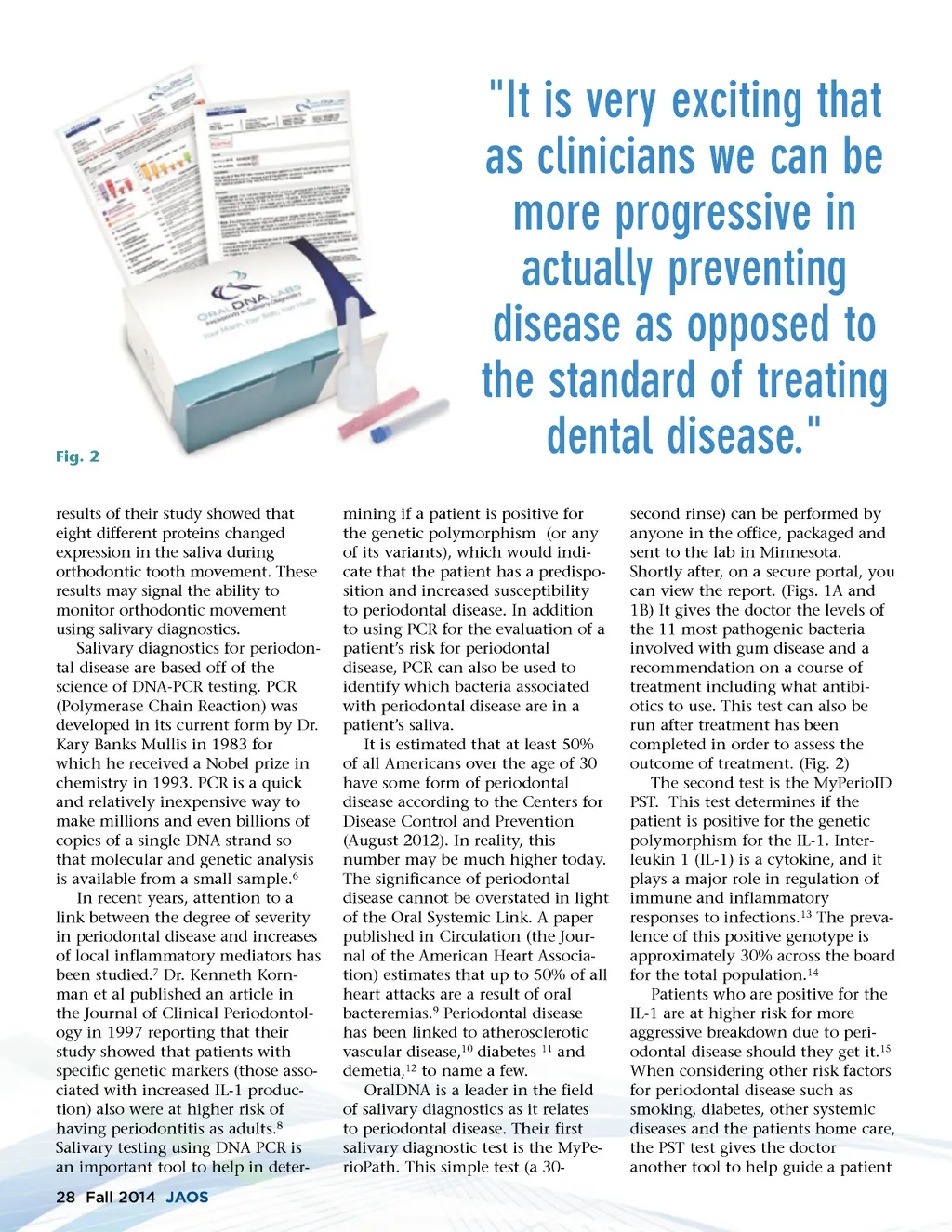
Fig. 2 "It is very exciting that as clinicians we can be more progressive in actually preventing disease as opposed to the standard of treating dental disease." mining if a patient is positive for the genetic polymorphism (or any of its variants), which would indi-cate that the patient has a predispo-sition and increased susceptibility to periodontal disease. In addition to using PCR for the evaluation of a patient’s risk for periodontal disease, PCR can also be used to identify which bacteria associated with periodontal disease are in a patient’s saliva. It is estimated that at least 50% of all Americans over the age of 30 have some form of periodontal disease according to the Centers for Disease Control and Prevention (August 2012). In reality, this number may be much higher today. The significance of periodontal disease cannot be overstated in light of the Oral Systemic Link. A paper published in Circulation (the Jour-nal of the American Heart Associa-tion) estimates that up to 50% of all heart attacks are a result of oral bacteremias. 9 Periodontal disease has been linked to atherosclerotic vascular disease, 10 diabetes 11 and demetia, 12 to name a few. OralDNA is a leader in the field of salivary diagnostics as it relates to periodontal disease. Their first salivary diagnostic test is the MyPe-rioPath. This simple test (a 30-second rinse) can be performed by anyone in the office, packaged and sent to the lab in Minnesota. Shortly after, on a secure portal, you can view the report. (Figs. 1A and 1B) It gives the doctor the levels of the 11 most pathogenic bacteria involved with gum disease and a recommendation on a course of treatment including what antibi-otics to use. This test can also be run after treatment has been completed in order to assess the outcome of treatment. (Fig. 2) The second test is the MyPerioID PST. This test determines if the patient is positive for the genetic polymorphism for the IL-1. Inter-leukin 1 (IL-1) is a cytokine, and it plays a major role in regulation of immune and inflammatory responses to infections. 13 The preva-lence of this positive genotype is approximately 30% across the board for the total population. 14 Patients who are positive for the IL-1 are at higher risk for more aggressive breakdown due to peri-odontal disease should they get it. 15 When considering other risk factors for periodontal disease such as smoking, diabetes, other systemic diseases and the patients home care, the PST test gives the doctor another tool to help guide a patient results of their study showed that eight different proteins changed expression in the saliva during orthodontic tooth movement. These results may signal the ability to monitor orthodontic movement using salivary diagnostics. Salivary diagnostics for periodon-tal disease are based off of the science of DNA-PCR testing. PCR (Polymerase Chain Reaction) was developed in its current form by Dr. Kary Banks Mullis in 1983 for which he received a Nobel prize in chemistry in 1993. PCR is a quick and relatively inexpensive way to make millions and even billions of copies of a single DNA strand so that molecular and genetic analysis is available from a small sample. 6 In recent years, attention to a link between the degree of severity in periodontal disease and increases of local inflammatory mediators has been studied. 7 Dr. Kenneth Korn-man et al published an article in the Journal of Clinical Periodontol-ogy in 1997 reporting that their study showed that patients with specific genetic markers (those asso-ciated with increased IL-1 produc-tion) also were at higher risk of having periodontitis as adults. 8 Salivary testing using DNA PCR is an important tool to help in deter-28 Fall 2014 JAOS
Journal of the American Orthodontic Society Fall 2014: Page 28