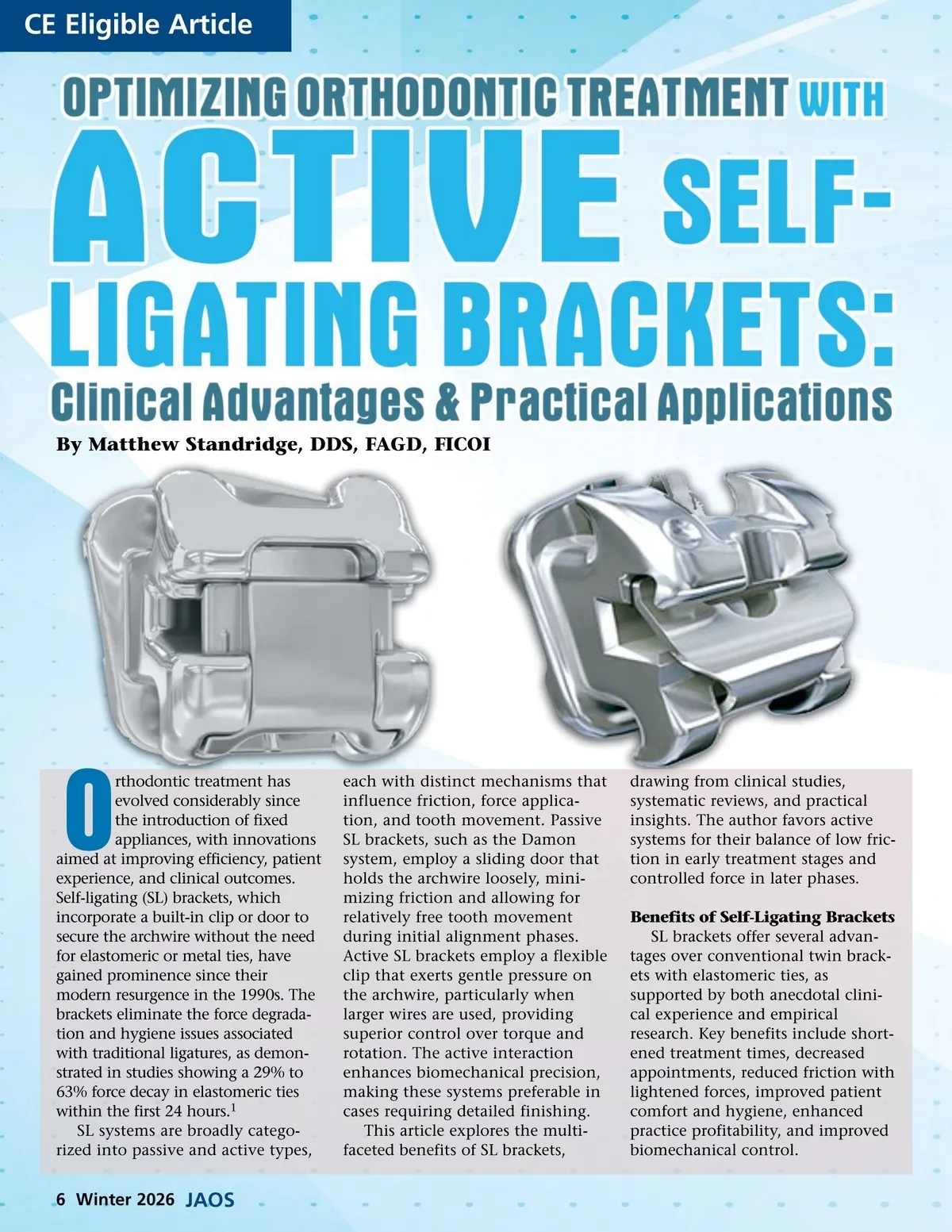
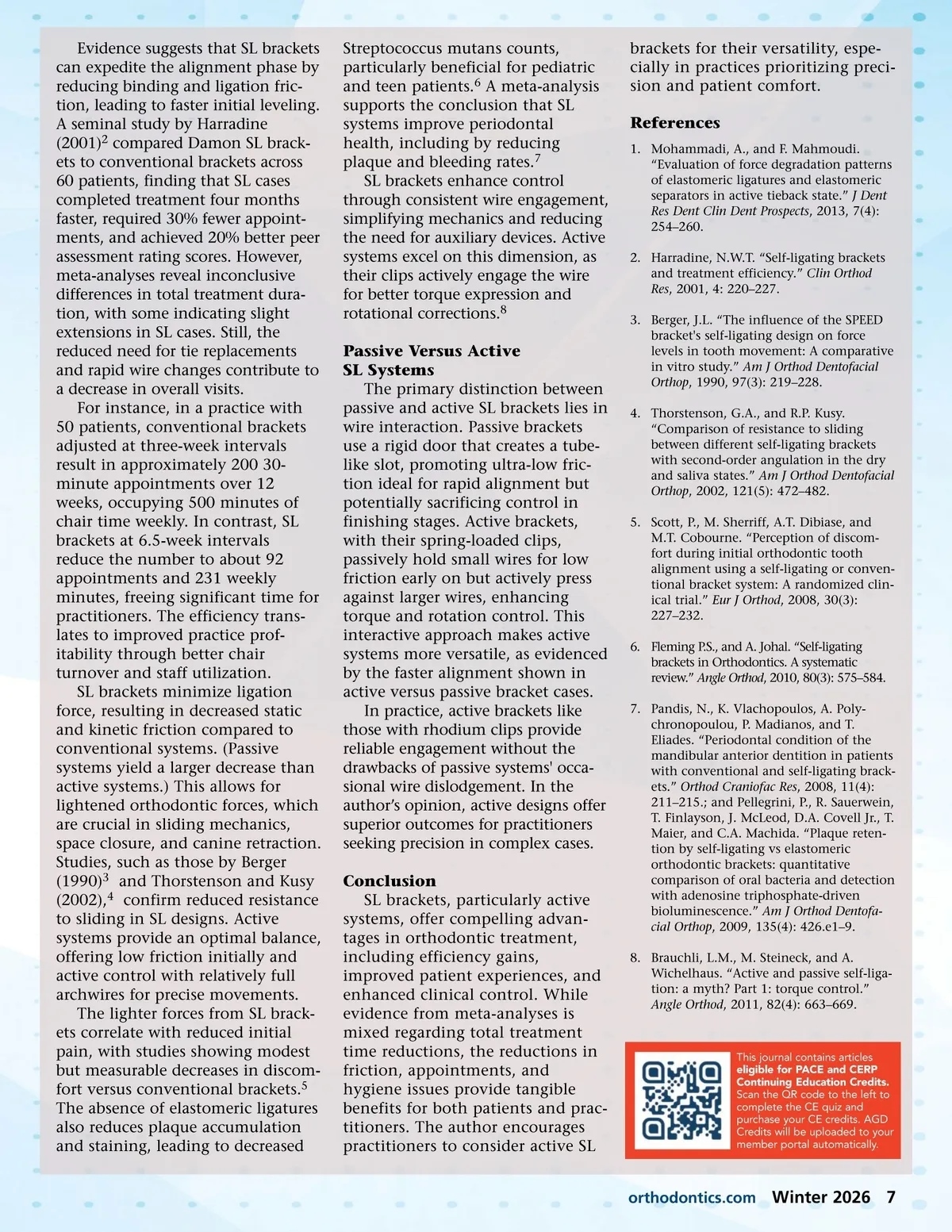
Evidence suggests that SL brackets can expedite the alignment phase by reducing binding and ligation fric-tion, leading to faster initial leveling. A seminal study by Harradine (2001) 2 compared Damon SL brack-ets to conventional brackets across 60 patients, finding that SL cases completed treatment four months faster, required 30% fewer appoint-ments, and achieved 20% better peer assessment rating scores. However, meta-analyses reveal inconclusive differences in total treatment dura-tion, with some indicating slight extensions in SL cases. Still, the reduced need for tie replacements and rapid wire changes contribute to a decrease in overall visits. For instance, in a practice with 50 patients, conventional brackets adjusted at three-week intervals result in approximately 200 30-minute appointments over 12 weeks, occupying 500 minutes of chair time weekly. In contrast, SL brackets at 6.5-week intervals reduce the number to about 92 appointments and 231 weekly minutes, freeing significant time for practitioners. The efficiency trans-lates to improved practice prof-itability through better chair turnover and staff utilization. SL brackets minimize ligation force, resulting in decreased static and kinetic friction compared to conventional systems. (Passive systems yield a larger decrease than active systems.) This allows for lightened orthodontic forces, which are crucial in sliding mechanics, space closure, and canine retraction. Studies, such as those by Berger (1990) 3 and Thorstenson and Kusy (2002), 4 confirm reduced resistance to sliding in SL designs. Active systems provide an optimal balance, offering low friction initially and active control with relatively full archwires for precise movements. The lighter forces from SL brack-ets correlate with reduced initial pain, with studies showing modest but measurable decreases in discom-fort versus conventional brackets. 5 The absence of elastomeric ligatures also reduces plaque accumulation and staining, leading to decreased Streptococcus mutans counts, particularly beneficial for pediatric and teen patients. 6 A meta-analysis supports the conclusion that SL systems improve periodontal health, including by reducing plaque and bleeding rates. 7 SL brackets enhance control through consistent wire engagement, simplifying mechanics and reducing the need for auxiliary devices. Active systems excel on this dimension, as their clips actively engage the wire for better torque expression and rotational corrections. 8 Passive Versus Active SL Systems The primary distinction between passive and active SL brackets lies in wire interaction. Passive brackets use a rigid door that creates a tube-like slot, promoting ultra-low fric-tion ideal for rapid alignment but potentially sacrificing control in finishing stages. Active brackets, with their spring-loaded clips, passively hold small wires for low friction early on but actively press against larger wires, enhancing torque and rotation control. This interactive approach makes active systems more versatile, as evidenced by the faster alignment shown in active versus passive bracket cases. In practice, active brackets like those with rhodium clips provide reliable engagement without the drawbacks of passive systems' occa-sional wire dislodgement. In the author’s opinion, active designs offer superior outcomes for practitioners seeking precision in complex cases. Conclusion SL brackets, particularly active systems, offer compelling advan-tages in orthodontic treatment, including efficiency gains, improved patient experiences, and enhanced clinical control. While evidence from meta-analyses is mixed regarding total treatment time reductions, the reductions in friction, appointments, and hygiene issues provide tangible benefits for both patients and prac-titioners. The author encourages practitioners to consider active SL brackets for their versatility, espe-cially in practices prioritizing preci-sion and patient comfort. References 1. Mohammadi, A., and F. Mahmoudi. “Evaluation of force degradation patterns of elastomeric ligatures and elastomeric separators in active tieback state.” J Dent Res Dent Clin Dent Prospects , 2013, 7(4): 254–260. 2. Harradine, N.W.T. “Self-ligating brackets and treatment efficiency.” Clin Orthod Res , 2001, 4: 220–227. 3. Berger, J.L. “The influence of the SPEED bracket's self-ligating design on force levels in tooth movement: A comparative in vitro study.” Am J Orthod Dentofacial Orthop , 1990, 97(3): 219–228. 4. Thorstenson, G.A., and R.P. Kusy. “Comparison of resistance to sliding between different self-ligating brackets with second-order angulation in the dry and saliva states.” Am J Orthod Dentofacial Orthop , 2002, 121(5): 472–482. 5. Scott, P., M. Sherriff, A.T. Dibiase, and M.T. Cobourne. “Perception of discom-fort during initial orthodontic tooth alignment using a self-ligating or conven-tional bracket system: A randomized clin-ical trial.” Eur J Orthod , 2008, 30(3): 227–232. 6. Fleming P.S., and A. Johal. “Self-ligating brackets in Orthodontics. A systematic review.” Angle Orthod , 2010, 80(3): 575–584. 7. Pandis, N., K. Vlachopoulos, A. Poly-chronopoulou, P. Madianos, and T. Eliades. “Periodontal condition of the mandibular anterior dentition in patients with conventional and self-ligating brack-ets.” Orthod Craniofac Res , 2008, 11(4): 211–215.; and Pellegrini, P., R. Sauerwein, T. Finlayson, J. McLeod, D.A. Covell Jr., T. Maier, and C.A. Machida. “Plaque reten-tion by self-ligating vs elastomeric orthodontic brackets: quantitative comparison of oral bacteria and detection with adenosine triphosphate-driven bioluminescence.” Am J Orthod Dentofa-cial Orthop , 2009, 135(4): 426.e1–9. 8. Brauchli, L.M., M. Steineck, and A. Wichelhaus. “Active and passive self-liga-tion: a myth? Part 1: torque control.” Angle Orthod , 2011, 82(4): 663–669. This journal contains articles eligible for PACE and CERP Continuing Education Credits. Scan the QR code to the left to complete the CE quiz and purchase your CE credits. AGD Credits will be uploaded to your member portal automatically. orthodontics.com Winter 2026 7
Journal of the American Orthodontic Society Winter 2026: Page 7