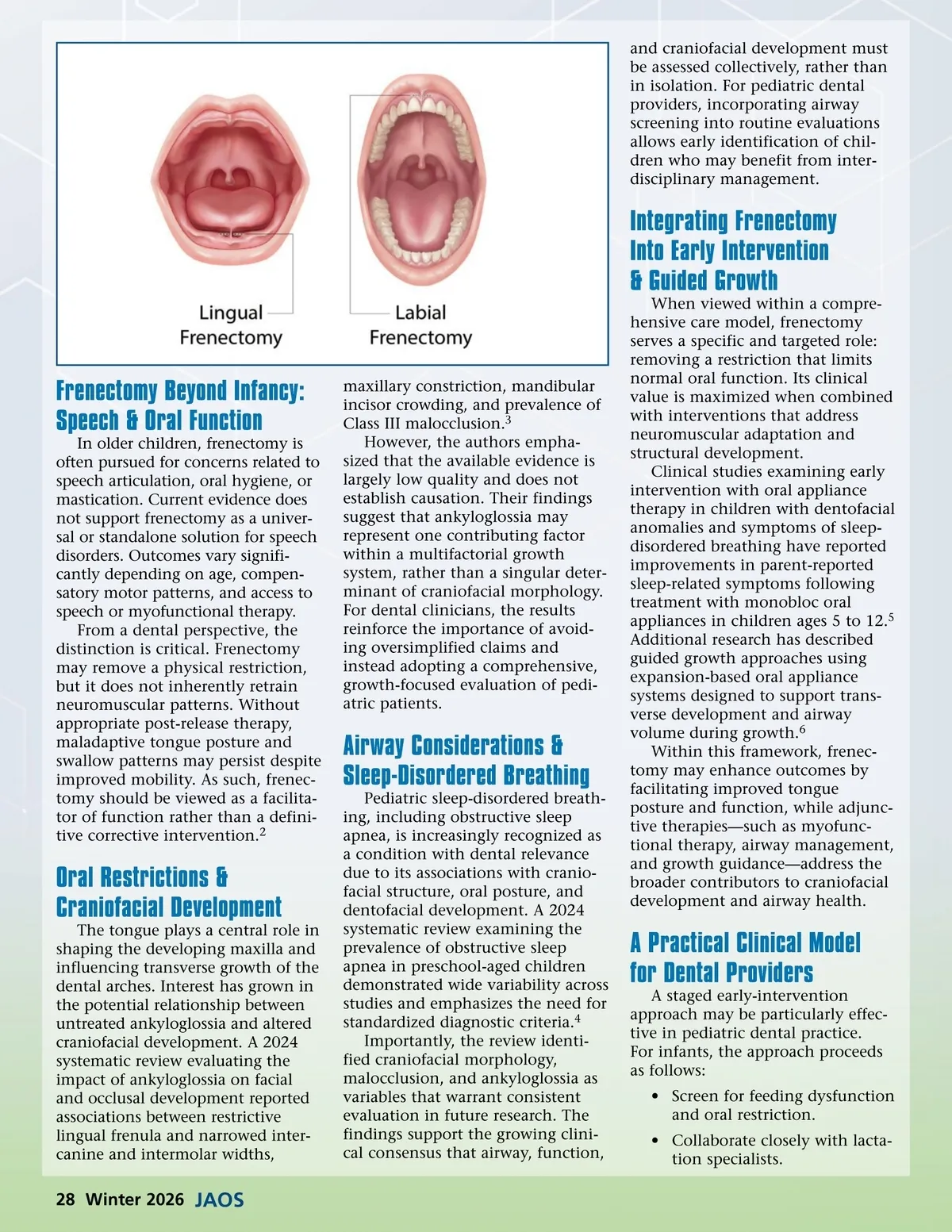
• Consider frenectomy only when functional limitations persist despite conservative care. 7 For toddlers and preschool-aged children, practitioners should: • Evaluate oral posture, breath-ing patterns, and early occlusal development. • Screen for airway symptoms and coordinate medical refer-ral when indicated. • Pair frenectomy with appro-priate functional therapy. 8 Finally, practitioners should use the following approach for school-aged children: • Assess dentofacial develop-ment, airway risk, and neuro-muscular patterns. • Consider guided growth, oral appliance therapy, and inter-disciplinary care for children with documented anomalies and symptoms. 9 advanced education remains essen-tial. Specialized training is available that focuses on frenectomy evalua-tion, clinical decision making, and procedural execution within a comprehensive pediatric framework. Clinicians seeking to expand their expertise in frenectomy releases and early growth and development are encouraged to explore the available continuing education. References 1. Thomas, J.; Bunik, M.; Holmes, A.; et al.: Identification and management of anky-loglossia and its effect on breastfeeding in infants: Clinical report. Pediatrics 154:e2024067605, Aug. 2024. 2. American Academy of Pediatric Dentistry: Management of the frenulum in pediatric patients. Ref Manual Pediatr Dent 2024– 2025:80–86, 2025. 3. Kotarska, M.; W ą dołowska, A.; Sarul, M.; Kawala, B.; Lis, J.: Does ankyloglossia surgery promote normal facial develop-ment? A systematic review. J Clin Med 14:81, Dec. 2024. 4.Magnusdottir, S.; Hill, E.A.: Prevalence of obstructive sleep apnea among preschool-aged children in the general population: A systematic review. Sleep Med Rev 73:101871, Feb. 2024. 5. Davidson, K.P.; Dixon, C.; Wilde, Z.; Hart, T.: Effectiveness of early intervention with a monobloc oral appliance in reduc-ing symptoms of breathing disorders at sleep in children with dentofacial anoma-lies ages 5–12. J Sleep Disord Ther 12:446, Jun. 2023. 6. Davidson, K.P.; Paracha, H.: Oral appli-ance therapy in children. Eur J Pediatr 184:424–424, 2025. 7. Paracha, H.; Davidson, K.P.; Dixon, C.; Wilde, Z.: A novel intervention to simul-taneously address breathing disorders during sleep and attention deficit hyper-activity disorder in school-aged children. J Atten Disord 28:293–301, Feb. 2024. 8. Davidson, K.P.: The association of noctur-nal enuresis and breathing disorders in children treated with a monobloc oral appliance. J Sleep Disord Ther 11:1000359, Jan. 2022. 9. Magnusdottir; Davidson, et al.; Davidson and Paracha; Paracha; Davidson. Conclusion Frenectomy releases in infants and children can be effective when performed for clearly defined func-tional indications and integrated into a broad early-intervention strategy. Current evidence supports their role in improving feeding outcomes in symptomatic infants and suggests a potential association between untreated oral restrictions and altered craniofacial develop-ment. However, frenectomy alone is unlikely to normalize growth or airway function. For dental professionals, the most responsible and effective approach prioritizes functional assessment, incorporates airway screening, and uses guided growth interventions judiciously. When frenectomy is combined with appropriate therapy, interdisci-plinary collaboration, and growth guidance when indicated, clinicians are better positioned to support healthy craniofacial development and long-term pediatric outcomes. As clinical interest in frenectomy procedures and early airway-focused intervention continues to grow, orthodontics.com Winter 2026 29
Journal of the American Orthodontic Society Winter 2026: Page 29