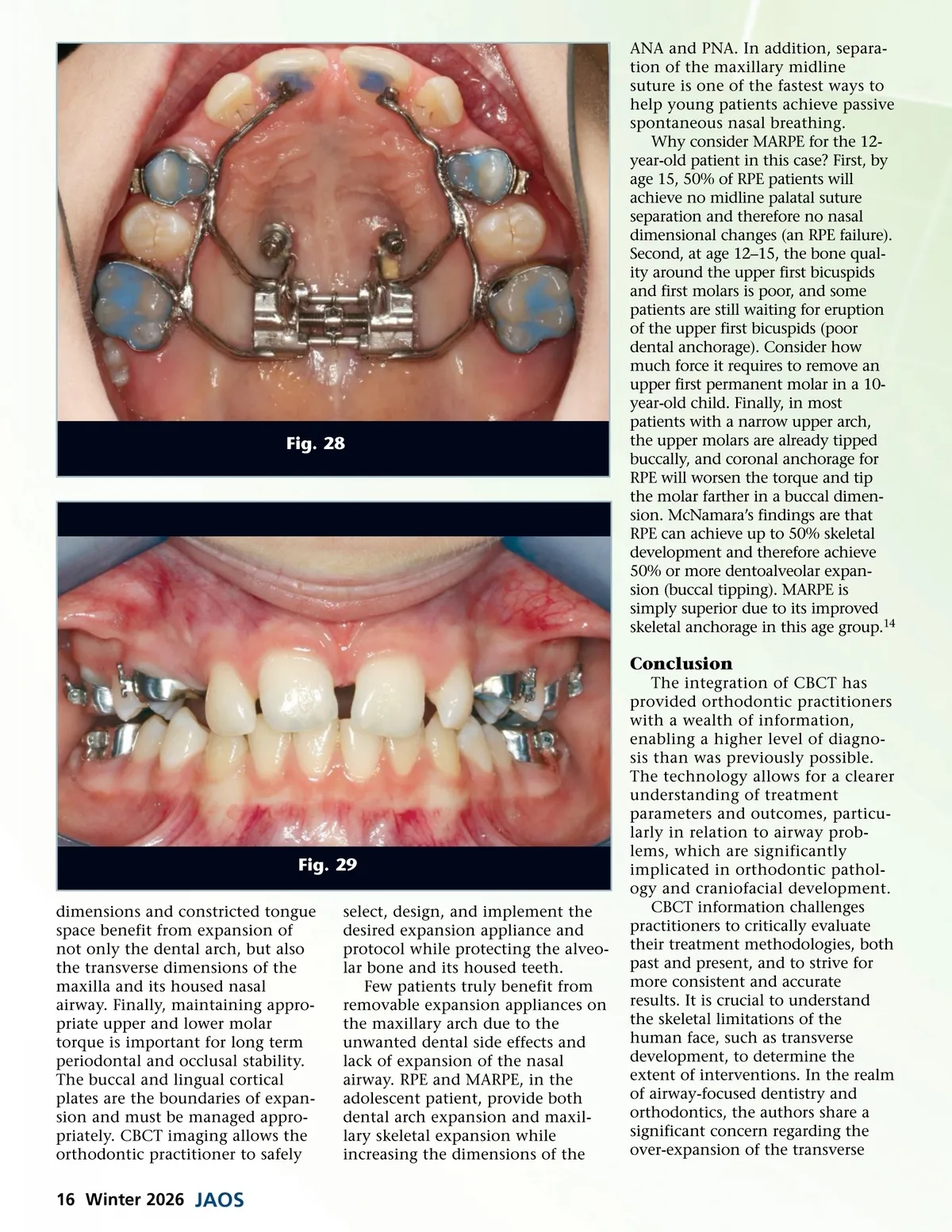
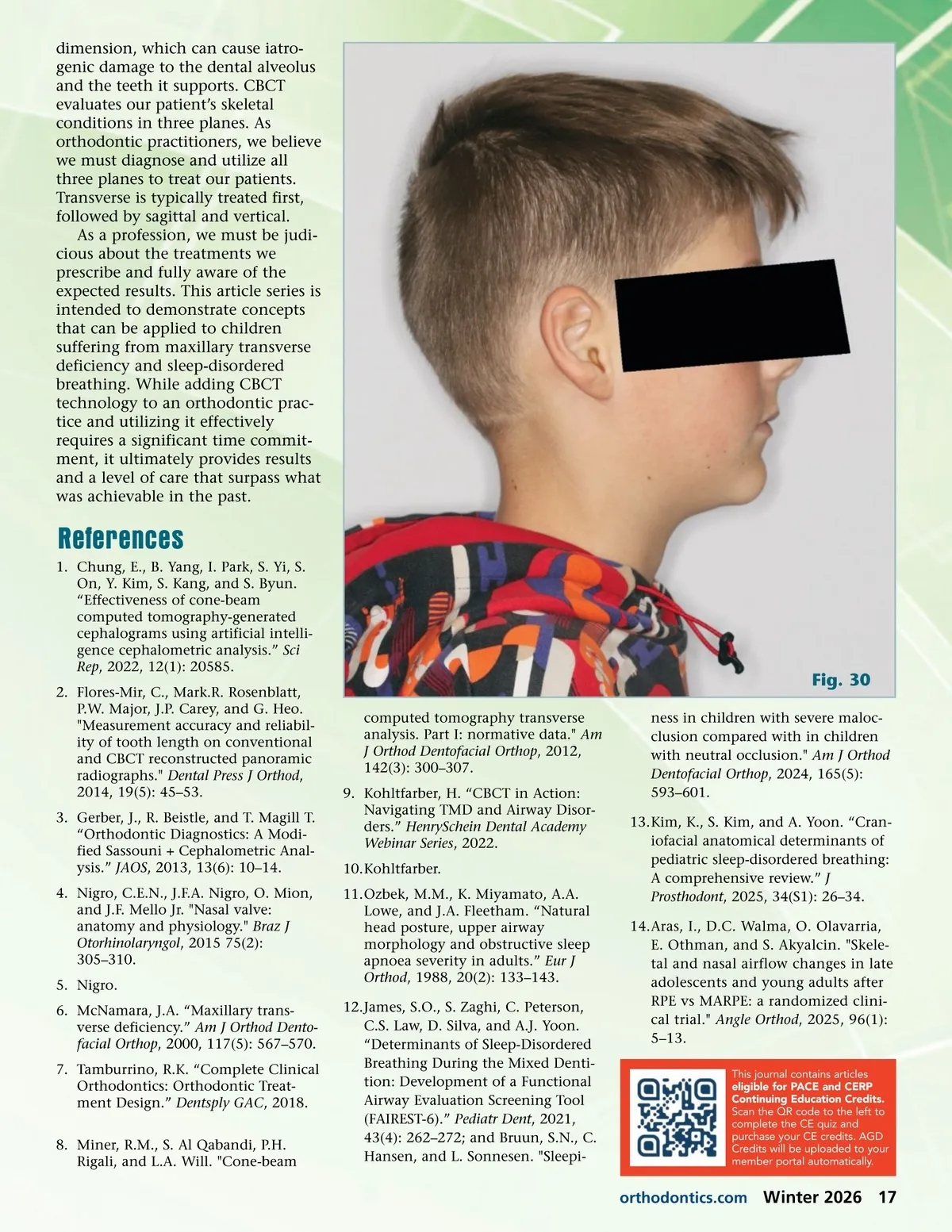
dimension, which can cause iatro-genic damage to the dental alveolus and the teeth it supports. CBCT evaluates our patient’s skeletal conditions in three planes. As orthodontic practitioners, we believe we must diagnose and utilize all three planes to treat our patients. Transverse is typically treated first, followed by sagittal and vertical. As a profession, we must be judi-cious about the treatments we prescribe and fully aware of the expected results. This article series is intended to demonstrate concepts that can be applied to children suffering from maxillary transverse deficiency and sleep-disordered breathing. While adding CBCT technology to an orthodontic prac-tice and utilizing it effectively requires a significant time commit-ment, it ultimately provides results and a level of care that surpass what was achievable in the past. References 1. Chung, E., B. Yang, I. Park, S. Yi, S. On, Y. Kim, S. Kang, and S. Byun. “Effectiveness of cone-beam computed tomography-generated cephalograms using artificial intelli-gence cephalometric analysis.” Sci Rep , 2022, 12(1): 20585. 2. Flores-Mir, C., Mark.R. Rosenblatt, P.W. Major, J.P. Carey, and G. Heo. "Measurement accuracy and reliabil-ity of tooth length on conventional and CBCT reconstructed panoramic radiographs." Dental Press J Orthod , 2014, 19(5): 45–53. 3. Gerber, J., R. Beistle, and T. Magill T. “Orthodontic Diagnostics: A Modi-fied Sassouni + Cephalometric Anal-ysis.” JAOS , 2013, 13(6): 10–14. 4. Nigro, C.E.N., J.F.A. Nigro, O. Mion, and J.F. Mello Jr. "Nasal valve: anatomy and physiology." Braz J Otorhinolaryngol , 2015 75(2): 305–310. 5. Nigro. 6. McNamara, J.A. “Maxillary trans-verse deficiency.” Am J Orthod Dento-facial Orthop , 2000, 117(5): 567–570. 7. Tamburrino, R.K. “Complete Clinical Orthodontics: Orthodontic Treat-ment Design.” Dentsply GAC , 2018. 8. Miner, R.M., S. Al Qabandi, P.H. Rigali, and L.A. Will. "Cone-beam Fig. 30 computed tomography transverse analysis. Part I: normative data." Am J Orthod Dentofacial Orthop , 2012, 142(3): 300–307. 9. Kohltfarber, H. “CBCT in Action: Navigating TMD and Airway Disor-ders.” HenrySchein Dental Academy Webinar Series , 2022. 10.Kohltfarber. 11.Ozbek, M.M., K. Miyamato, A.A. Lowe, and J.A. Fleetham. “Natural head posture, upper airway morphology and obstructive sleep apnoea severity in adults.” Eur J Orthod , 1988, 20(2): 133–143. 12.James, S.O., S. Zaghi, C. Peterson, C.S. Law, D. Silva, and A.J. Yoon. “Determinants of Sleep-Disordered Breathing During the Mixed Denti-tion: Development of a Functional Airway Evaluation Screening Tool (FAIREST-6).” Pediatr Dent , 2021, 43(4): 262–272; and Bruun, S.N., C. Hansen, and L. Sonnesen. "Sleepi-ness in children with severe maloc-clusion compared with in children with neutral occlusion." Am J Orthod Dentofacial Orthop , 2024, 165(5): 593–601. 13.Kim, K., S. Kim, and A. Yoon. “Cran-iofacial anatomical determinants of pediatric sleep-disordered breathing: A comprehensive review.” J Prosthodont , 2025, 34(S1): 26–34. 14.Aras, I., D.C. Walma, O. Olavarria, E. Othman, and S. Akyalcin. "Skele-tal and nasal airflow changes in late adolescents and young adults after RPE vs MARPE: a randomized clini-cal trial." Angle Orthod , 2025, 96(1): 5–13. This journal contains articles eligible for PACE and CERP Continuing Education Credits. Scan the QR code to the left to complete the CE quiz and purchase your CE credits. AGD Credits will be uploaded to your member portal automatically. orthodontics.com Winter 2026 17
Journal of the American Orthodontic Society Winter 2026: Page 17