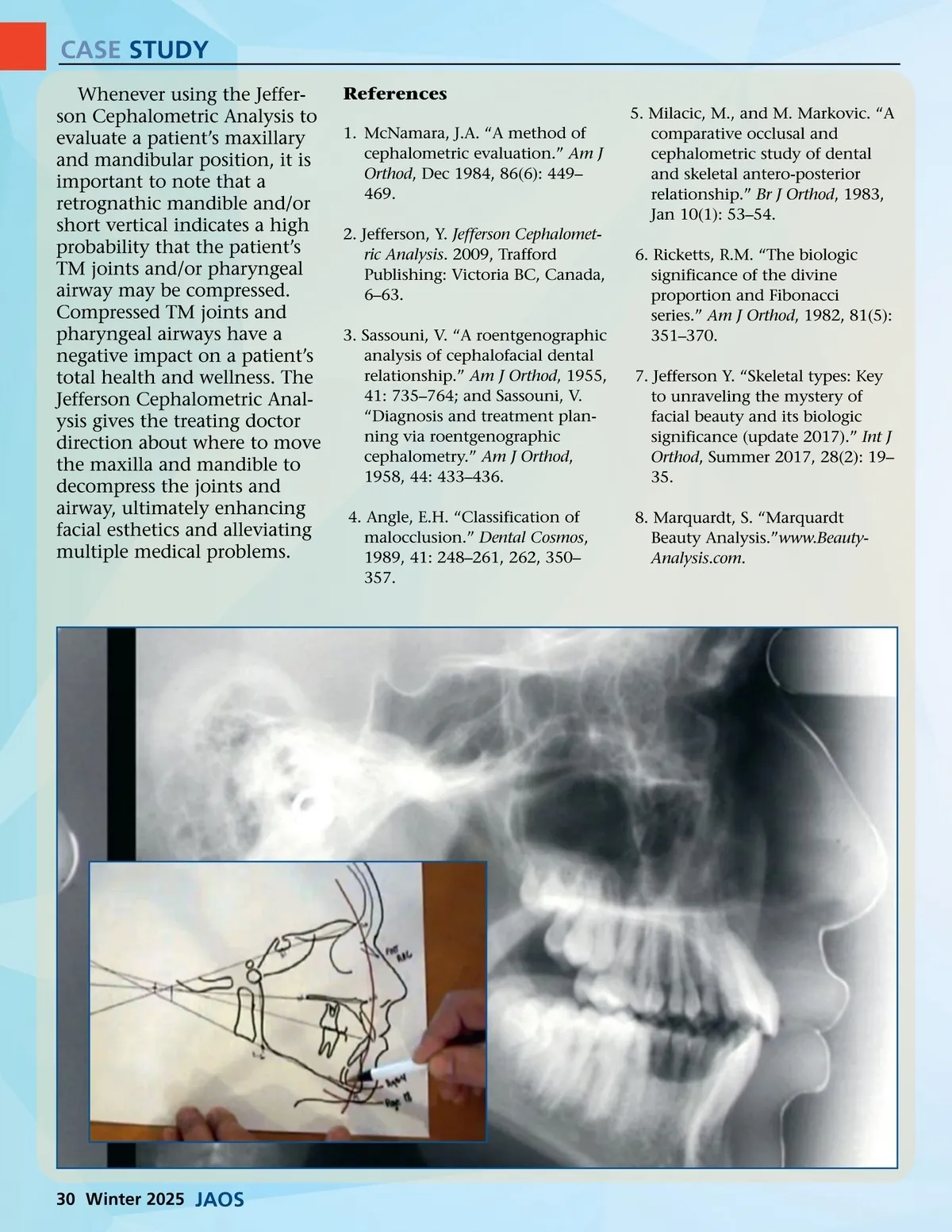
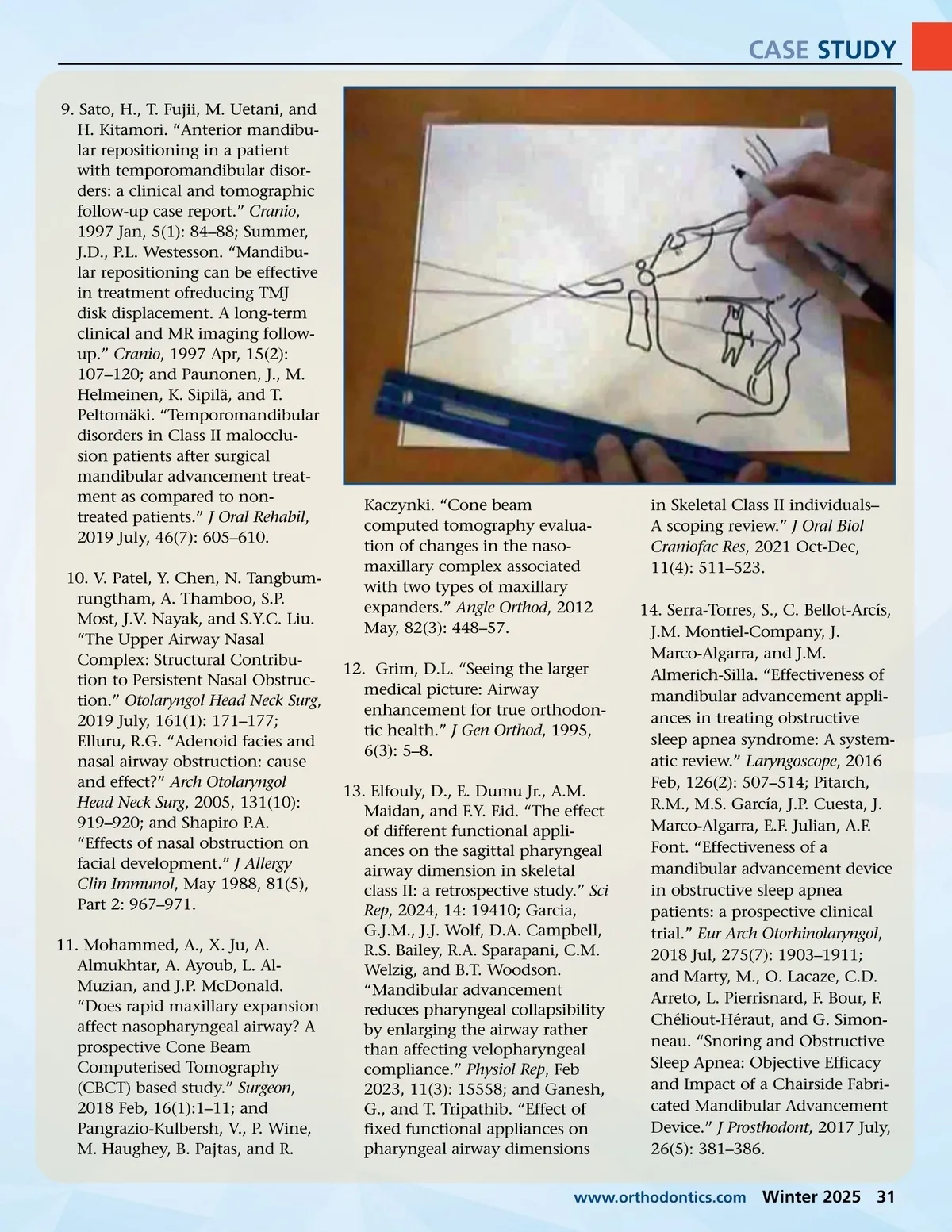
CASE STUDY Whenever using the Jeffer-son Cephalometric Analysis to evaluate a patient’s maxillary and mandibular position, it is important to note that a retrognathic mandible and/or short vertical indicates a high probability that the patient’s TM joints and/or pharyngeal airway may be compressed. Compressed TM joints and pharyngeal airways have a negative impact on a patient’s total health and wellness. The Jefferson Cephalometric Anal-ysis gives the treating doctor direction about where to move the maxilla and mandible to decompress the joints and airway, ultimately enhancing facial esthetics and alleviating multiple medical problems. References 1. McNamara, J.A. “A method of cephalometric evaluation.” Am J Orthod , Dec 1984, 86(6): 449– 469. 2. Jefferson, Y. Jefferson Cephalomet-ric Analysis . 2009, Trafford Publishing: Victoria BC, Canada, 6–63. 3. Sassouni, V. “A roentgenographic analysis of cephalofacial dental relationship.” Am J Orthod , 1955, 41: 735–764; and Sassouni, V. “Diagnosis and treatment plan-ning via roentgenographic cephalometry.” Am J Orthod , 1958, 44: 433–436. 4. Angle, E.H. “Classification of malocclusion.” Dental Cosmos , 1989, 41: 248–261, 262, 350– 357. 5. Milacic, M., and M. Markovic. “A comparative occlusal and cephalometric study of dental and skeletal antero-posterior relationship.” Br J Orthod , 1983, Jan 10(1): 53–54. 6. Ricketts, R.M. “The biologic significance of the divine proportion and Fibonacci series.” Am J Orthod , 1982, 81(5): 351–370. 7. Jefferson Y. “Skeletal types: Key to unraveling the mystery of facial beauty and its biologic significance (update 2017).” Int J Orthod , Summer 2017, 28(2): 19– 35. 8. Marquardt, S. “Marquardt Beauty Analysis.” www.Beauty-Analysis.com. 30 Winter 2025 JAOS
Journal of the American Orthodontic Society Winter 2025: Page 30