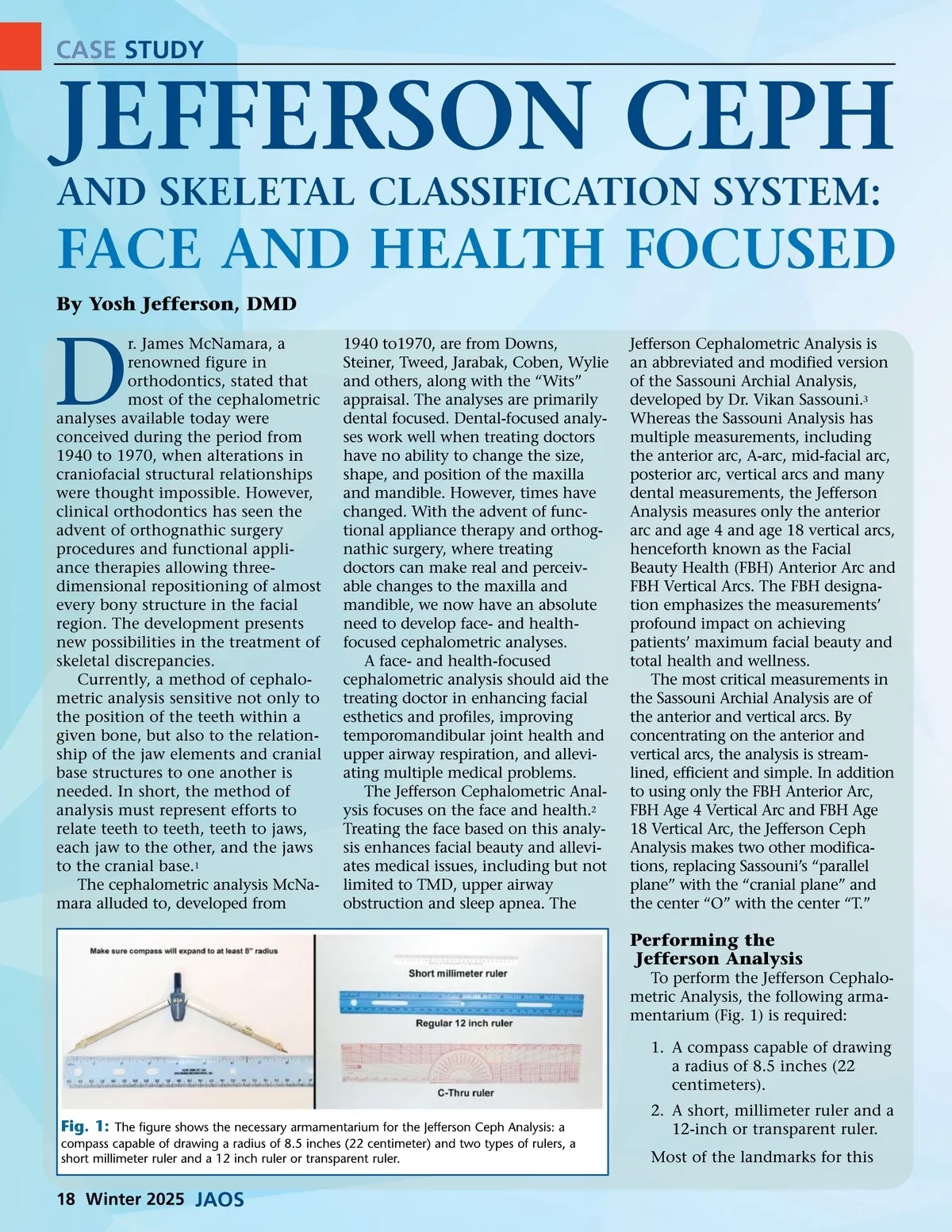
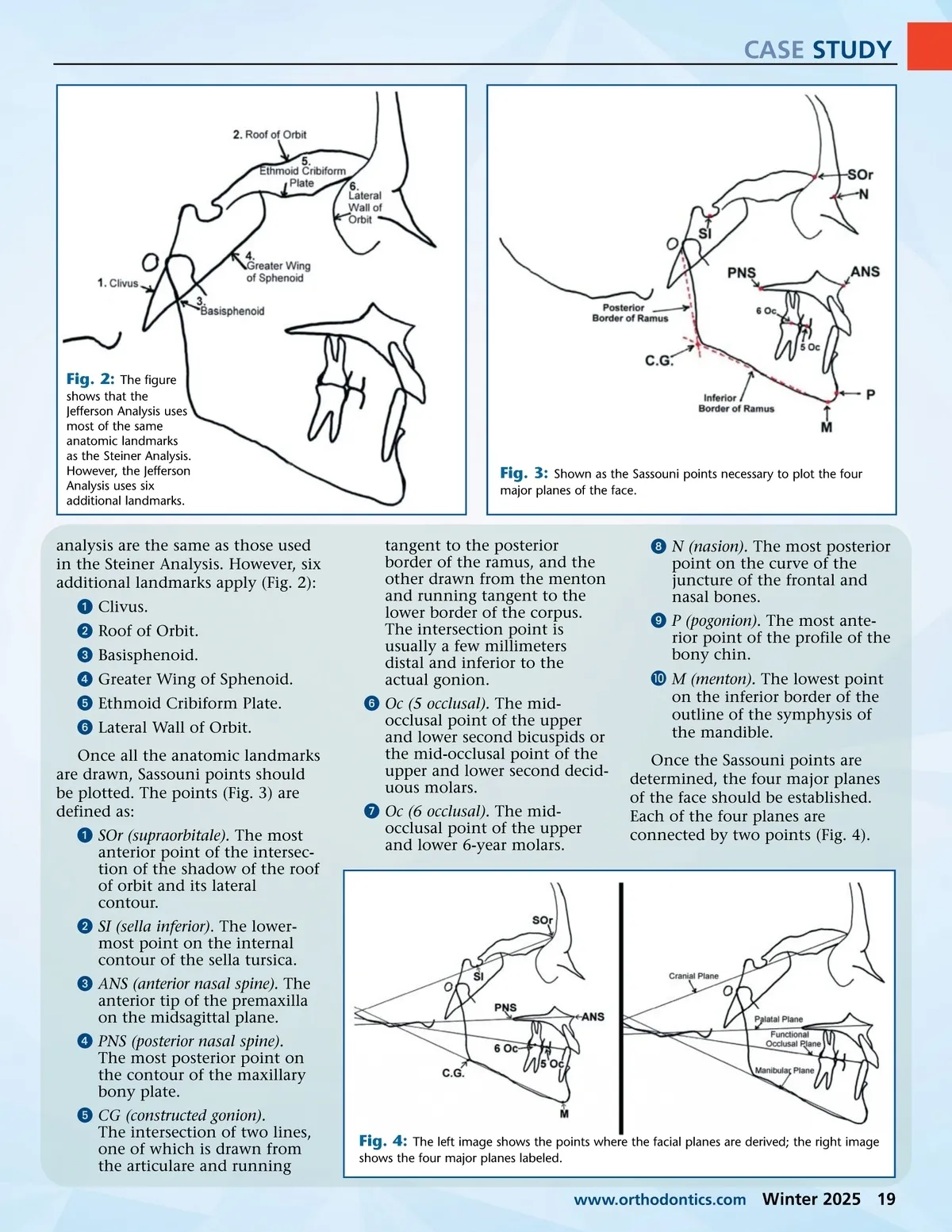
CASE STUDY JEFFERSON CEPH AND SKELETAL CLASSIFICATION SYSTEM: FACE AND HEALTH FOCUSED By Yosh Jefferson, DMD D r. James McNamara, a renowned figure in orthodontics, stated that most of the cephalometric analyses available today were conceived during the period from 1940 to 1970, when alterations in craniofacial structural relationships were thought impossible. However, clinical orthodontics has seen the advent of orthognathic surgery procedures and functional appli-ance therapies allowing three-dimensional repositioning of almost every bony structure in the facial region. The development presents new possibilities in the treatment of skeletal discrepancies. Currently, a method of cephalo-metric analysis sensitive not only to the position of the teeth within a given bone, but also to the relation-ship of the jaw elements and cranial base structures to one another is needed. In short, the method of analysis must represent efforts to relate teeth to teeth, teeth to jaws, each jaw to the other, and the jaws to the cranial base. 1 The cephalometric analysis McNa-mara alluded to, developed from 1940 to1970, are from Downs, Steiner, Tweed, Jarabak, Coben, Wylie and others, along with the “Wits” appraisal. The analyses are primarily dental focused. Dental-focused analy-ses work well when treating doctors have no ability to change the size, shape, and position of the maxilla and mandible. However, times have changed. With the advent of func-tional appliance therapy and orthog-nathic surgery, where treating doctors can make real and perceiv-able changes to the maxilla and mandible, we now have an absolute need to develop face-and health-focused cephalometric analyses. A face-and health-focused cephalometric analysis should aid the treating doctor in enhancing facial esthetics and profiles, improving temporomandibular joint health and upper airway respiration, and allevi-ating multiple medical problems. The Jefferson Cephalometric Anal-ysis focuses on the face and health. 2 Treating the face based on this analy-sis enhances facial beauty and allevi-ates medical issues, including but not limited to TMD, upper airway obstruction and sleep apnea. The Jefferson Cephalometric Analysis is an abbreviated and modified version of the Sassouni Archial Analysis, developed by Dr. Vikan Sassouni. 3 Whereas the Sassouni Analysis has multiple measurements, including the anterior arc, A-arc, mid-facial arc, posterior arc, vertical arcs and many dental measurements, the Jefferson Analysis measures only the anterior arc and age 4 and age 18 vertical arcs, henceforth known as the Facial Beauty Health (FBH) Anterior Arc and FBH Vertical Arcs. The FBH designa-tion emphasizes the measurements’ profound impact on achieving patients’ maximum facial beauty and total health and wellness. The most critical measurements in the Sassouni Archial Analysis are of the anterior and vertical arcs. By concentrating on the anterior and vertical arcs, the analysis is stream-lined, efficient and simple. In addition to using only the FBH Anterior Arc, FBH Age 4 Vertical Arc and FBH Age 18 Vertical Arc, the Jefferson Ceph Analysis makes two other modifica-tions, replacing Sassouni’s “parallel plane” with the “cranial plane” and the center “O” with the center “T.” Performing the Jefferson Analysis To perform the Jefferson Cephalo-metric Analysis, the following arma-mentarium (Fig. 1) is required: 1. A compass capable of drawing a radius of 8.5 inches (22 centimeters). Fig. 1: The figure shows the necessary armamentarium for the Jefferson Ceph Analysis: a compass capable of drawing a radius of 8.5 inches (22 centimeter) and two types of rulers, a short millimeter ruler and a 12 inch ruler or transparent ruler. 2. A short, millimeter ruler and a 12-inch or transparent ruler. Most of the landmarks for this 18 Winter 2025 JAOS
Journal of the American Orthodontic Society Winter 2025: Page 18