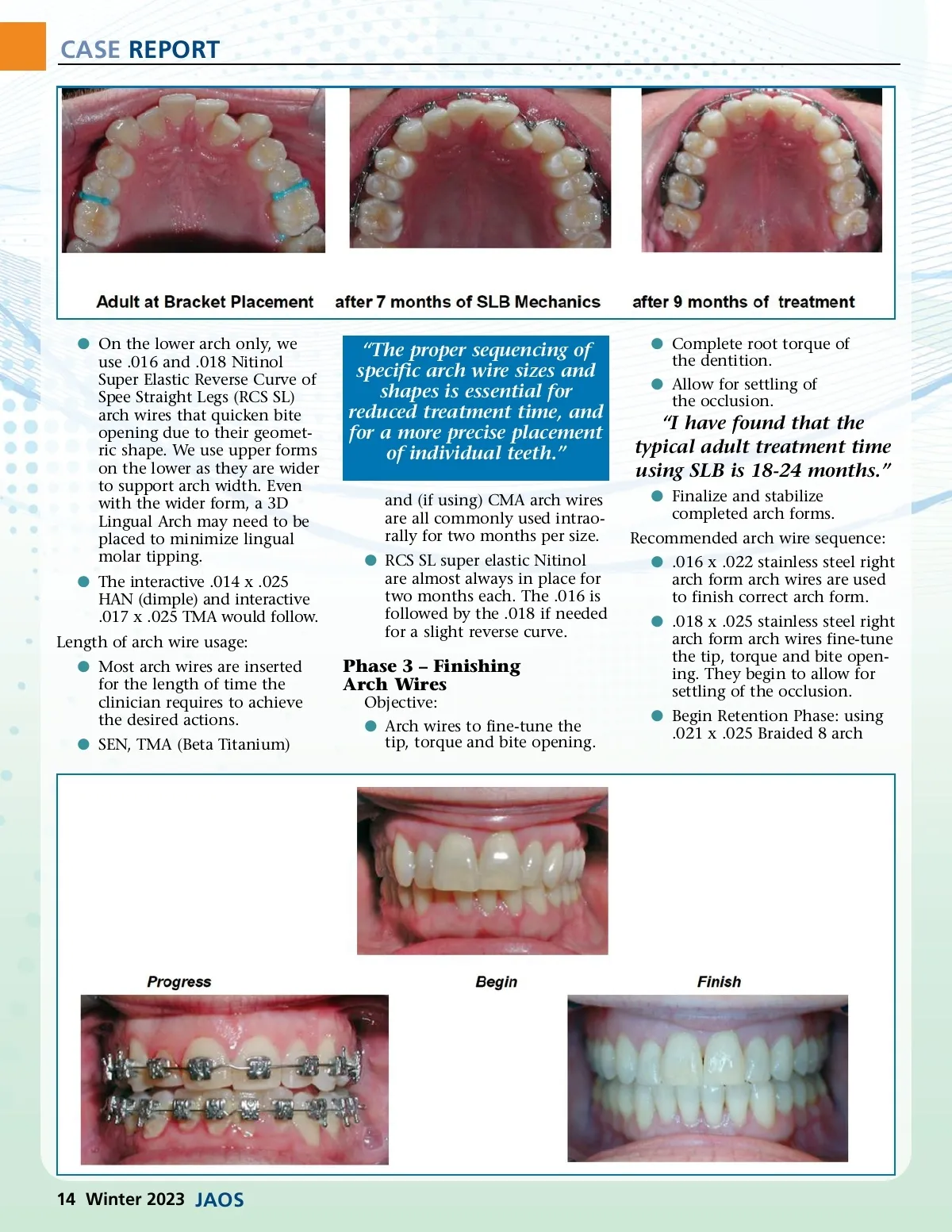
CASE REPORT b On the lower arch only, we use .016 and .018 Nitinol Super Elastic Reverse Curve of Spee Straight Legs (RCS SL) arch wires that quicken bite opening due to their geomet-ric shape. We use upper forms on the lower as they are wider to support arch width. Even with the wider form, a 3D Lingual Arch may need to be placed to minimize lingual molar tipping. b The interactive .014 x .025 HAN (dimple) and interactive .017 x .025 TMA would follow. Length of arch wire usage: b Most arch wires are inserted for the length of time the clinician requires to achieve the desired actions. b SEN, TMA (Beta Titanium) “The proper sequencing of specific arch wire sizes and shapes is essential for reduced treatment time, and for a more precise placement of individual teeth.” and (if using) CMA arch wires are all commonly used intrao-rally for two months per size. b RCS SL super elastic Nitinol are almost always in place for two months each. The .016 is followed by the .018 if needed for a slight reverse curve. b Complete root torque of the dentition. b Allow for settling of the occlusion. “I have found that the typical adult treatment time using SLB is 18-24 months.” b Finalize and stabilize completed arch forms. Recommended arch wire sequence: b .016 x .022 stainless steel right arch form arch wires are used to finish correct arch form. b .018 x .025 stainless steel right arch form arch wires fine-tune the tip, torque and bite open-ing. They begin to allow for settling of the occlusion. b Begin Retention Phase: using .021 x .025 Braided 8 arch Phase 3 – Finishing Arch Wires Objective: b Arch wires to fine-tune the tip, torque and bite opening. 14 Winter 2023 JAOS
Journal of the American Orthodontic Society Winter 2023: Page 14