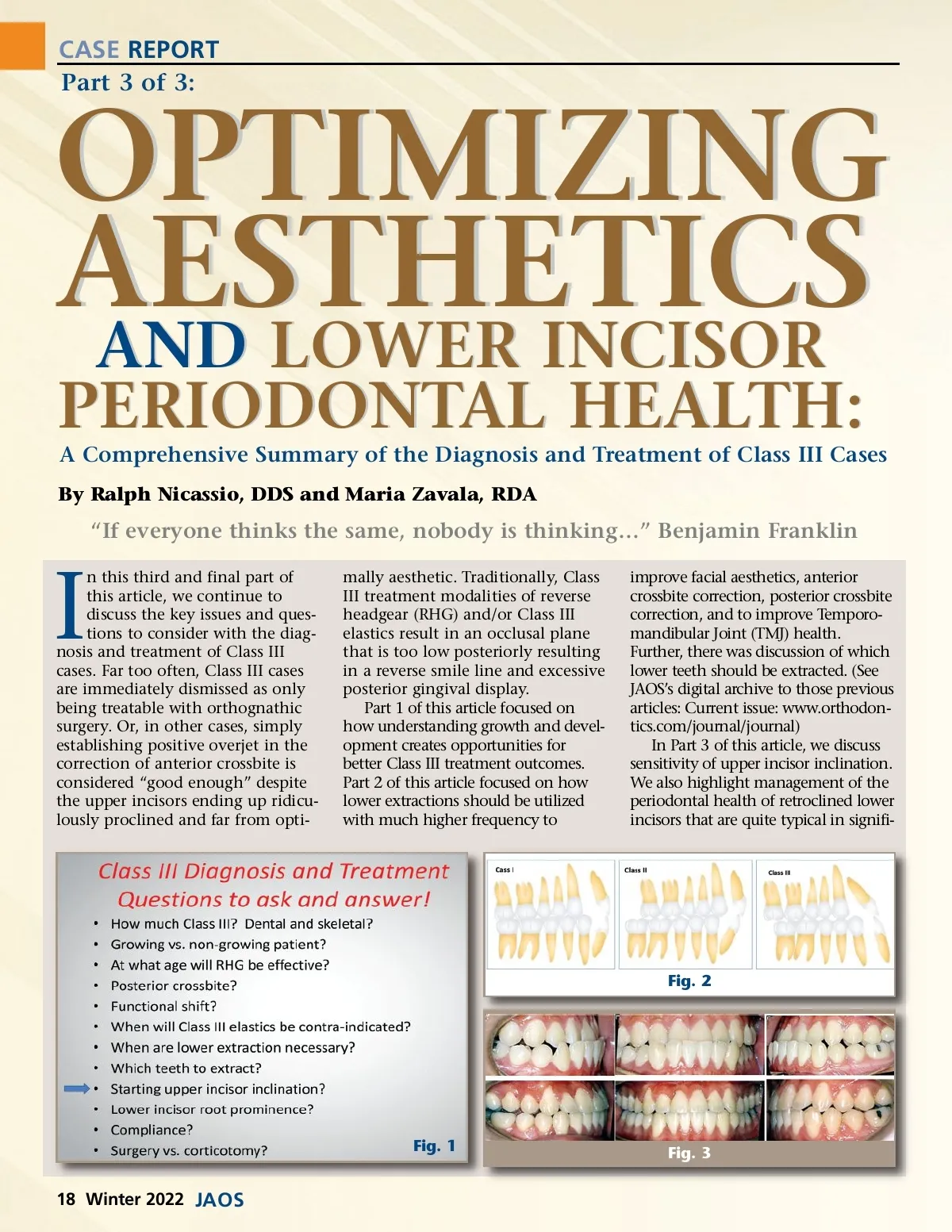
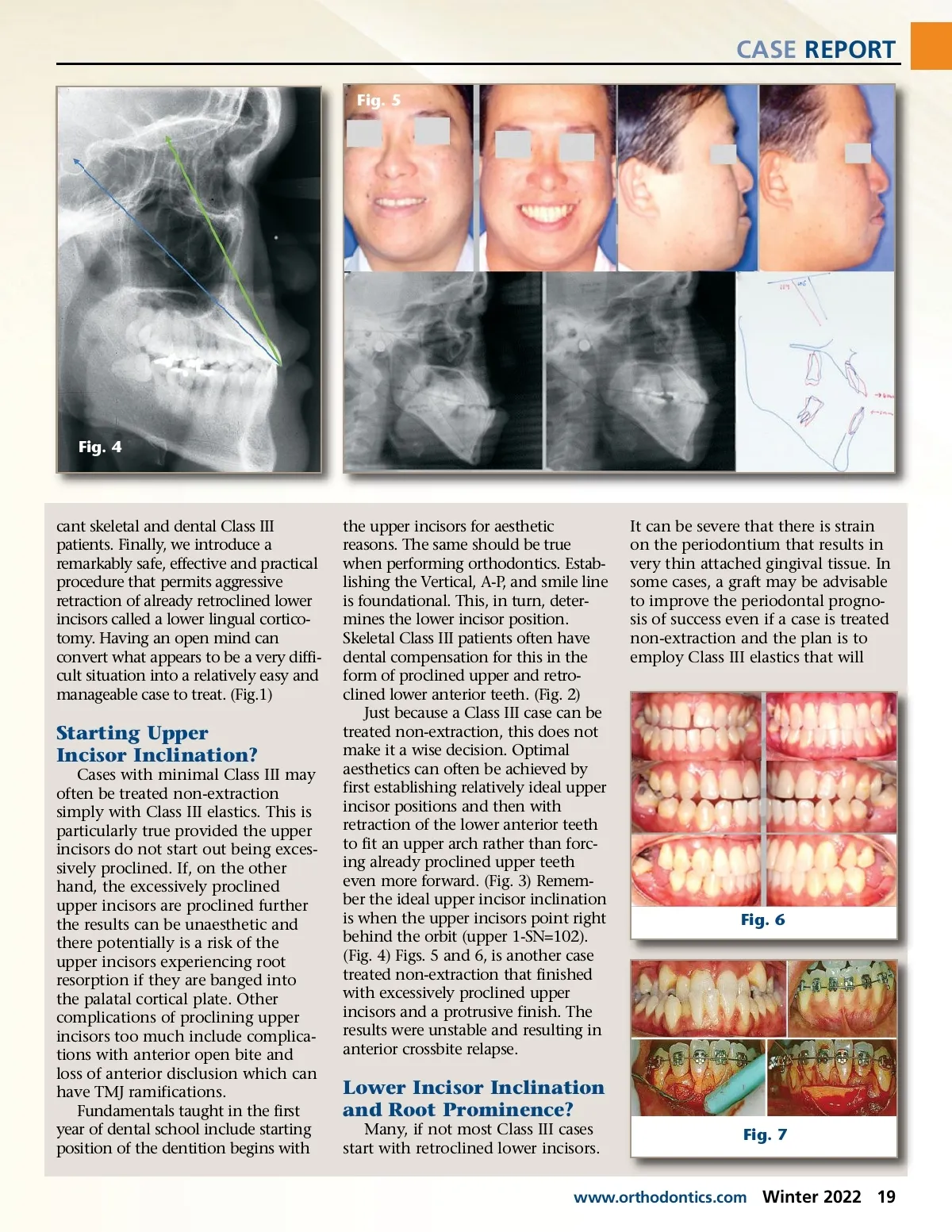
CASE REPORT Part 3 of 3: OPTIMIZING AESTHETICS AND LOWER INCISOR PERIODONTAL HEALTH: By Ralph Nicassio, DDS and Maria Zavala, RDA A Comprehensive Summary of the Diagnosis and Treatment of Class III Cases “If everyone thinks the same, nobody is thinking…” Benjamin Franklin I n this third and final part of this article, we continue to discuss the key issues and ques-tions to consider with the diag-nosis and treatment of Class III cases. Far too often, Class III cases are immediately dismissed as only being treatable with orthognathic surgery. Or, in other cases, simply establishing positive overjet in the correction of anterior crossbite is considered “good enough” despite the upper incisors ending up ridicu-lously proclined and far from opti-mally aesthetic. Traditionally, Class III treatment modalities of reverse headgear (RHG) and/or Class III elastics result in an occlusal plane that is too low posteriorly resulting in a reverse smile line and excessive posterior gingival display. Part 1 of this article focused on how understanding growth and devel-opment creates opportunities for better Class III treatment outcomes. Part 2 of this article focused on how lower extractions should be utilized with much higher frequency to improve facial aesthetics, anterior crossbite correction, posterior crossbite correction, and to improve Temporo-mandibular Joint (TMJ) health. Further, there was discussion of which lower teeth should be extracted. (See JAOS’s digital archive to those previous articles: Current issue: www.orthodon-tics.com/journal/journal) In Part 3 of this article, we discuss sensitivity of upper incisor inclination. We also highlight management of the periodontal health of retroclined lower incisors that are quite typical in signifi-Fig. 2 Fig. 1 Fig. 3 18 Winter 2022 JAOS
Journal of the American Orthodontic Society Winter 2022: Page 18