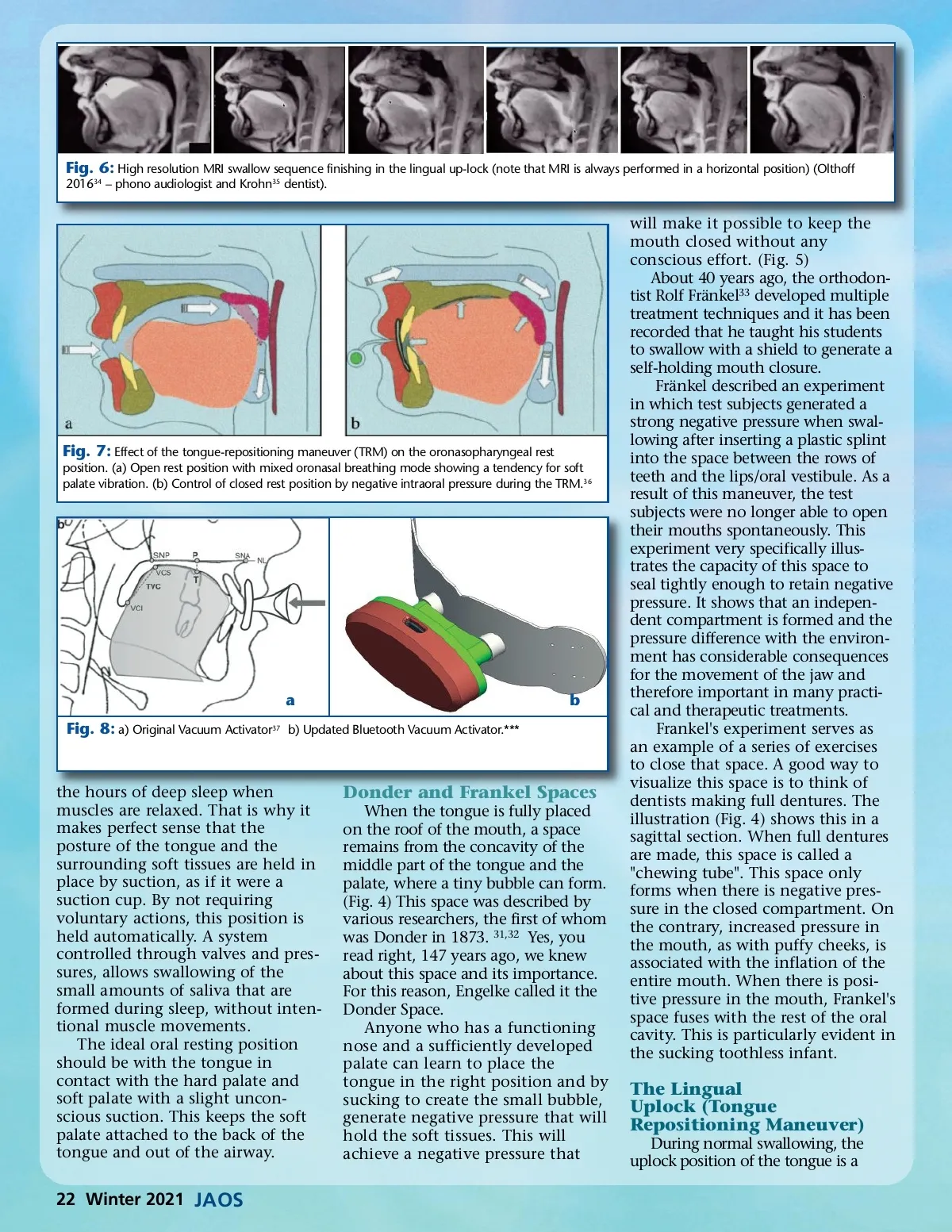
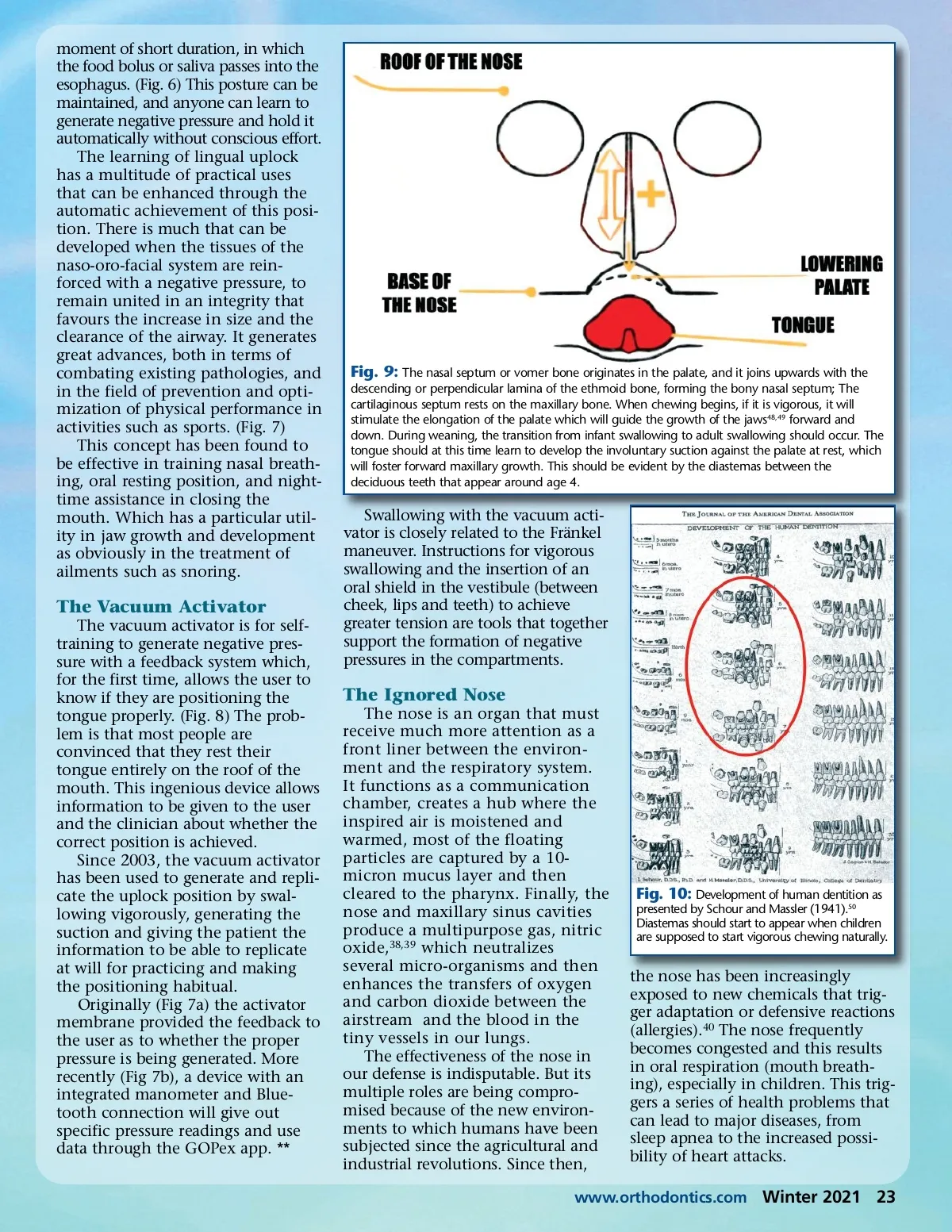
moment of short duration, in which the food bolus or saliva passes into the esophagus. (Fig. 6) This posture can be maintained, and anyone can learn to generate negative pressure and hold it automatically without conscious effort. The learning of lingual uplock has a multitude of practical uses that can be enhanced through the automatic achievement of this posi-tion. There is much that can be developed when the tissues of the naso-oro-facial system are rein-forced with a negative pressure, to remain united in an integrity that favours the increase in size and the clearance of the airway. It generates great advances, both in terms of combating existing pathologies, and in the field of prevention and opti-mization of physical performance in activities such as sports. (Fig. 7) This concept has been found to be effective in training nasal breath-ing, oral resting position, and night-time assistance in closing the mouth. Which has a particular util-ity in jaw growth and development as obviously in the treatment of ailments such as snoring. Fig. 9: The nasal septum or vomer bone originates in the palate, and it joins upwards with the descending or perpendicular lamina of the ethmoid bone, forming the bony nasal septum; The cartilaginous septum rests on the maxillary bone. When chewing begins, if it is vigorous, it will stimulate the elongation of the palate which will guide the growth of the jaws 48,49 forward and down. During weaning, the transition from infant swallowing to adult swallowing should occur. The tongue should at this time learn to develop the involuntary suction against the palate at rest, which will foster forward maxillary growth. This should be evident by the diastemas between the deciduous teeth that appear around age 4. Swallowing with the vacuum acti-vator is closely related to the Fränkel maneuver. Instructions for vigorous swallowing and the insertion of an oral shield in the vestibule (between cheek, lips and teeth) to achieve greater tension are tools that together support the formation of negative pressures in the compartments. The Vacuum Activator The vacuum activator is for self-training to generate negative pres-sure with a feedback system which, for the first time, allows the user to know if they are positioning the tongue properly. (Fig. 8) The prob-lem is that most people are convinced that they rest their tongue entirely on the roof of the mouth. This ingenious device allows information to be given to the user and the clinician about whether the correct position is achieved. Since 2003, the vacuum activator has been used to generate and repli-cate the uplock position by swal-lowing vigorously, generating the suction and giving the patient the information to be able to replicate at will for practicing and making the positioning habitual. Originally (Fig 7a) the activator membrane provided the feedback to the user as to whether the proper pressure is being generated. More recently (Fig 7b), a device with an integrated manometer and Blue-tooth connection will give out specific pressure readings and use data through the GOPex app. ** The Ignored Nose The nose is an organ that must receive much more attention as a front liner between the environ-ment and the respiratory system. It functions as a communication chamber, creates a hub where the inspired air is moistened and warmed, most of the floating particles are captured by a 10-micron mucus layer and then cleared to the pharynx. Finally, the nose and maxillary sinus cavities produce a multipurpose gas, nitric oxide, 38,39 which neutralizes several micro-organisms and then enhances the transfers of oxygen and carbon dioxide between the airstream and the blood in the tiny vessels in our lungs. The effectiveness of the nose in our defense is indisputable. But its multiple roles are being compro-mised because of the new environ-ments to which humans have been subjected since the agricultural and industrial revolutions. Since then, Fig. 10: Development of human dentition as presented by Schour and Massler (1941). 50 Diastemas should start to appear when children are supposed to start vigorous chewing naturally. the nose has been increasingly exposed to new chemicals that trig-ger adaptation or defensive reactions (allergies). 40 The nose frequently becomes congested and this results in oral respiration (mouth breath-ing), especially in children. This trig-gers a series of health problems that can lead to major diseases, from sleep apnea to the increased possi-bility of heart attacks. www.orthodontics.com Winter 2021 23
Journal of the American Orthodontic Society Winter 2021: Page 23