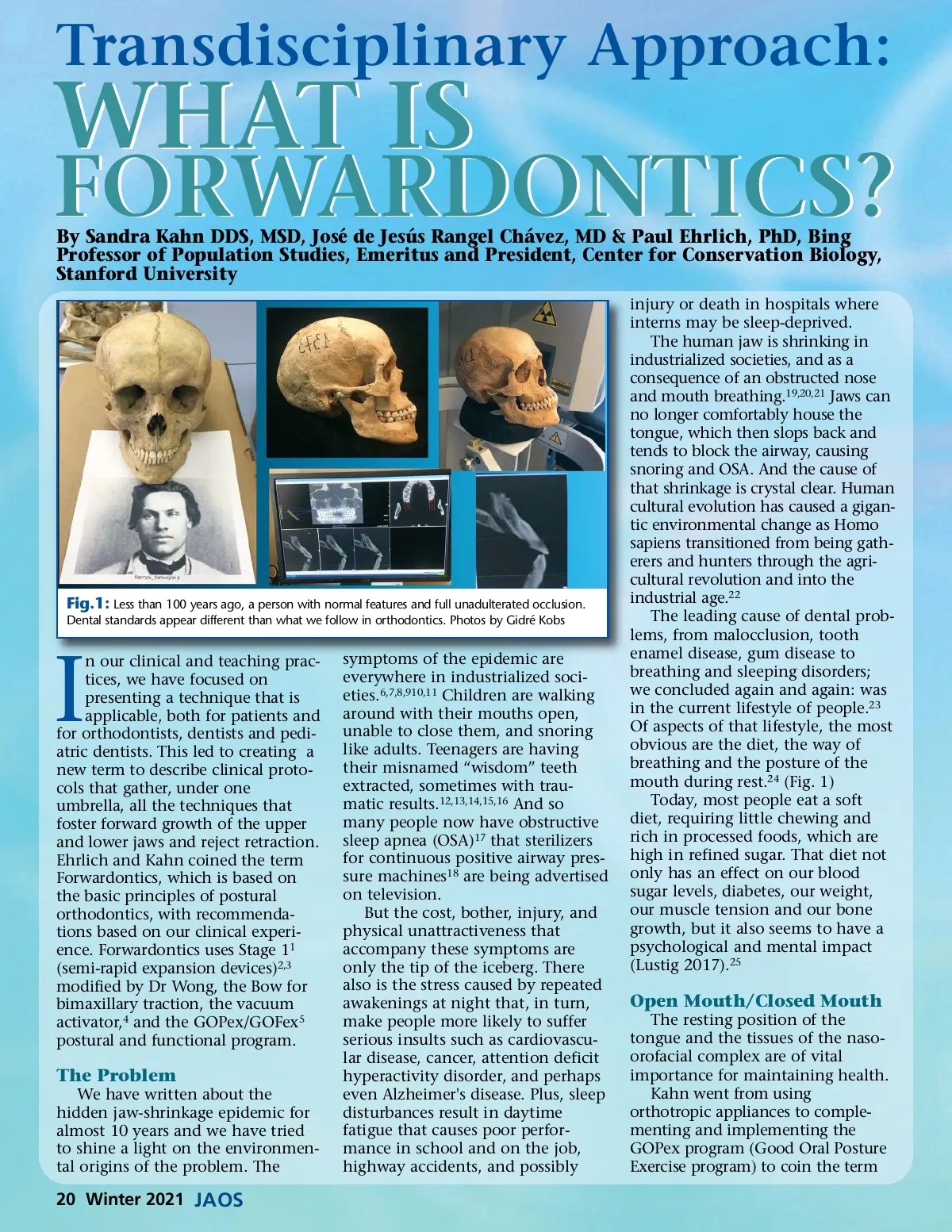
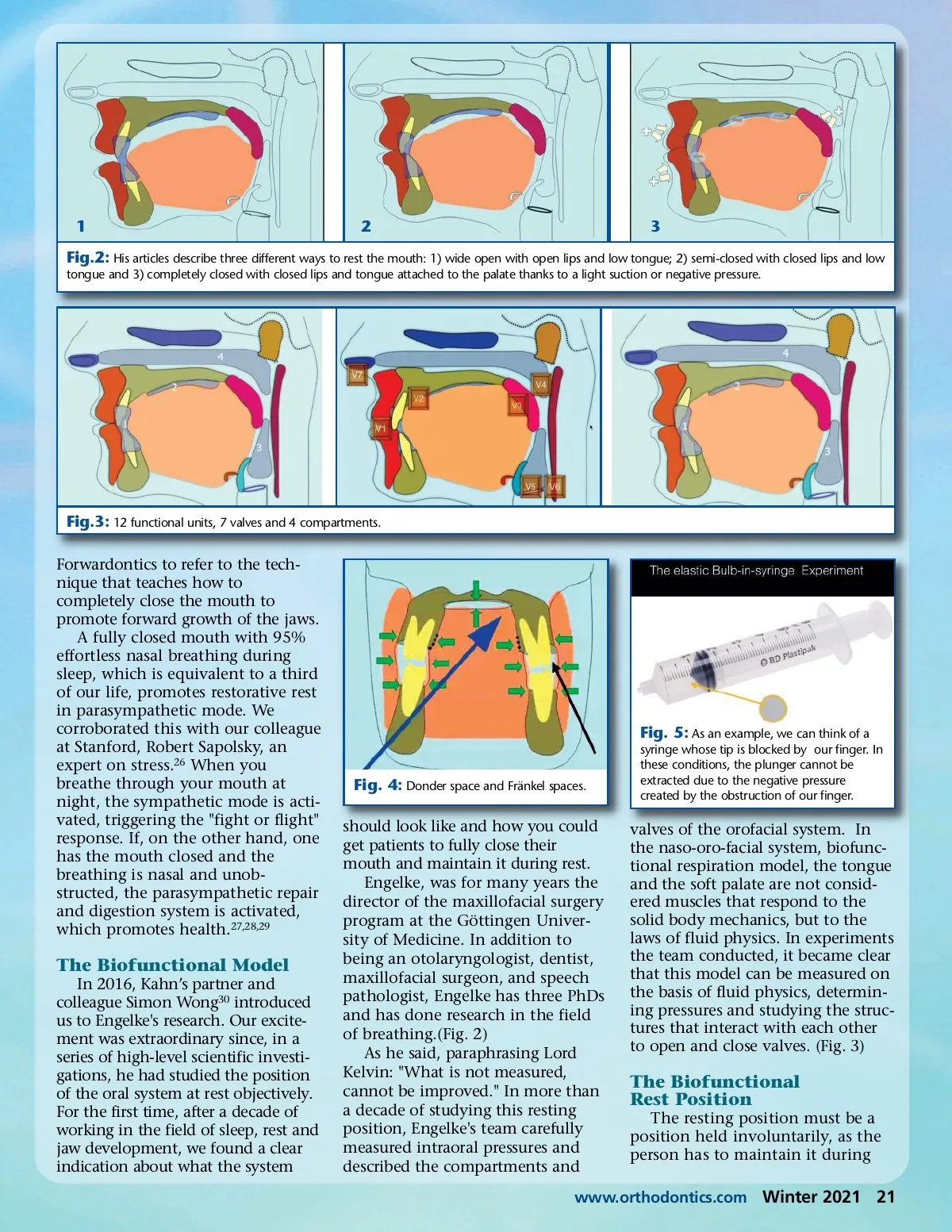
1 2 3 Fig.2: His articles describe three different ways to rest the mouth: 1) wide open with open lips and low tongue; 2) semi-closed with closed lips and low tongue and 3) completely closed with closed lips and tongue attached to the palate thanks to a light suction or negative pressure. Fig.3: 12 functional units, 7 valves and 4 compartments. Forwardontics to refer to the tech-nique that teaches how to completely close the mouth to promote forward growth of the jaws. A fully closed mouth with 95% effortless nasal breathing during sleep, which is equivalent to a third of our life, promotes restorative rest in parasympathetic mode. We corroborated this with our colleague at Stanford, Robert Sapolsky, an expert on stress. 26 When you breathe through your mouth at night, the sympathetic mode is acti-vated, triggering the "fight or flight" response. If, on the other hand, one has the mouth closed and the breathing is nasal and unob-structed, the parasympathetic repair and digestion system is activated, which promotes health. 27,28,29 Fig. 4: Donder space and Fränkel spaces. should look like and how you could get patients to fully close their mouth and maintain it during rest. Engelke, was for many years the director of the maxillofacial surgery program at the Göttingen Univer-sity of Medicine. In addition to being an otolaryngologist, dentist, maxillofacial surgeon, and speech pathologist, Engelke has three PhDs and has done research in the field of breathing.(Fig. 2) As he said, paraphrasing Lord Kelvin: "What is not measured, cannot be improved." In more than a decade of studying this resting position, Engelke's team carefully measured intraoral pressures and described the compartments and Fig. 5: As an example, we can think of a syringe whose tip is blocked by our finger. In these conditions, the plunger cannot be extracted due to the negative pressure created by the obstruction of our finger. valves of the orofacial system. In the naso-oro-facial system, biofunc-tional respiration model, the tongue and the soft palate are not consid-ered muscles that respond to the solid body mechanics, but to the laws of fluid physics. In experiments the team conducted, it became clear that this model can be measured on the basis of fluid physics, determin-ing pressures and studying the struc-tures that interact with each other to open and close valves. (Fig. 3) The Biofunctional Model In 2016, Kahn’s partner and colleague Simon Wong 30 introduced us to Engelke's research. Our excite-ment was extraordinary since, in a series of high-level scientific investi-gations, he had studied the position of the oral system at rest objectively. For the first time, after a decade of working in the field of sleep, rest and jaw development, we found a clear indication about what the system The Biofunctional Rest Position The resting position must be a position held involuntarily, as the person has to maintain it during www.orthodontics.com Winter 2021 21
Journal of the American Orthodontic Society Winter 2021: Page 21