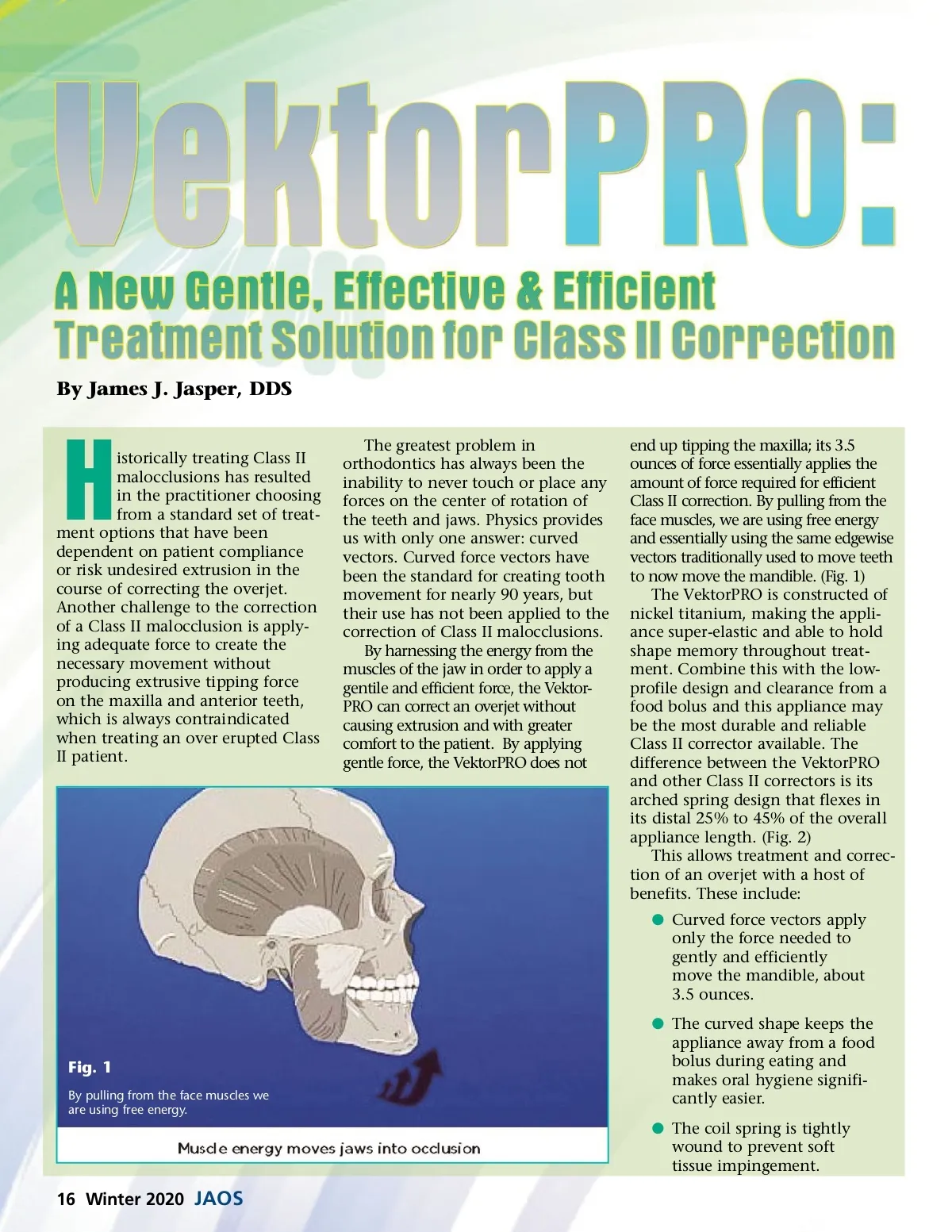
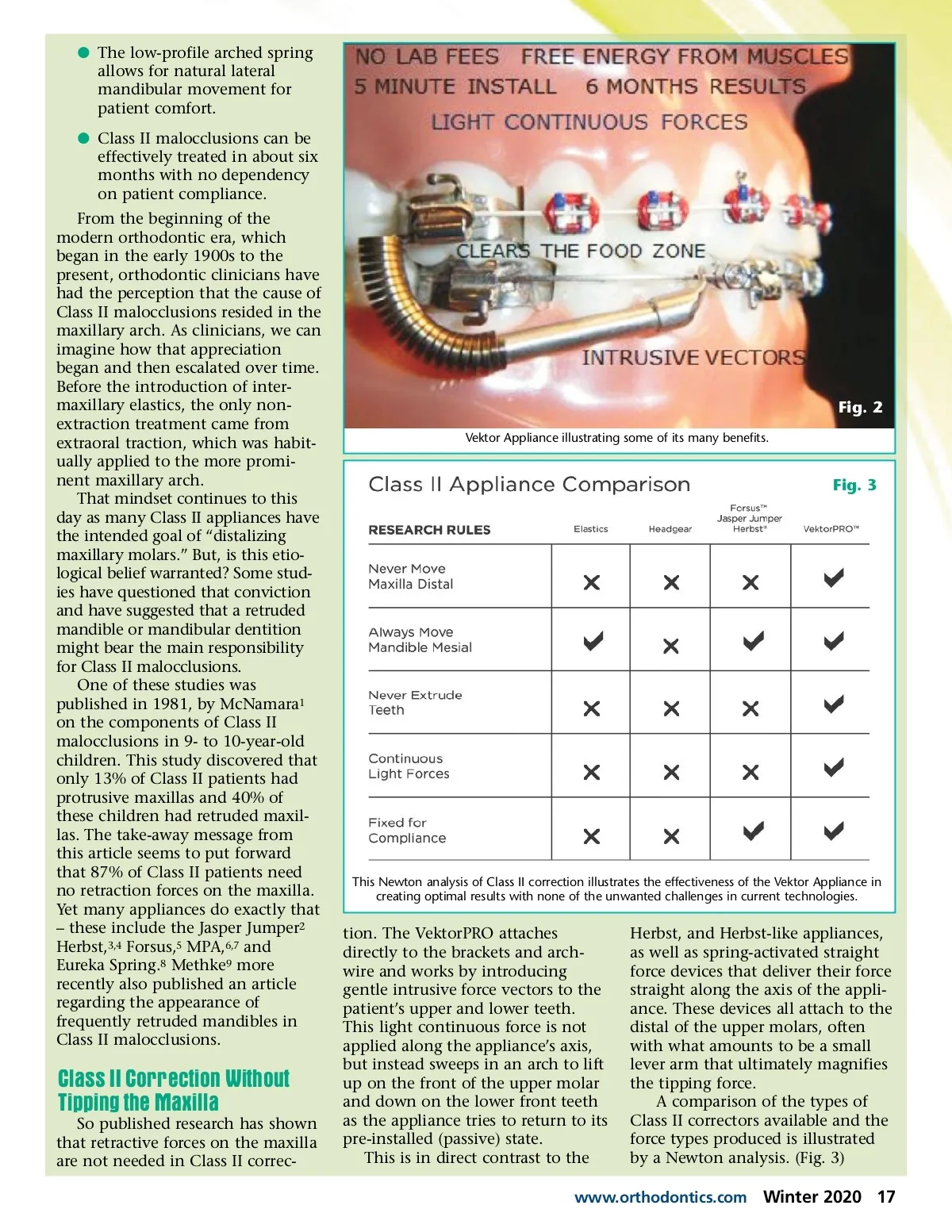
b The low-profile arched spring allows for natural lateral mandibular movement for patient comfort. b Class II malocclusions can be effectively treated in about six months with no dependency on patient compliance. From the beginning of the modern orthodontic era, which began in the early 1900s to the present, orthodontic clinicians have had the perception that the cause of Class II malocclusions resided in the maxillary arch. As clinicians, we can imagine how that appreciation began and then escalated over time. Before the introduction of inter-maxillary elastics, the only non-extraction treatment came from extraoral traction, which was habit-ually applied to the more promi-nent maxillary arch. That mindset continues to this day as many Class II appliances have the intended goal of “distalizing maxillary molars.” But, is this etio-logical belief warranted? Some stud-ies have questioned that conviction and have suggested that a retruded mandible or mandibular dentition might bear the main responsibility for Class II malocclusions. One of these studies was published in 1981, by McNamara 1 on the components of Class II malocclusions in 9-to 10-year-old children. This study discovered that only 13% of Class II patients had protrusive maxillas and 40% of these children had retruded maxil-las. The take-away message from this article seems to put forward that 87% of Class II patients need no retraction forces on the maxilla. Yet many appliances do exactly that – these include the Jasper Jumper 2 Herbst, 3,4 Forsus, 5 MPA, 6,7 and Eureka Spring. 8 Methke 9 more recently also published an article regarding the appearance of frequently retruded mandibles in Class II malocclusions. Fig. 2 Vektor Appliance illustrating some of its many benefits. Fig. 3 This Newton analysis of Class II correction illustrates the effectiveness of the Vektor Appliance in creating optimal results with none of the unwanted challenges in current technologies. Class II Correction Without Tipping the Maxilla So published research has shown that retractive forces on the maxilla are not needed in Class II correc-tion. The VektorPRO attaches directly to the brackets and arch-wire and works by introducing gentle intrusive force vectors to the patient’s upper and lower teeth. This light continuous force is not applied along the appliance’s axis, but instead sweeps in an arch to lift up on the front of the upper molar and down on the lower front teeth as the appliance tries to return to its pre-installed (passive) state. This is in direct contrast to the Herbst, and Herbst-like appliances, as well as spring-activated straight force devices that deliver their force straight along the axis of the appli-ance. These devices all attach to the distal of the upper molars, often with what amounts to be a small lever arm that ultimately magnifies the tipping force. A comparison of the types of Class II correctors available and the force types produced is illustrated by a Newton analysis. (Fig. 3) www.orthodontics.com Winter 2020 17
Journal of the American Orthodontic Society Winter 2020: Page 17