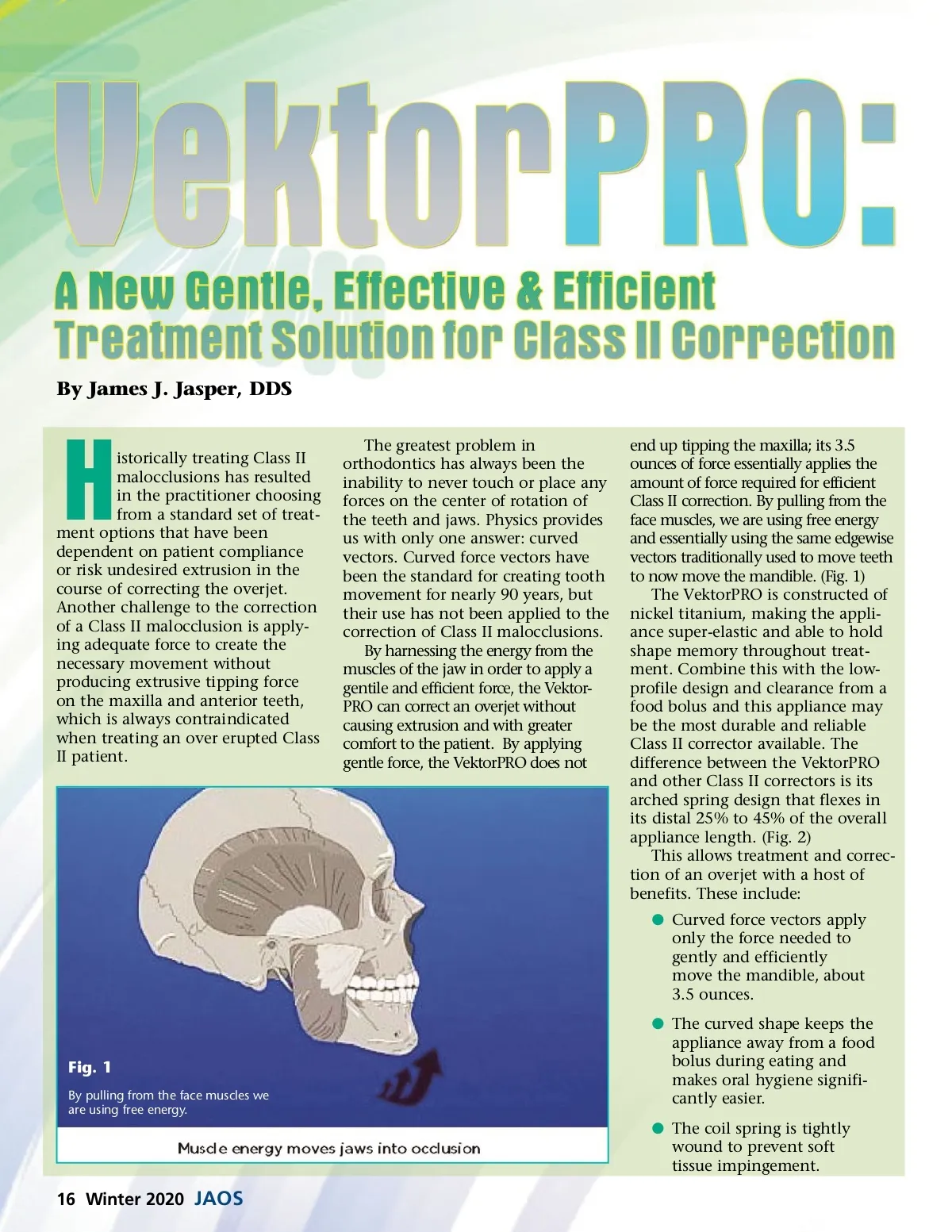
By James J. Jasper, DDS H istorically treating Class II malocclusions has resulted in the practitioner choosing from a standard set of treat-ment options that have been dependent on patient compliance or risk undesired extrusion in the course of correcting the overjet. Another challenge to the correction of a Class II malocclusion is apply-ing adequate force to create the necessary movement without producing extrusive tipping force on the maxilla and anterior teeth, which is always contraindicated when treating an over erupted Class II patient. The greatest problem in orthodontics has always been the inability to never touch or place any forces on the center of rotation of the teeth and jaws. Physics provides us with only one answer: curved vectors. Curved force vectors have been the standard for creating tooth movement for nearly 90 years, but their use has not been applied to the correction of Class II malocclusions. By harnessing the energy from the muscles of the jaw in order to apply a gentile and efficient force, the Vektor-PRO can correct an overjet without causing extrusion and with greater comfort to the patient. By applying gentle force, the VektorPRO does not end up tipping the maxilla; its 3.5 ounces of force essentially applies the amount of force required for efficient Class II correction. By pulling from the face muscles, we are using free energy and essentially using the same edgewise vectors traditionally used to move teeth to now move the mandible. (Fig. 1) The VektorPRO is constructed of nickel titanium, making the appli-ance super-elastic and able to hold shape memory throughout treat-ment. Combine this with the low-profile design and clearance from a food bolus and this appliance may be the most durable and reliable Class II corrector available. The difference between the VektorPRO and other Class II correctors is its arched spring design that flexes in its distal 25% to 45% of the overall appliance length. (Fig. 2) This allows treatment and correc-tion of an overjet with a host of benefits. These include: b Curved force vectors apply only the force needed to gently and efficiently move the mandible, about 3.5 ounces. b The curved shape keeps the appliance away from a food bolus during eating and makes oral hygiene signifi-cantly easier. b The coil spring is tightly wound to prevent soft tissue impingement. Fig. 1 By pulling from the face muscles we are using free energy. 16 Winter 2020 JAOS
Journal of the American Orthodontic Society Winter 2020: Page 16