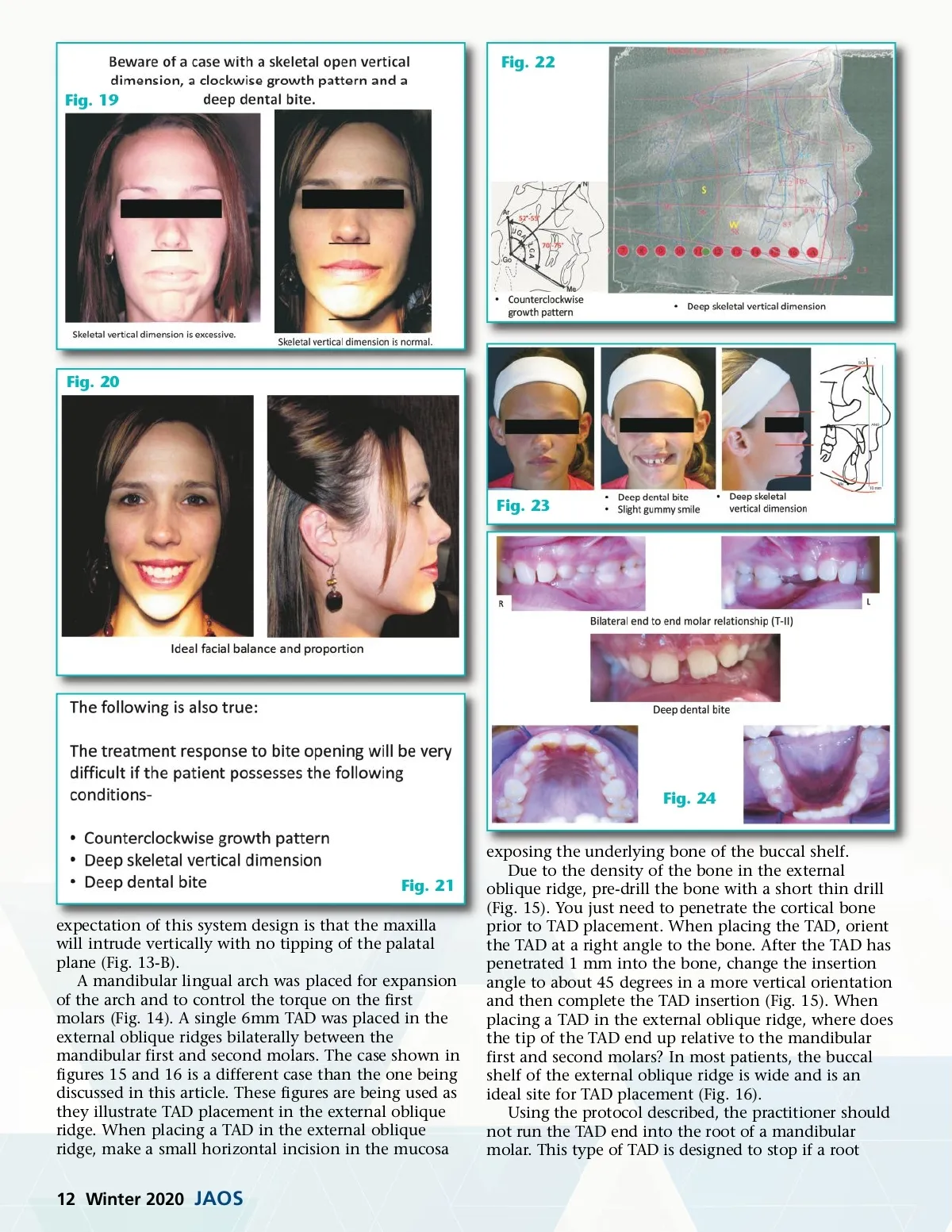
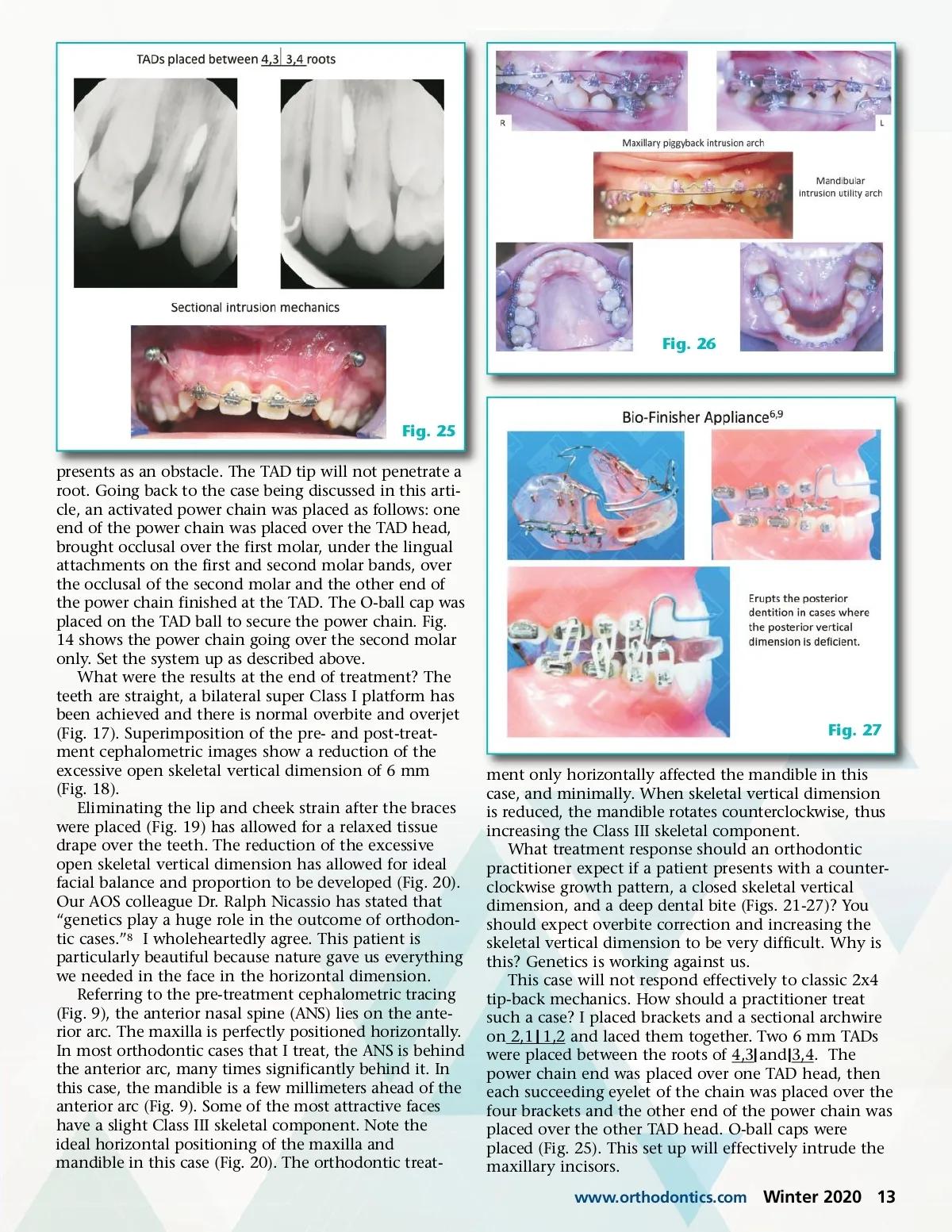
Fig. 26 Fig. 25 presents as an obstacle. The TAD tip will not penetrate a root. Going back to the case being discussed in this arti-cle, an activated power chain was placed as follows: one end of the power chain was placed over the TAD head, brought occlusal over the first molar, under the lingual attachments on the first and second molar bands, over the occlusal of the second molar and the other end of the power chain finished at the TAD. The O-ball cap was placed on the TAD ball to secure the power chain. Fig. 14 shows the power chain going over the second molar only. Set the system up as described above. What were the results at the end of treatment? The teeth are straight, a bilateral super Class I platform has been achieved and there is normal overbite and overjet (Fig. 17). Superimposition of the pre-and post-treat-ment cephalometric images show a reduction of the excessive open skeletal vertical dimension of 6 mm (Fig. 18). Eliminating the lip and cheek strain after the braces were placed (Fig. 19) has allowed for a relaxed tissue drape over the teeth. The reduction of the excessive open skeletal vertical dimension has allowed for ideal facial balance and proportion to be developed (Fig. 20). Our AOS colleague Dr. Ralph Nicassio has stated that “genetics play a huge role in the outcome of orthodon-tic cases.” 8 I wholeheartedly agree. This patient is particularly beautiful because nature gave us everything we needed in the face in the horizontal dimension. Referring to the pre-treatment cephalometric tracing (Fig. 9), the anterior nasal spine (ANS) lies on the ante-rior arc. The maxilla is perfectly positioned horizontally. In most orthodontic cases that I treat, the ANS is behind the anterior arc, many times significantly behind it. In this case, the mandible is a few millimeters ahead of the anterior arc (Fig. 9). Some of the most attractive faces have a slight Class III skeletal component. Note the ideal horizontal positioning of the maxilla and mandible in this case (Fig. 20). The orthodontic treat-Fig. 27 ment only horizontally affected the mandible in this case, and minimally. When skeletal vertical dimension is reduced, the mandible rotates counterclockwise, thus increasing the Class III skeletal component. What treatment response should an orthodontic practitioner expect if a patient presents with a counter-clockwise growth pattern, a closed skeletal vertical dimension, and a deep dental bite (Figs. 21-27)? You should expect overbite correction and increasing the skeletal vertical dimension to be very difficult. Why is this? Genetics is working against us. This case will not respond effectively to classic 2x4 tip-back mechanics. How should a practitioner treat such a case? I placed brackets and a sectional archwire on 2,1 1,2 and laced them together. Two 6 mm TADs were placed between the roots of 4,3 and 3,4. The power chain end was placed over one TAD head, then each succeeding eyelet of the chain was placed over the four brackets and the other end of the power chain was placed over the other TAD head. O-ball caps were placed (Fig. 25). This set up will effectively intrude the maxillary incisors. www.orthodontics.com Winter 2020 13
Journal of the American Orthodontic Society Winter 2020: Page 13