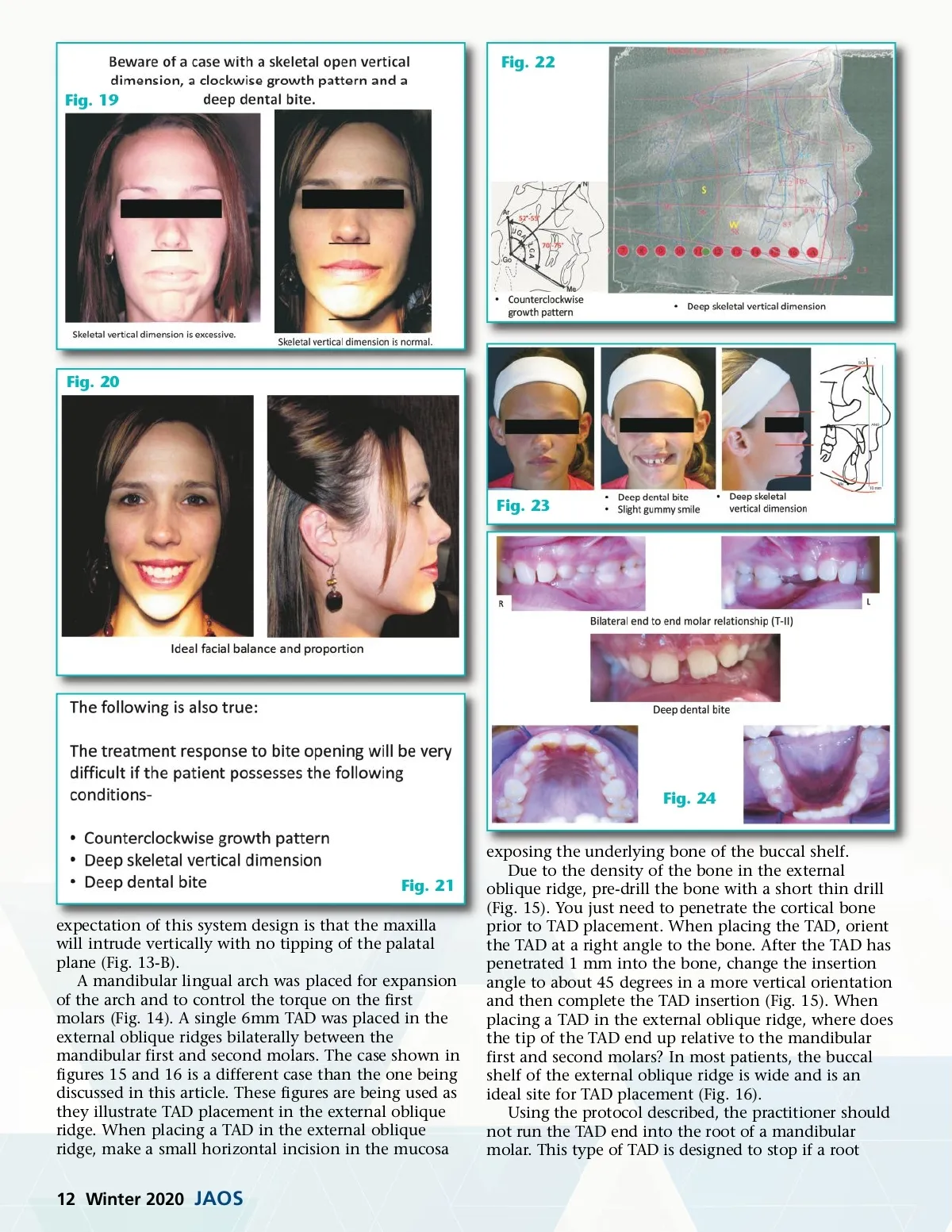
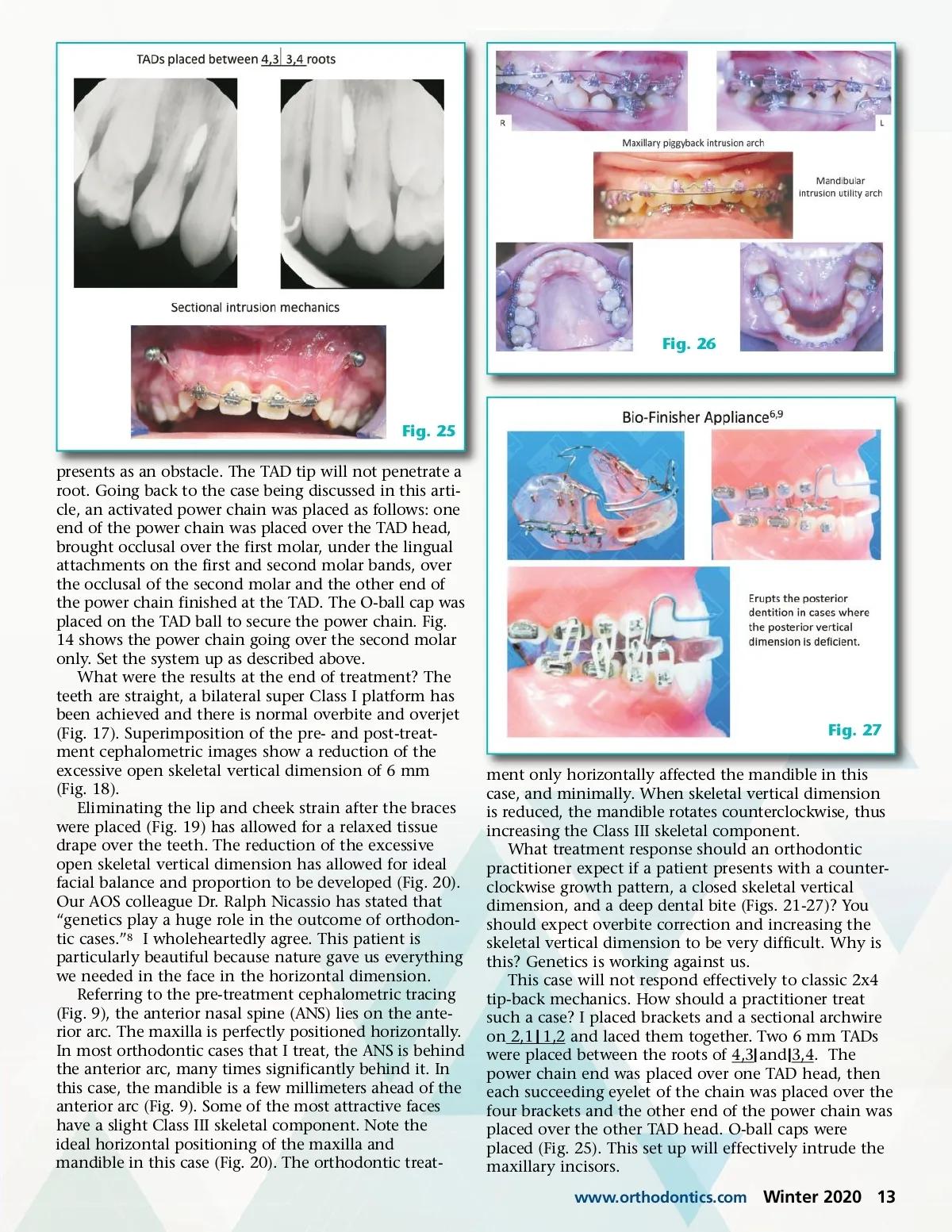
Fig. 22 Fig. 19 Fig. 20 Fig. 23 Fig. 24 exposing the underlying bone of the buccal shelf. Due to the density of the bone in the external oblique ridge, pre-drill the bone with a short thin drill (Fig. 15). You just need to penetrate the cortical bone prior to TAD placement. When placing the TAD, orient the TAD at a right angle to the bone. After the TAD has penetrated 1 mm into the bone, change the insertion angle to about 45 degrees in a more vertical orientation and then complete the TAD insertion (Fig. 15). When placing a TAD in the external oblique ridge, where does the tip of the TAD end up relative to the mandibular first and second molars? In most patients, the buccal shelf of the external oblique ridge is wide and is an ideal site for TAD placement (Fig. 16). Using the protocol described, the practitioner should not run the TAD end into the root of a mandibular molar. This type of TAD is designed to stop if a root Fig. 21 expectation of this system design is that the maxilla will intrude vertically with no tipping of the palatal plane (Fig. 13-B). A mandibular lingual arch was placed for expansion of the arch and to control the torque on the first molars (Fig. 14). A single 6mm TAD was placed in the external oblique ridges bilaterally between the mandibular first and second molars. The case shown in figures 15 and 16 is a different case than the one being discussed in this article. These figures are being used as they illustrate TAD placement in the external oblique ridge. When placing a TAD in the external oblique ridge, make a small horizontal incision in the mucosa 12 Winter 2020 JAOS
Journal of the American Orthodontic Society Winter 2020: Page 12