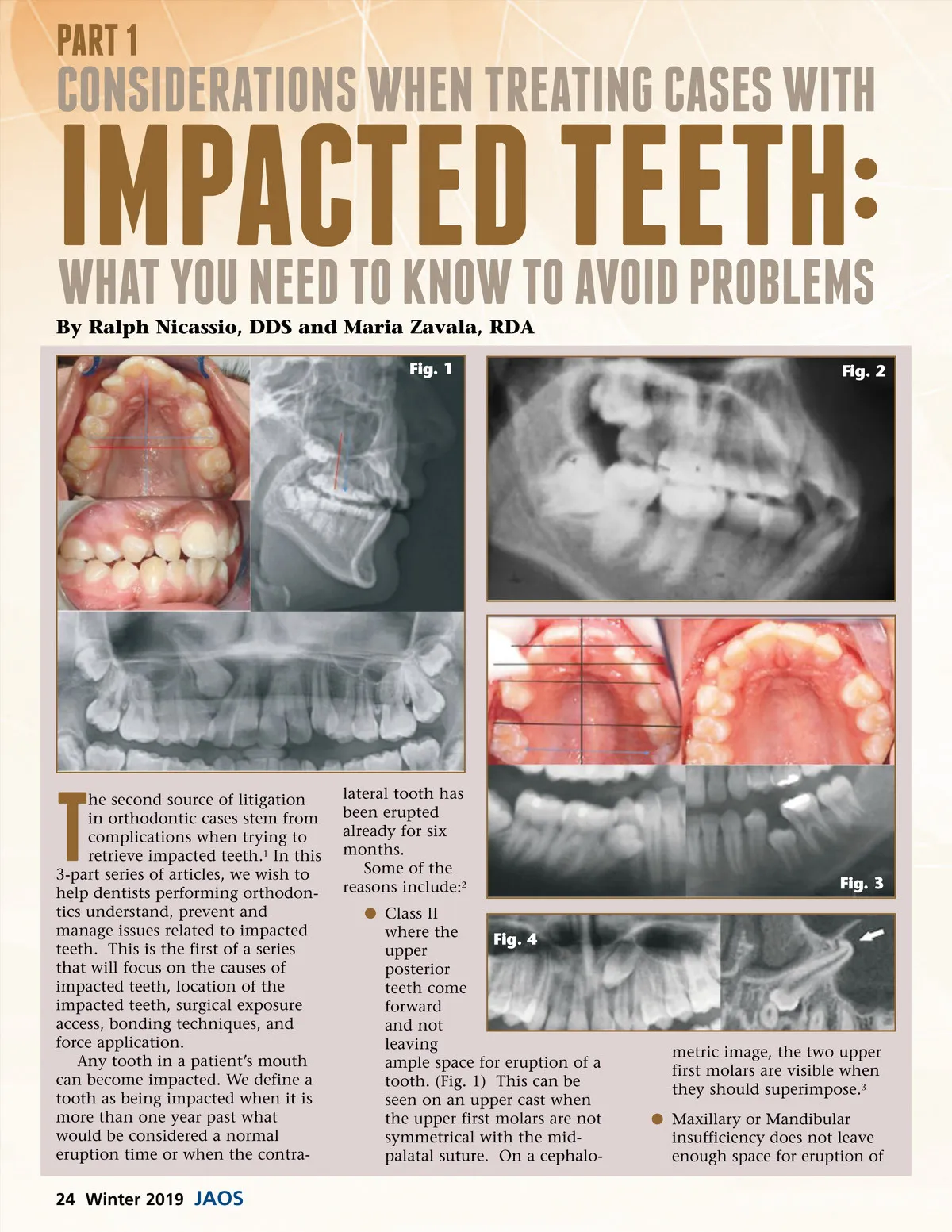
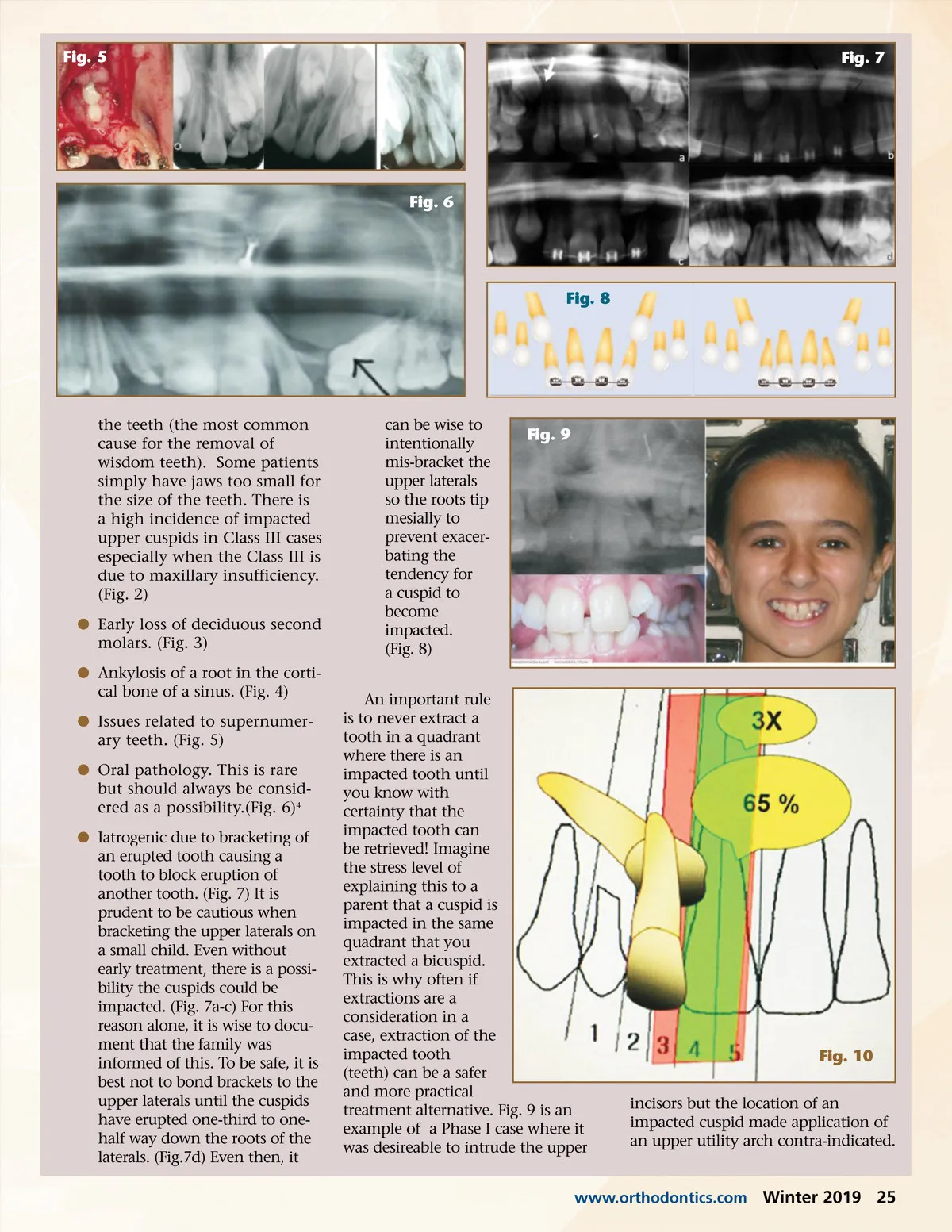
part 1 consIderatIons When treatIng cases WIth Impacted teeth: What You need to KnoW to avoId problems Fig. 1 Fig. 2 By Ralph Nicassio, DDS and Maria Zavala, RDA he second source of litigation in orthodontic cases stem from complications when trying to retrieve impacted teeth. 1 In this 3-part series of articles, we wish to help dentists performing orthodon-tics understand, prevent and manage issues related to impacted teeth. This is the first of a series that will focus on the causes of impacted teeth, location of the impacted teeth, surgical exposure access, bonding techniques, and force application. Any tooth in a patient’s mouth can become impacted. We define a tooth as being impacted when it is more than one year past what would be considered a normal eruption time or when the contra-t lateral tooth has been erupted already for six months. Some of the reasons include: 2 b Class II where the Fig. 4 upper posterior teeth come forward and not leaving ample space for eruption of a tooth. (Fig. 1) This can be seen on an upper cast when the upper first molars are not symmetrical with the mid-palatal suture. On a cephalo-Fig. 3 metric image, the two upper first molars are visible when they should superimpose. 3 b Maxillary or Mandibular insufficiency does not leave enough space for eruption of 24 Winter 2019 JAOS
Journal of the American Orthodontic Society Winter 2019: Page 24