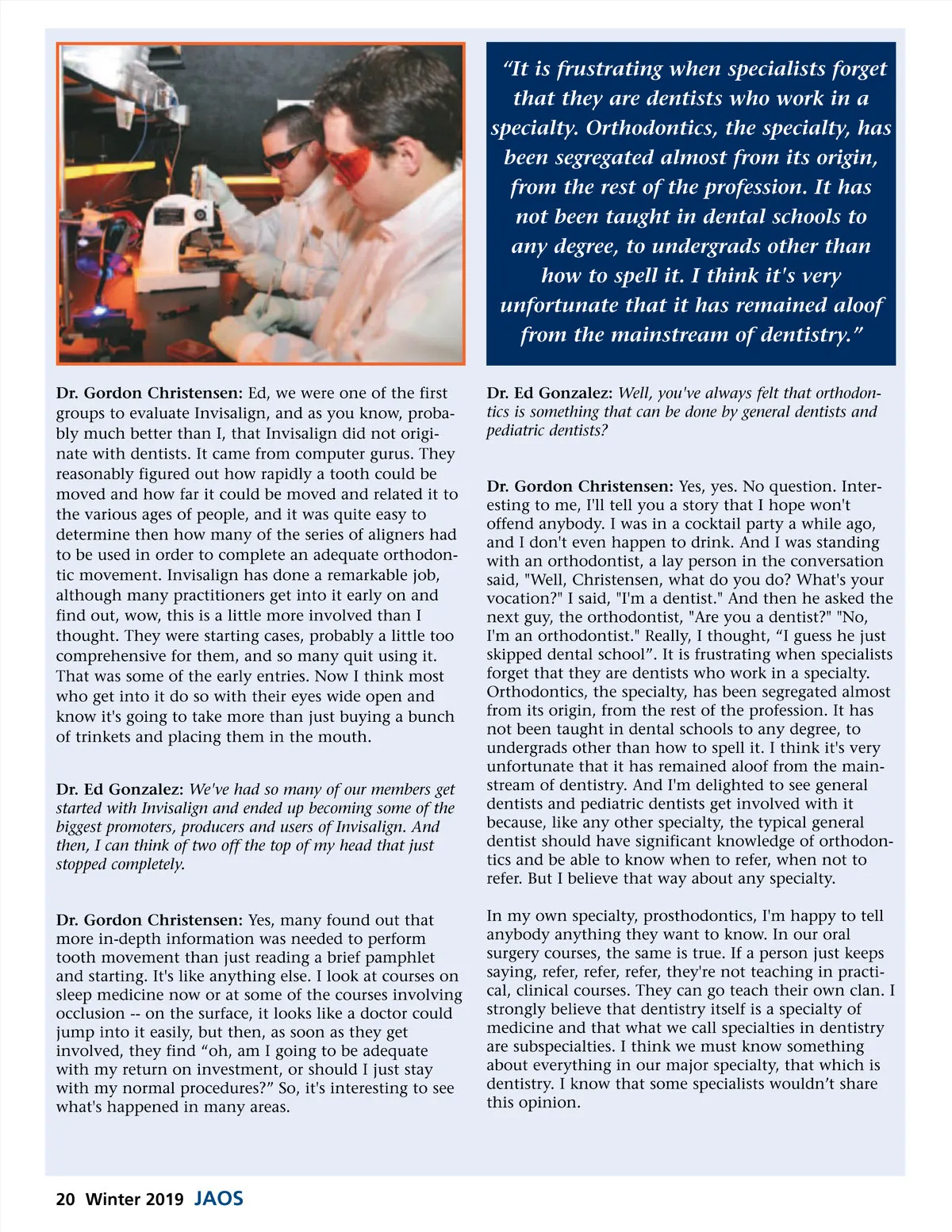
“It is frustrating when specialists forget that they are dentists who work in a specialty. Orthodontics, the specialty, has been segregated almost from its origin, from the rest of the profession. It has not been taught in dental schools to any degree, to undergrads other than how to spell it. I think it's very unfortunate that it has remained aloof from the mainstream of dentistry.” Dr. Gordon Christensen: Ed, we were one of the first groups to evaluate Invisalign, and as you know, proba-bly much better than I, that Invisalign did not origi-nate with dentists. It came from computer gurus. They reasonably figured out how rapidly a tooth could be moved and how far it could be moved and related it to the various ages of people, and it was quite easy to determine then how many of the series of aligners had to be used in order to complete an adequate orthodon-tic movement. Invisalign has done a remarkable job, although many practitioners get into it early on and find out, wow, this is a little more involved than I thought. They were starting cases, probably a little too comprehensive for them, and so many quit using it. That was some of the early entries. Now I think most who get into it do so with their eyes wide open and know it's going to take more than just buying a bunch of trinkets and placing them in the mouth. Dr. Ed Gonzalez: We've had so many of our members get started with Invisalign and ended up becoming some of the biggest promoters, producers and users of Invisalign. And then, I can think of two off the top of my head that just stopped completely. Dr. Ed Gonzalez: Well, you've always felt that orthodon-tics is something that can be done by general dentists and pediatric dentists? Dr. Gordon Christensen: Yes, yes. No question. Inter-esting to me, I'll tell you a story that I hope won't offend anybody. I was in a cocktail party a while ago, and I don't even happen to drink. And I was standing with an orthodontist, a lay person in the conversation said, "Well, Christensen, what do you do? What's your vocation?" I said, "I'm a dentist." And then he asked the next guy, the orthodontist, "Are you a dentist?" "No, I'm an orthodontist." Really, I thought, “I guess he just skipped dental school”. It is frustrating when specialists forget that they are dentists who work in a specialty. Orthodontics, the specialty, has been segregated almost from its origin, from the rest of the profession. It has not been taught in dental schools to any degree, to undergrads other than how to spell it. I think it's very unfortunate that it has remained aloof from the main-stream of dentistry. And I'm delighted to see general dentists and pediatric dentists get involved with it because, like any other specialty, the typical general dentist should have significant knowledge of orthodon-tics and be able to know when to refer, when not to refer. But I believe that way about any specialty. In my own specialty, prosthodontics, I'm happy to tell anybody anything they want to know. In our oral surgery courses, the same is true. If a person just keeps saying, refer, refer, refer, they're not teaching in practi-cal, clinical courses. They can go teach their own clan. I strongly believe that dentistry itself is a specialty of medicine and that what we call specialties in dentistry are subspecialties. I think we must know something about everything in our major specialty, that which is dentistry. I know that some specialists wouldn’t share this opinion. Dr. Gordon Christensen: Yes, many found out that more in-depth information was needed to perform tooth movement than just reading a brief pamphlet and starting. It's like anything else. I look at courses on sleep medicine now or at some of the courses involving occlusion --on the surface, it looks like a doctor could jump into it easily, but then, as soon as they get involved, they find “oh, am I going to be adequate with my return on investment, or should I just stay with my normal procedures?” So, it's interesting to see what's happened in many areas. 20 Winter 2019 JAOS
Journal of the American Orthodontic Society Winter 2019: Page 20