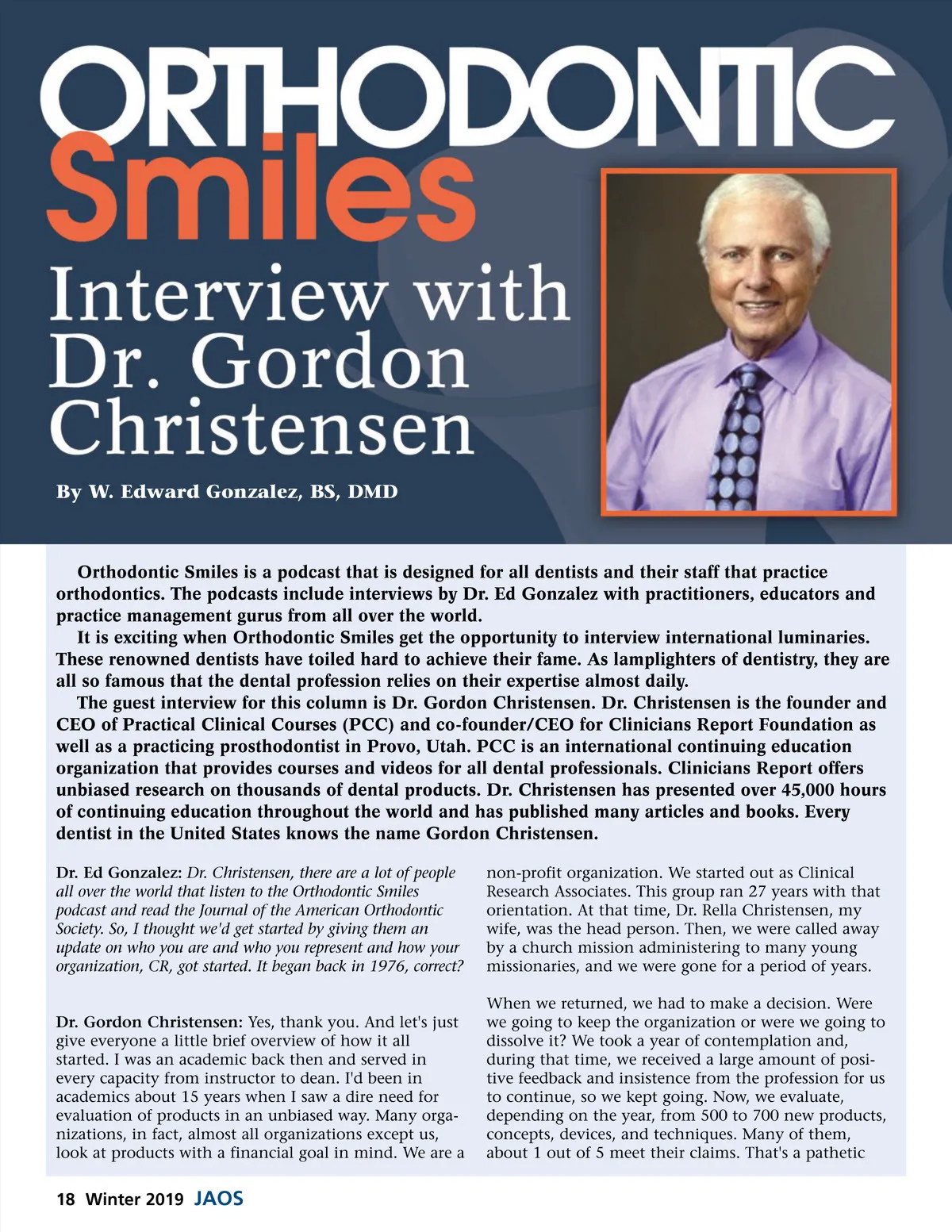
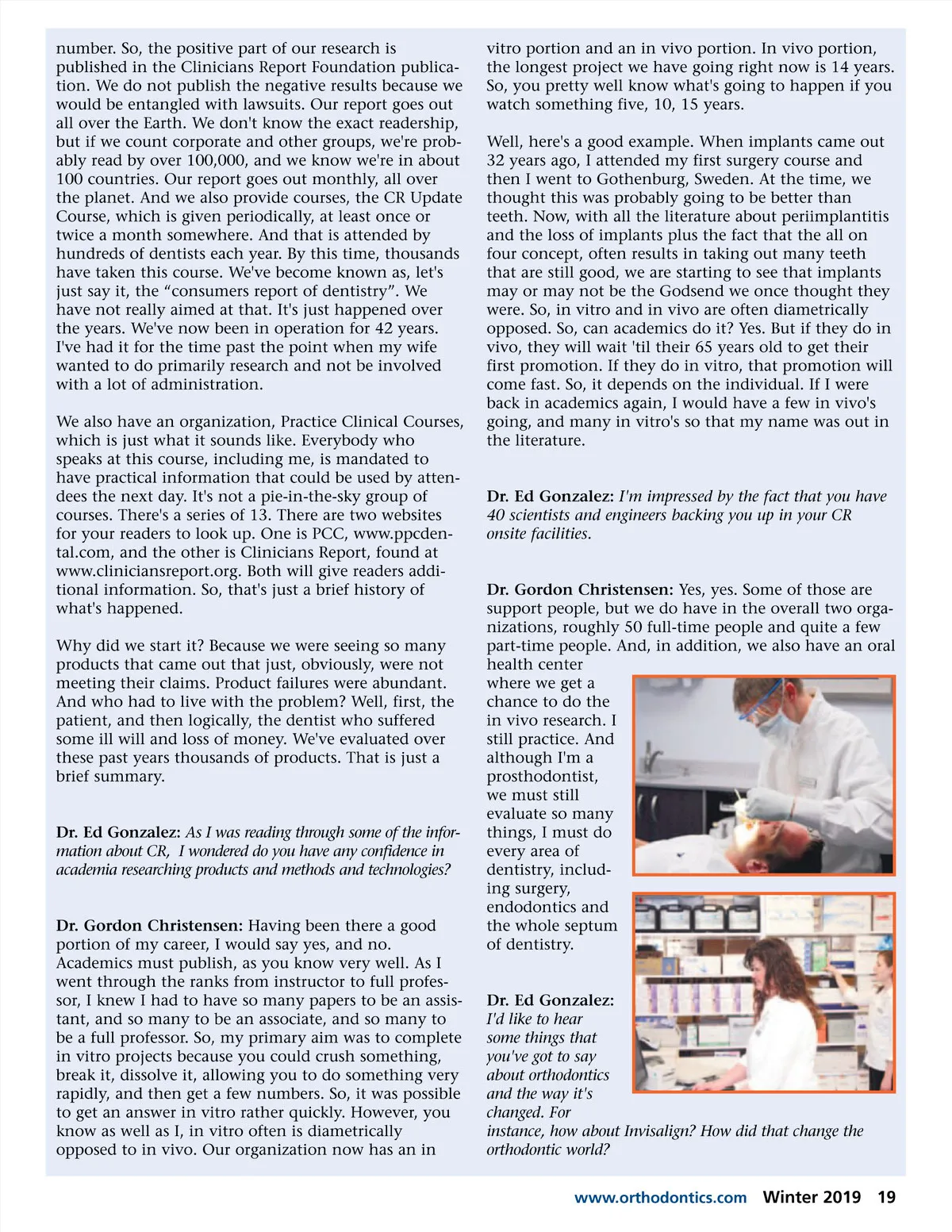
number. So, the positive part of our research is published in the Clinicians Report Foundation publica-tion. We do not publish the negative results because we would be entangled with lawsuits. Our report goes out all over the Earth. We don't know the exact readership, but if we count corporate and other groups, we're prob-ably read by over 100,000, and we know we're in about 100 countries. Our report goes out monthly, all over the planet. And we also provide courses, the CR Update Course, which is given periodically, at least once or twice a month somewhere. And that is attended by hundreds of dentists each year. By this time, thousands have taken this course. We've become known as, let's just say it, the “consumers report of dentistry”. We have not really aimed at that. It's just happened over the years. We've now been in operation for 42 years. I've had it for the time past the point when my wife wanted to do primarily research and not be involved with a lot of administration. We also have an organization, Practice Clinical Courses, which is just what it sounds like. Everybody who speaks at this course, including me, is mandated to have practical information that could be used by atten-dees the next day. It's not a pie-in-the-sky group of courses. There's a series of 13. There are two websites for your readers to look up. One is PCC, www.ppcden-tal.com, and the other is Clinicians Report, found at www.cliniciansreport.org. Both will give readers addi-tional information. So, that's just a brief history of what's happened. Why did we start it? Because we were seeing so many products that came out that just, obviously, were not meeting their claims. Product failures were abundant. And who had to live with the problem? Well, first, the patient, and then logically, the dentist who suffered some ill will and loss of money. We've evaluated over these past years thousands of products. That is just a brief summary. vitro portion and an in vivo portion. In vivo portion, the longest project we have going right now is 14 years. So, you pretty well know what's going to happen if you watch something five, 10, 15 years. Well, here's a good example. When implants came out 32 years ago, I attended my first surgery course and then I went to Gothenburg, Sweden. At the time, we thought this was probably going to be better than teeth. Now, with all the literature about periimplantitis and the loss of implants plus the fact that the all on four concept, often results in taking out many teeth that are still good, we are starting to see that implants may or may not be the Godsend we once thought they were. So, in vitro and in vivo are often diametrically opposed. So, can academics do it? Yes. But if they do in vivo, they will wait 'til their 65 years old to get their first promotion. If they do in vitro, that promotion will come fast. So, it depends on the individual. If I were back in academics again, I would have a few in vivo's going, and many in vitro's so that my name was out in the literature. Dr. Ed Gonzalez: I'm impressed by the fact that you have 40 scientists and engineers backing you up in your CR onsite facilities. Dr. Ed Gonzalez: As I was reading through some of the infor-mation about CR, I wondered do you have any confidence in academia researching products and methods and technologies? Dr. Gordon Christensen: Having been there a good portion of my career, I would say yes, and no. Academics must publish, as you know very well. As I went through the ranks from instructor to full profes-sor, I knew I had to have so many papers to be an assis-tant, and so many to be an associate, and so many to be a full professor. So, my primary aim was to complete in vitro projects because you could crush something, break it, dissolve it, allowing you to do something very rapidly, and then get a few numbers. So, it was possible to get an answer in vitro rather quickly. However, you know as well as I, in vitro often is diametrically opposed to in vivo. Our organization now has an in Dr. Gordon Christensen: Yes, yes. Some of those are support people, but we do have in the overall two orga-nizations, roughly 50 full-time people and quite a few part-time people. And, in addition, we also have an oral health center where we get a chance to do the in vivo research. I still practice. And although I'm a prosthodontist, we must still evaluate so many things, I must do every area of dentistry, includ-ing surgery, endodontics and the whole septum of dentistry. Dr. Ed Gonzalez: I'd like to hear some things that you've got to say about orthodontics and the way it's changed. For instance, how about Invisalign? How did that change the orthodontic world? www.orthodontics.com Winter 2019 19
Journal of the American Orthodontic Society Winter 2019: Page 19