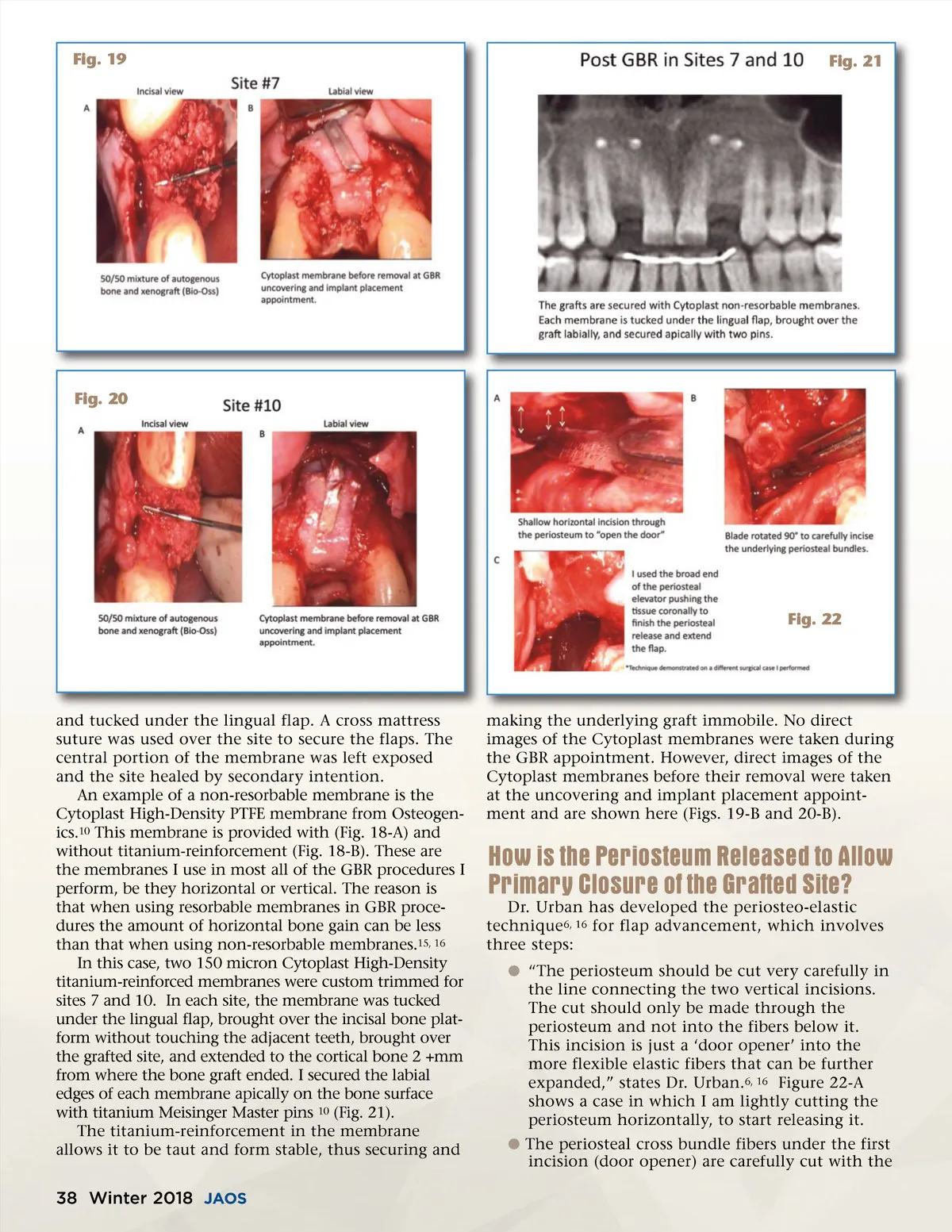
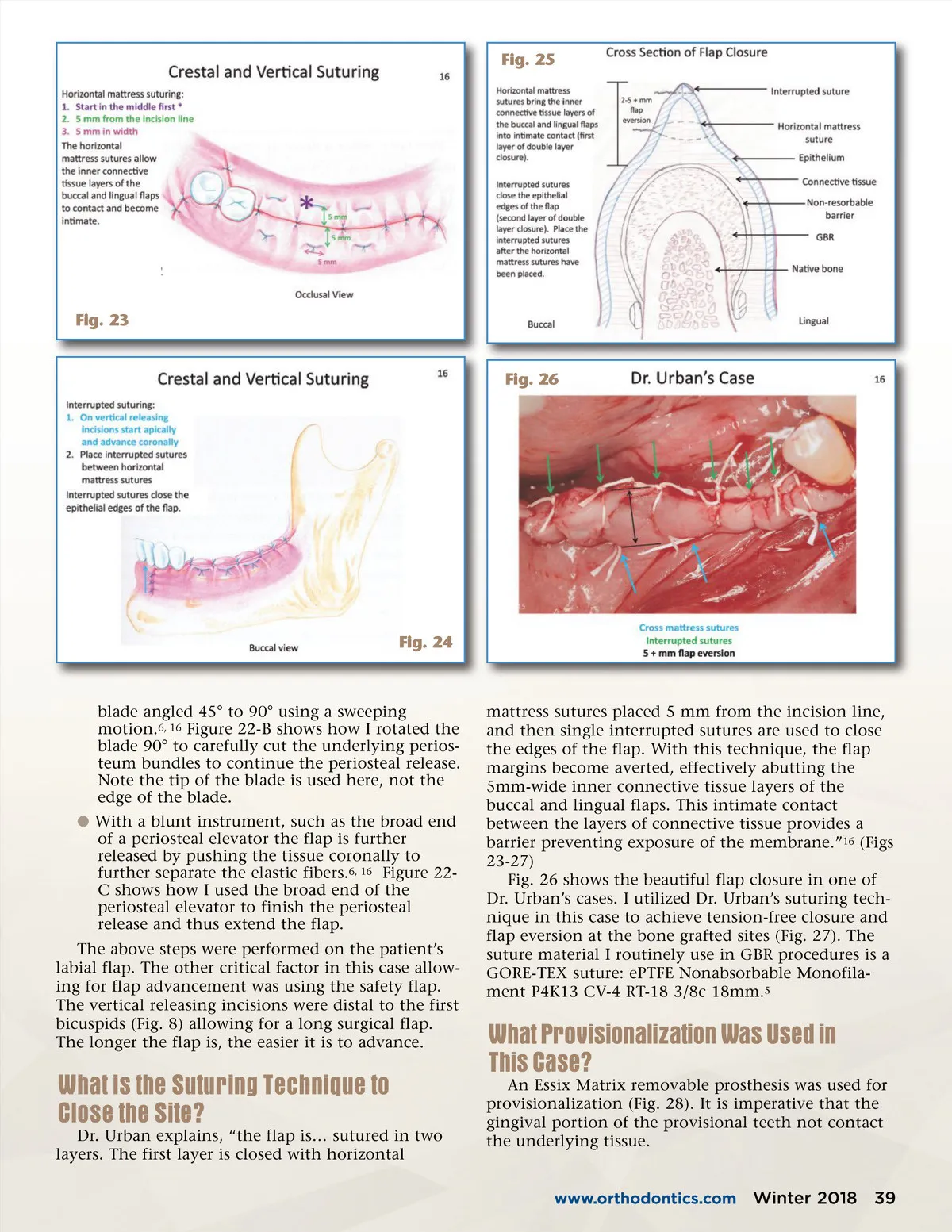
Fig. 25 Fig. 23 Fig. 26 Fig. 24 blade angled 45° to 90° using a sweeping motion. 6, 16 Figure 22-B shows how I rotated the blade 90° to carefully cut the underlying perios-teum bundles to continue the periosteal release. Note the tip of the blade is used here, not the edge of the blade. b With a blunt instrument, such as the broad end of a periosteal elevator the flap is further released by pushing the tissue coronally to further separate the elastic fibers. 6, 16 Figure 22-C shows how I used the broad end of the periosteal elevator to finish the periosteal release and thus extend the flap. The above steps were performed on the patient’s labial flap. The other critical factor in this case allow-ing for flap advancement was using the safety flap. The vertical releasing incisions were distal to the first bicuspids (Fig. 8) allowing for a long surgical flap. The longer the flap is, the easier it is to advance. mattress sutures placed 5 mm from the incision line, and then single interrupted sutures are used to close the edges of the flap. With this technique, the flap margins become averted, effectively abutting the 5mm-wide inner connective tissue layers of the buccal and lingual flaps. This intimate contact between the layers of connective tissue provides a barrier preventing exposure of the membrane.” 16 (Figs 23-27) Fig. 26 shows the beautiful flap closure in one of Dr. Urban’s cases. I utilized Dr. Urban’s suturing tech-nique in this case to achieve tension-free closure and flap eversion at the bone grafted sites (Fig. 27). The suture material I routinely use in GBR procedures is a GORE-TEX suture: ePTFE Nonabsorbable Monofila-ment P4K13 CV-4 RT-18 3/8c 18mm. 5 What Provisionalization Was Used in This Case? An Essix Matrix removable prosthesis was used for provisionalization (Fig. 28). It is imperative that the gingival portion of the provisional teeth not contact the underlying tissue. What is the Suturing Technique to Close the Site? Dr. Urban explains, “the flap is… sutured in two layers. The first layer is closed with horizontal www.orthodontics.com Winter 2018 39
Journal of the American Orthodontic Society Winter 2018: Page 39