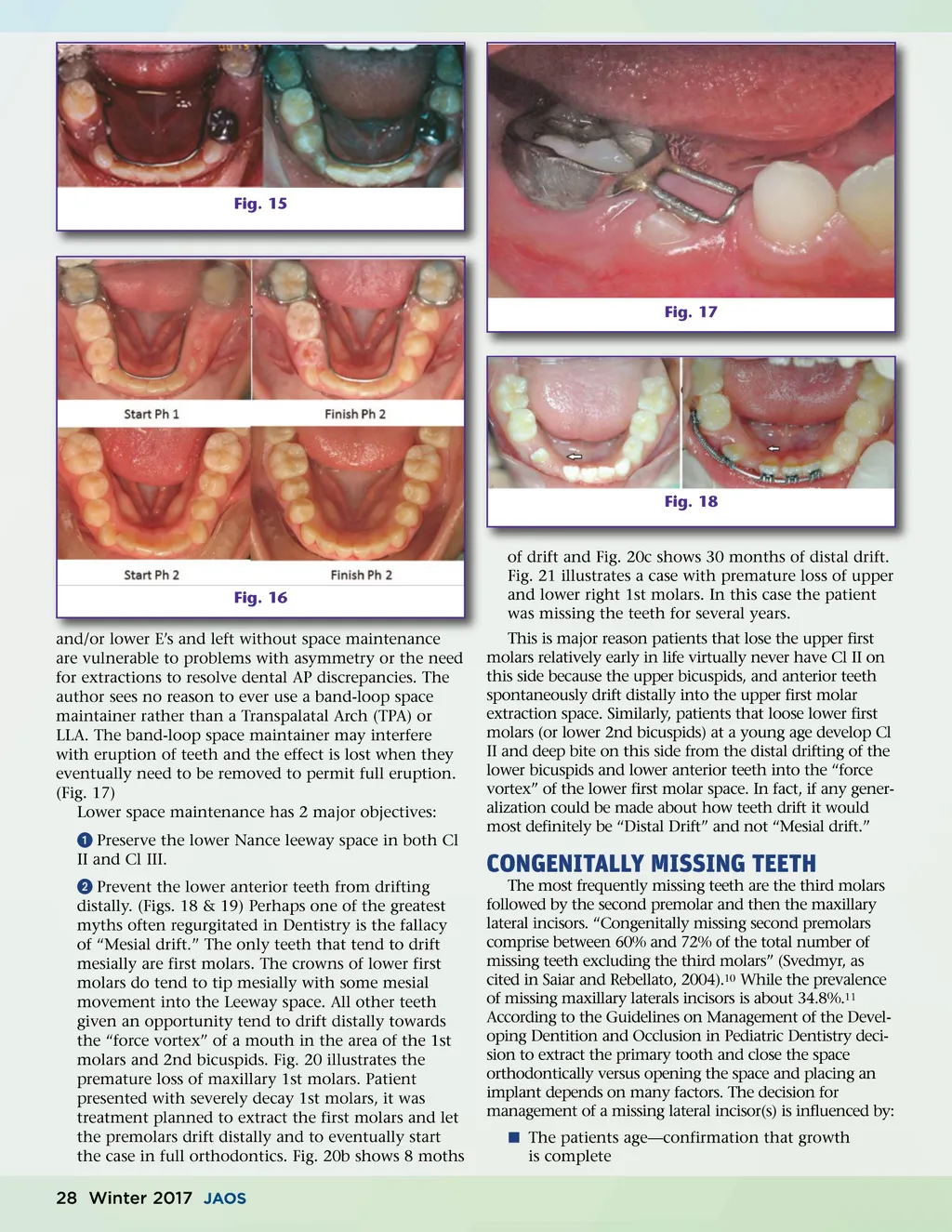
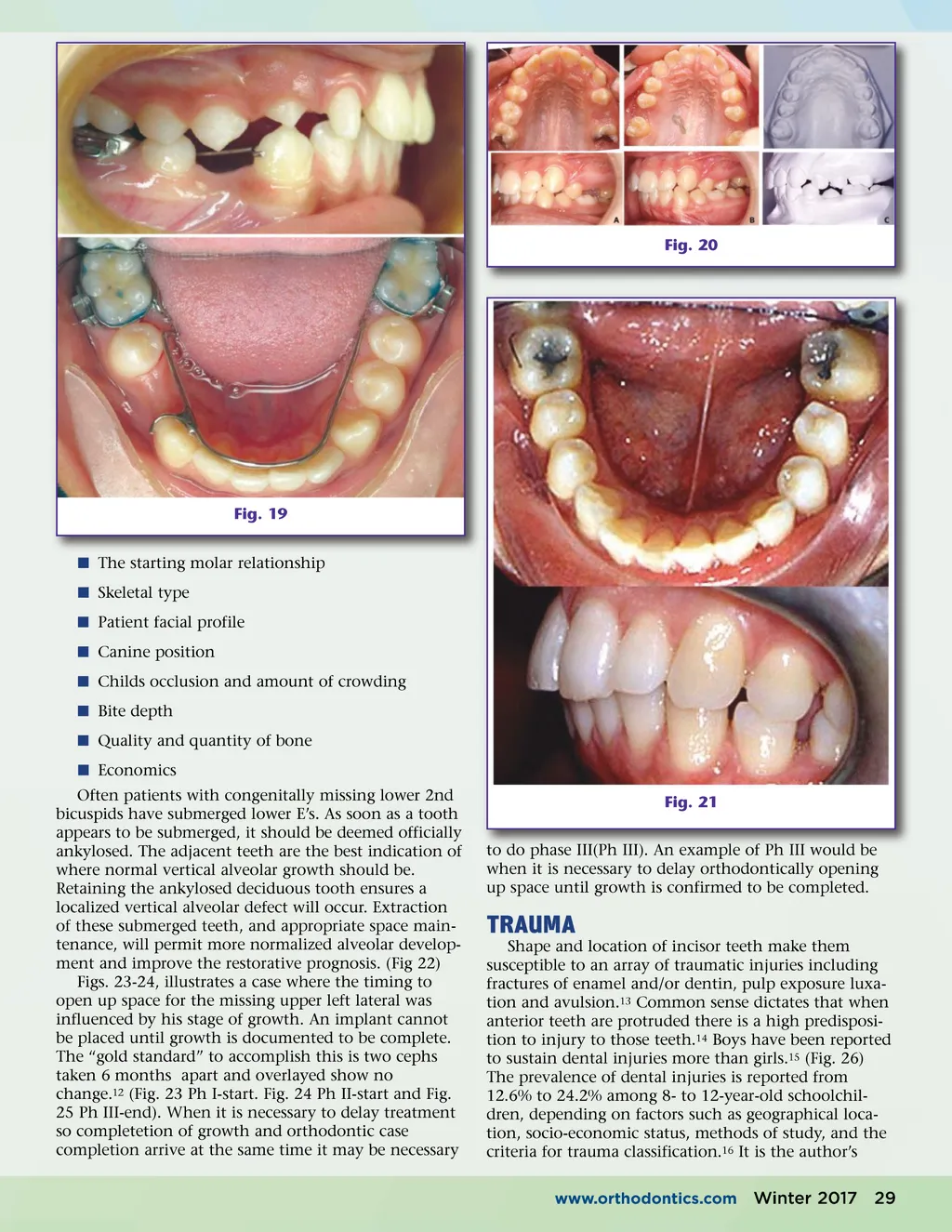
Fig. 15 Fig. 17 Fig. 18 Fig. 16 and/or lower E’s and left without space maintenance are vulnerable to problems with asymmetry or the need for extractions to resolve dental AP discrepancies. The author sees no reason to ever use a band-loop space maintainer rather than a Transpalatal Arch (TPA) or LLA. The band-loop space maintainer may interfere with eruption of teeth and the effect is lost when they eventually need to be removed to permit full eruption. (Fig. 17) Lower space maintenance has 2 major objectives: ᕡ Preserve the lower Nance leeway space in both Cl II and Cl III. ᕢ Prevent the lower anterior teeth from drifting distally. (Figs. 18 & 19) Perhaps one of the greatest myths often regurgitated in Dentistry is the fallacy of “Mesial drift.” The only teeth that tend to drift mesially are first molars. The crowns of lower first molars do tend to tip mesially with some mesial movement into the Leeway space. All other teeth given an opportunity tend to drift distally towards the “force vortex” of a mouth in the area of the 1st molars and 2nd bicuspids. Fig. 20 illustrates the premature loss of maxillary 1st molars. Patient presented with severely decay 1st molars, it was treatment planned to extract the first molars and let the premolars drift distally and to eventually start the case in full orthodontics. Fig. 20b shows 8 moths of drift and Fig. 20c shows 30 months of distal drift. Fig. 21 illustrates a case with premature loss of upper and lower right 1st molars. In this case the patient was missing the teeth for several years. This is major reason patients that lose the upper first molars relatively early in life virtually never have Cl II on this side because the upper bicuspids, and anterior teeth spontaneously drift distally into the upper first molar extraction space. Similarly, patients that loose lower first molars (or lower 2nd bicuspids) at a young age develop Cl II and deep bite on this side from the distal drifting of the lower bicuspids and lower anterior teeth into the “force vortex” of the lower first molar space. In fact, if any gener-alization could be made about how teeth drift it would most definitely be “Distal Drift” and not “Mesial drift.” CONGENITALLY MISSING TEETH The most frequently missing teeth are the third molars followed by the second premolar and then the maxillary lateral incisors. “Congenitally missing second premolars comprise between 60% and 72% of the total number of missing teeth excluding the third molars” (Svedmyr, as cited in Saiar and Rebellato, 2004). 10 While the prevalence of missing maxillary laterals incisors is about 34.8%. 11 According to the Guidelines on Management of the Devel-oping Dentition and Occlusion in Pediatric Dentistry deci-sion to extract the primary tooth and close the space orthodontically versus opening the space and placing an implant depends on many factors. The decision for management of a missing lateral incisor(s) is influenced by: í The patients age—confirmation that growth is complete 28 Winter 2017 JAOS
Journal of the American Orthodontic Society Winter 2017: Page 28