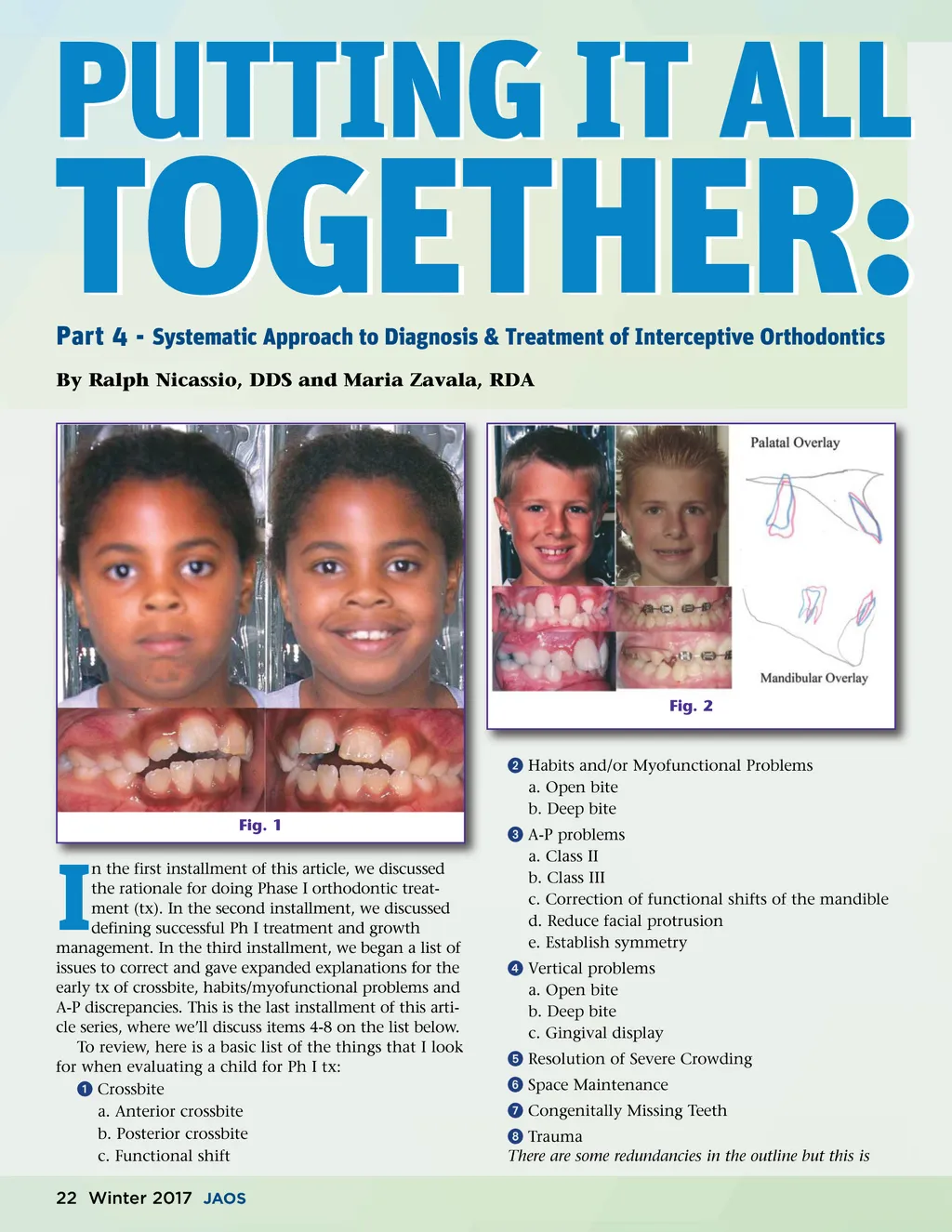
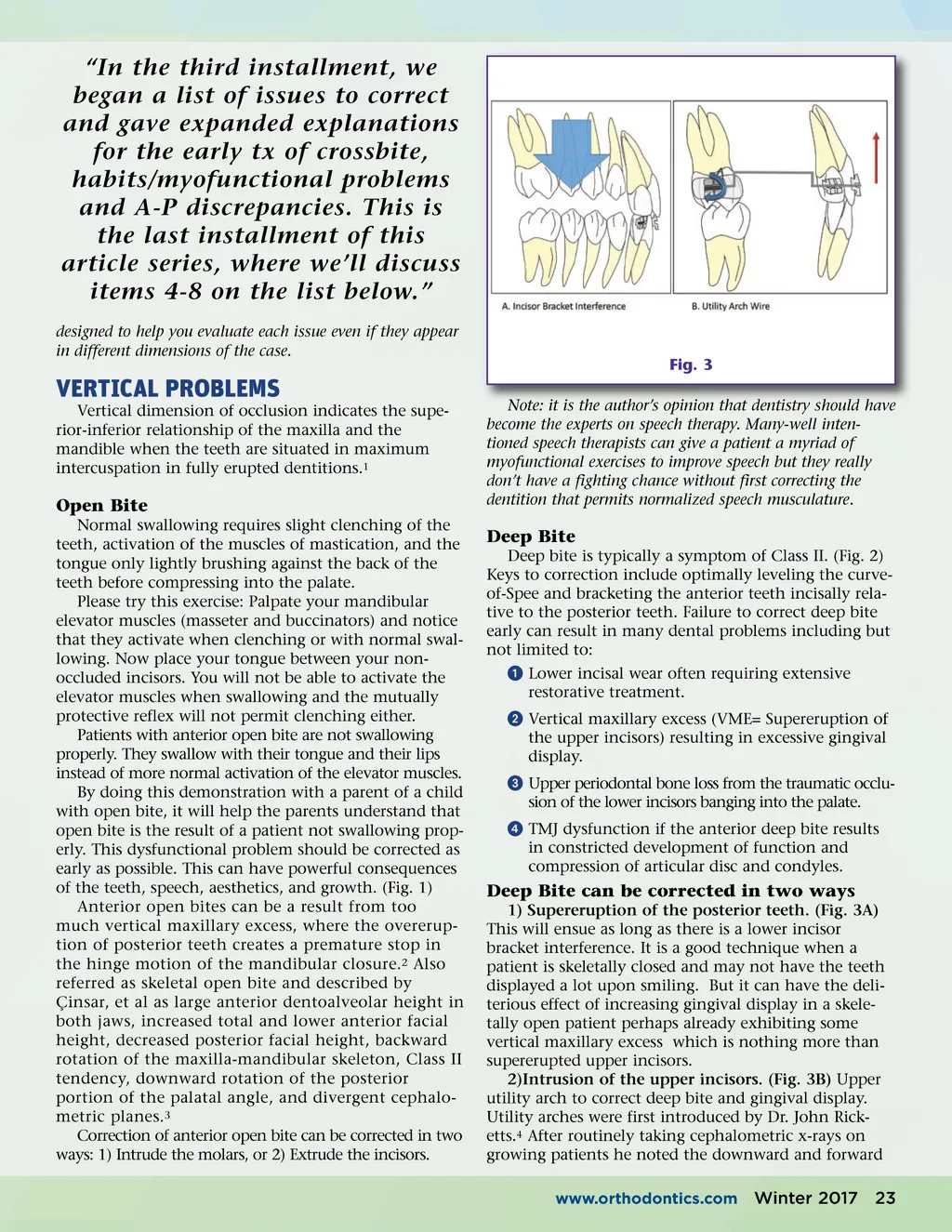
TOGETHER : Part 4 -Systematic Approach to Diagnosis & Treatment of Interceptive Orthodontics By Ralph Nicassio, DDS and Maria Zavala, RDA Fig. 2 ᕢ Habits and/or Myofunctional Problems a. Open bite b. Deep bite Fig. 1 n the first installment of this article, we discussed the rationale for doing Phase I orthodontic treat-ment (tx). In the second installment, we discussed defining successful Ph I treatment and growth management. In the third installment, we began a list of issues to correct and gave expanded explanations for the early tx of crossbite, habits/myofunctional problems and A-P discrepancies. This is the last installment of this arti-cle series, where we’ll discuss items 4-8 on the list below. To review, here is a basic list of the things that I look for when evaluating a child for Ph I tx: ᕡ Crossbite a. Anterior crossbite b. Posterior crossbite c. Functional shift ᕣ A-P problems a. Class II b. Class III c. Correction of functional shifts of the mandible d. Reduce facial protrusion e. Establish symmetry ᕤ Vertical problems a. Open bite b. Deep bite c. Gingival display ᕥ Resolution of Severe Crowding ᕦ Space Maintenance ᕧ Congenitally Missing Teeth ᕨ Trauma There are some redundancies in the outline but this is PUTTING IT ALL I 22 Winter 2017 JAOS
Journal of the American Orthodontic Society Winter 2017: Page 22