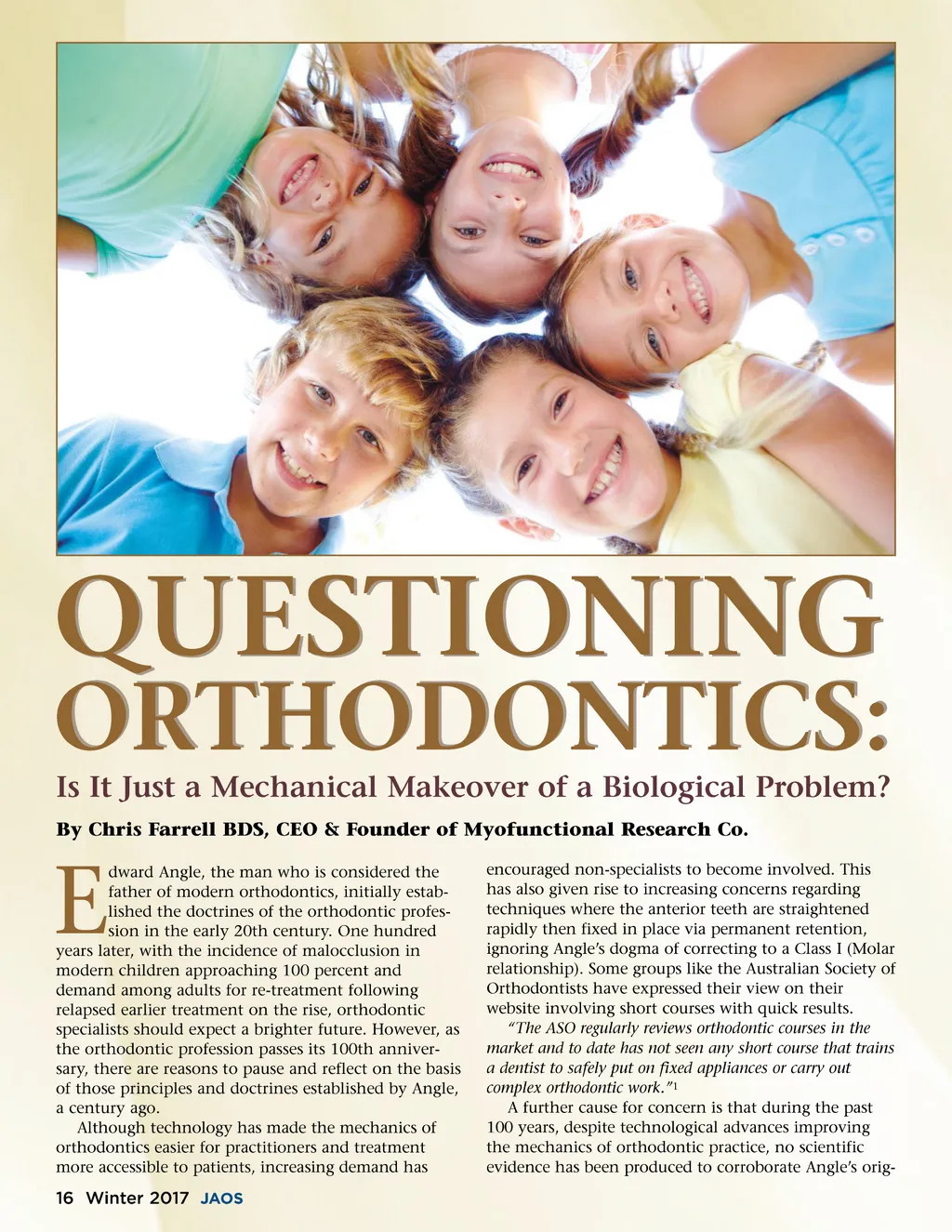
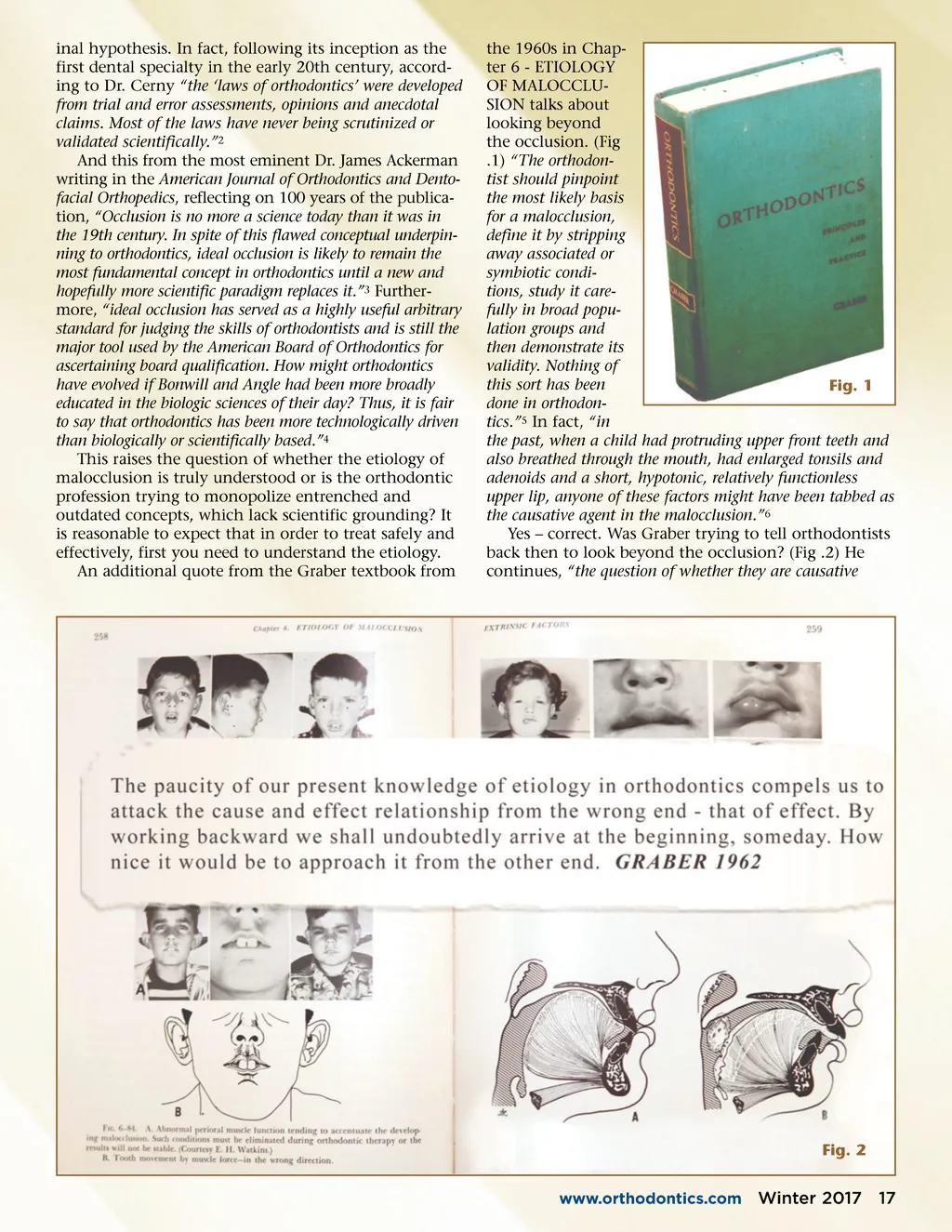
inal hypothesis. In fact, following its inception as the first dental specialty in the early 20th century, accord-ing to Dr. Cerny “the ‘laws of orthodontics’ were developed from trial and error assessments, opinions and anecdotal claims. Most of the laws have never being scrutinized or validated scientifically.” 2 And this from the most eminent Dr. James Ackerman writing in the American Journal of Orthodontics and Dento-facial Orthopedics , reflecting on 100 years of the publica-tion, “Occlusion is no more a science today than it was in the 19th century. In spite of this flawed conceptual underpin-ning to orthodontics, ideal occlusion is likely to remain the most fundamental concept in orthodontics until a new and hopefully more scientific paradigm replaces it.” 3 Further-more, “ideal occlusion has served as a highly useful arbitrary standard for judging the skills of orthodontists and is still the major tool used by the American Board of Orthodontics for ascertaining board qualification. How might orthodontics have evolved if Bonwill and Angle had been more broadly educated in the biologic sciences of their day? Thus, it is fair to say that orthodontics has been more technologically driven than biologically or scientifically based.” 4 This raises the question of whether the etiology of malocclusion is truly understood or is the orthodontic profession trying to monopolize entrenched and outdated concepts, which lack scientific grounding? It is reasonable to expect that in order to treat safely and effectively, first you need to understand the etiology. An additional quote from the Graber textbook from the 1960s in Chap-ter 6 -ETIOLOGY OF MALOCCLU-SION talks about looking beyond the occlusion. (Fig .1) “The orthodon-tist should pinpoint the most likely basis for a malocclusion, define it by stripping away associated or symbiotic condi-tions, study it care-fully in broad popu-lation groups and then demonstrate its validity. Nothing of this sort has been Fig. 1 done in orthodon-tics.” 5 In fact, “in the past, when a child had protruding upper front teeth and also breathed through the mouth, had enlarged tonsils and adenoids and a short, hypotonic, relatively functionless upper lip, anyone of these factors might have been tabbed as the causative agent in the malocclusion.” 6 Yes – correct. Was Graber trying to tell orthodontists back then to look beyond the occlusion? (Fig .2) He continues, “the question of whether they are causative Fig. 2 www.orthodontics.com Winter 2017 17
Journal of the American Orthodontic Society Winter 2017: Page 17