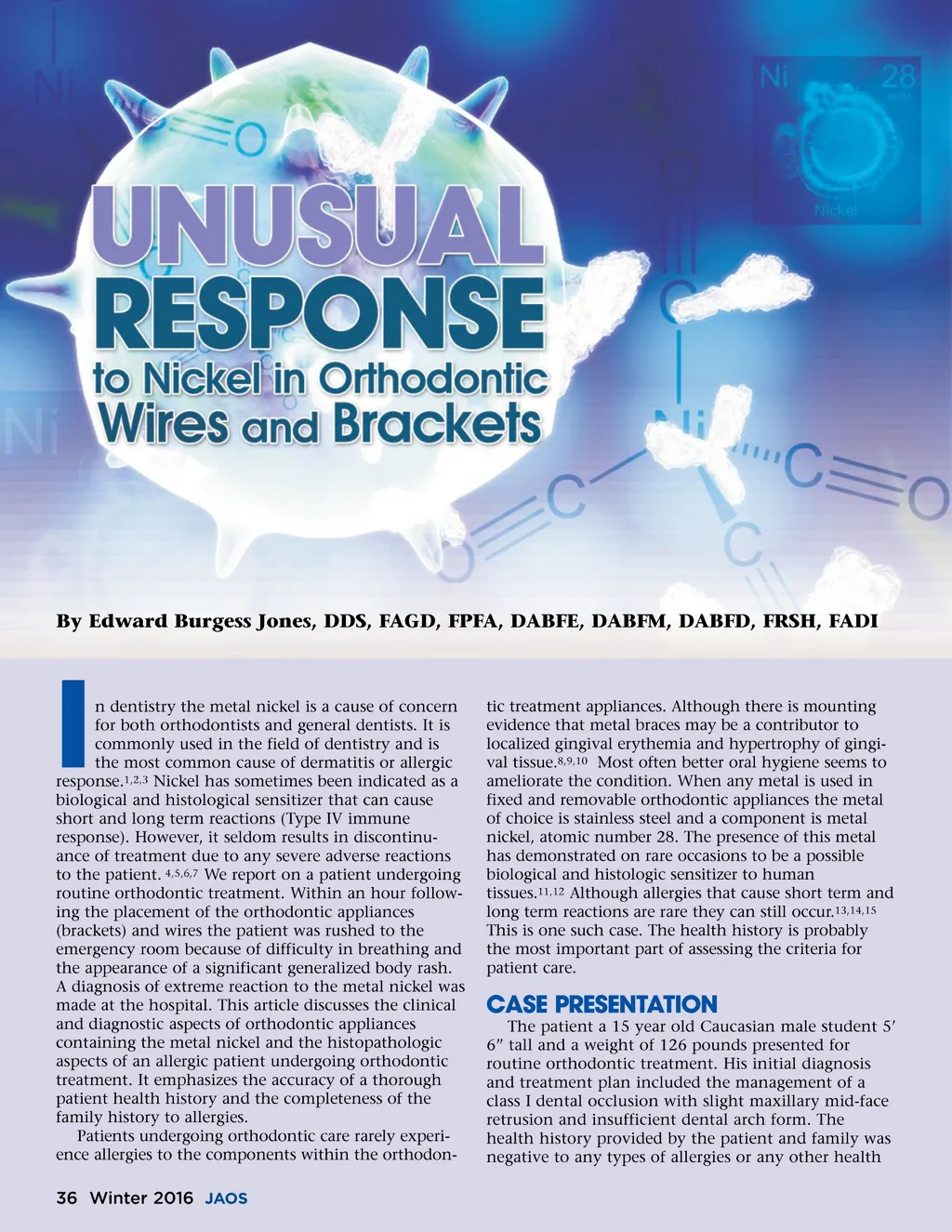
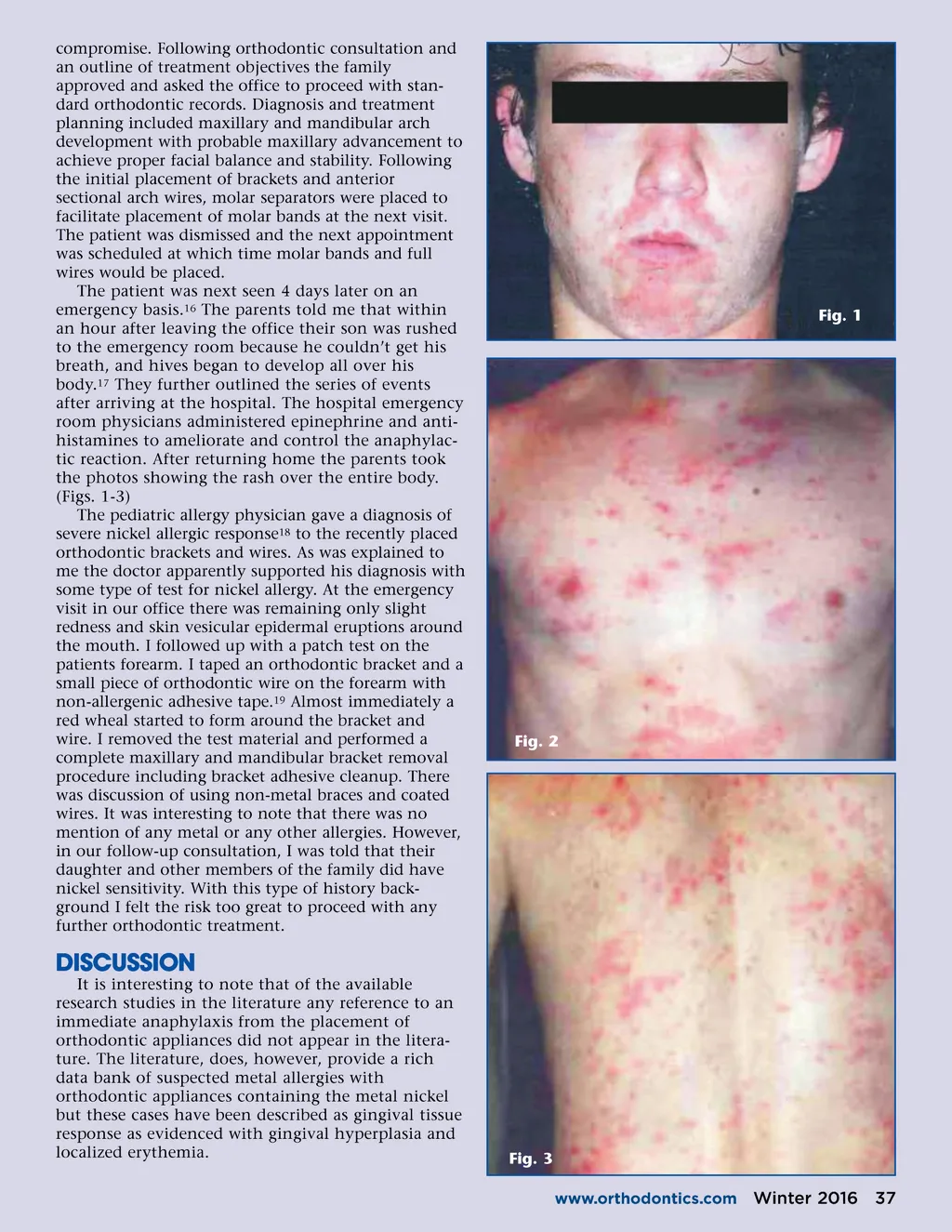
compromise. Following orthodontic consultation and an outline of treatment objectives the family approved and asked the office to proceed with stan-dard orthodontic records. Diagnosis and treatment planning included maxillary and mandibular arch development with probable maxillary advancement to achieve proper facial balance and stability. Following the initial placement of brackets and anterior sectional arch wires, molar separators were placed to facilitate placement of molar bands at the next visit. The patient was dismissed and the next appointment was scheduled at which time molar bands and full wires would be placed. The patient was next seen 4 days later on an emergency basis. 16 The parents told me that within an hour after leaving the office their son was rushed to the emergency room because he couldn’t get his breath, and hives began to develop all over his body. 17 They further outlined the series of events after arriving at the hospital. The hospital emergency room physicians administered epinephrine and anti-histamines to ameliorate and control the anaphylac-tic reaction. After returning home the parents took the photos showing the rash over the entire body. (Figs. 1-3) The pediatric allergy physician gave a diagnosis of severe nickel allergic response 18 to the recently placed orthodontic brackets and wires. As was explained to me the doctor apparently supported his diagnosis with some type of test for nickel allergy. At the emergency visit in our office there was remaining only slight redness and skin vesicular epidermal eruptions around the mouth. I followed up with a patch test on the patients forearm. I taped an orthodontic bracket and a small piece of orthodontic wire on the forearm with non-allergenic adhesive tape. 19 Almost immediately a red wheal started to form around the bracket and wire. I removed the test material and performed a complete maxillary and mandibular bracket removal procedure including bracket adhesive cleanup. There was discussion of using non-metal braces and coated wires. It was interesting to note that there was no mention of any metal or any other allergies. However, in our follow-up consultation, I was told that their daughter and other members of the family did have nickel sensitivity. With this type of history back-ground I felt the risk too great to proceed with any further orthodontic treatment. Fig. 1 Fig. 2 DISCUSSION It is interesting to note that of the available research studies in the literature any reference to an immediate anaphylaxis from the placement of orthodontic appliances did not appear in the litera-ture. The literature, does, however, provide a rich data bank of suspected metal allergies with orthodontic appliances containing the metal nickel but these cases have been described as gingival tissue response as evidenced with gingival hyperplasia and localized erythemia. Fig. 3 www.orthodontics.com Winter 2016 37
Journal of the American Orthodontic Society Winter 2016: Page 37