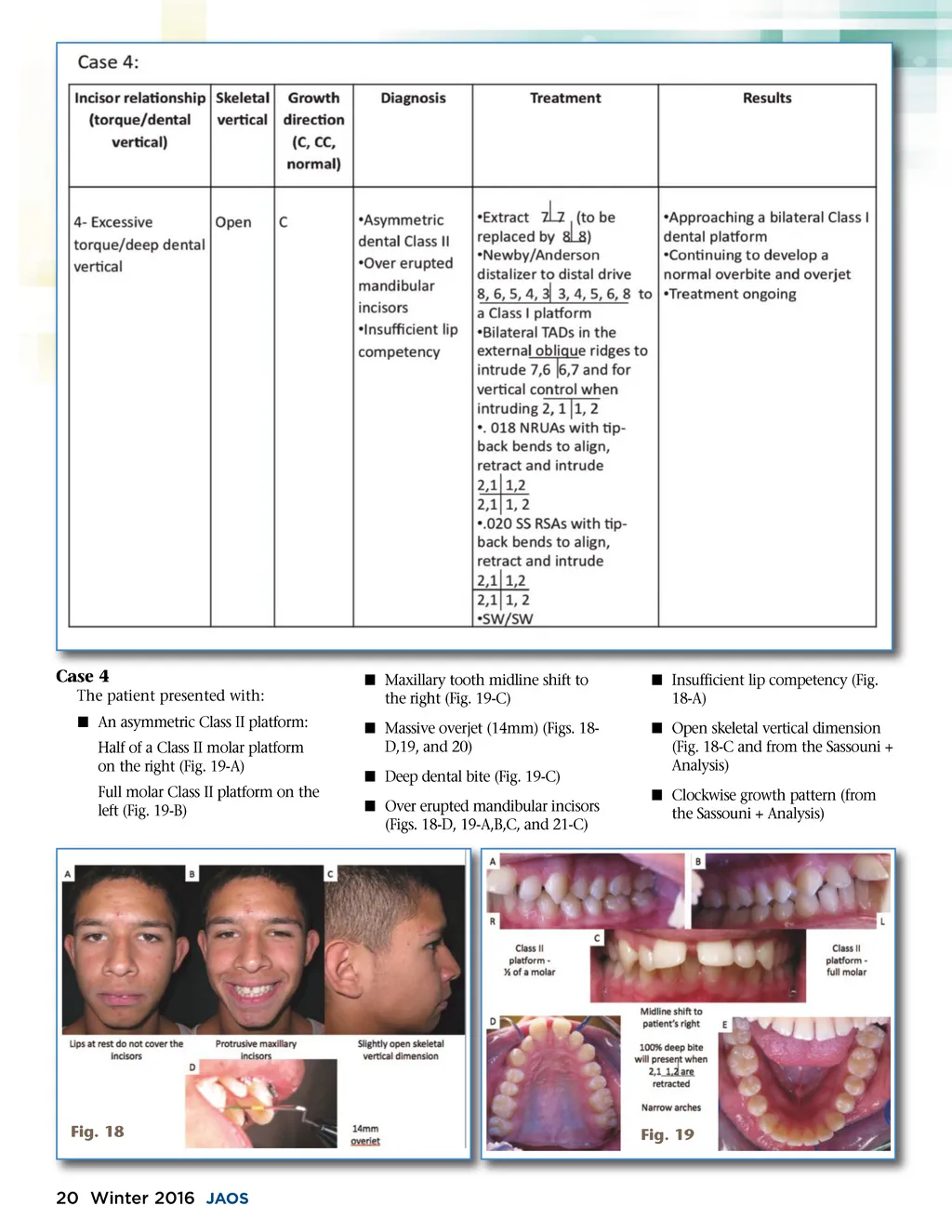
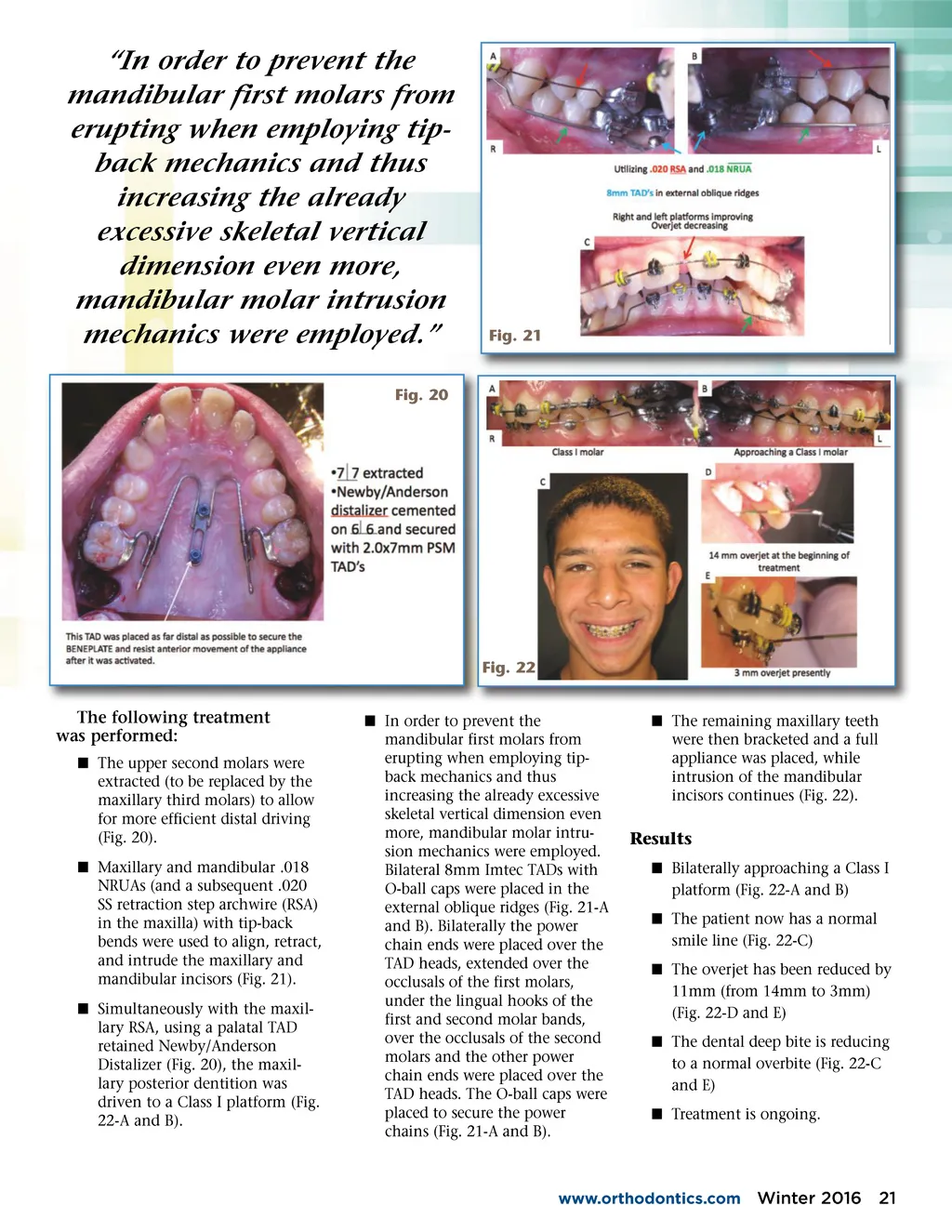
“In order to prevent the mandibular first molars from erupting when employing tip-back mechanics and thus increasing the already excessive skeletal vertical dimension even more, mandibular molar intrusion mechanics were employed.” Fig. 20 Fig. 21 Fig. 22 The following treatment was performed: í The upper second molars were extracted (to be replaced by the maxillary third molars) to allow for more efficient distal driving (Fig. 20). í Maxillary and mandibular .018 NRUAs (and a subsequent .020 SS retraction step archwire (RSA) in the maxilla) with tip-back bends were used to align, retract, and intrude the maxillary and mandibular incisors (Fig. 21). í Simultaneously with the maxil-lary RSA, using a palatal TAD retained Newby/Anderson Distalizer (Fig. 20), the maxil-lary posterior dentition was driven to a Class I platform (Fig. 22-A and B). í In order to prevent the mandibular first molars from erupting when employing tip-back mechanics and thus increasing the already excessive skeletal vertical dimension even more, mandibular molar intru-sion mechanics were employed. Bilateral 8mm Imtec TADs with O-ball caps were placed in the external oblique ridges (Fig. 21-A and B). Bilaterally the power chain ends were placed over the TAD heads, extended over the occlusals of the first molars, under the lingual hooks of the first and second molar bands, over the occlusals of the second molars and the other power chain ends were placed over the TAD heads. The O-ball caps were placed to secure the power chains (Fig. 21-A and B). í The remaining maxillary teeth were then bracketed and a full appliance was placed, while intrusion of the mandibular incisors continues (Fig. 22). Results í Bilaterally approaching a Class I platform (Fig. 22-A and B) í The patient now has a normal smile line (Fig. 22-C) í The overjet has been reduced by 11mm (from 14mm to 3mm) (Fig. 22-D and E) í The dental deep bite is reducing to a normal overbite (Fig. 22-C and E) í Treatment is ongoing. www.orthodontics.com Winter 2016 21
Journal of the American Orthodontic Society Winter 2016: Page 21