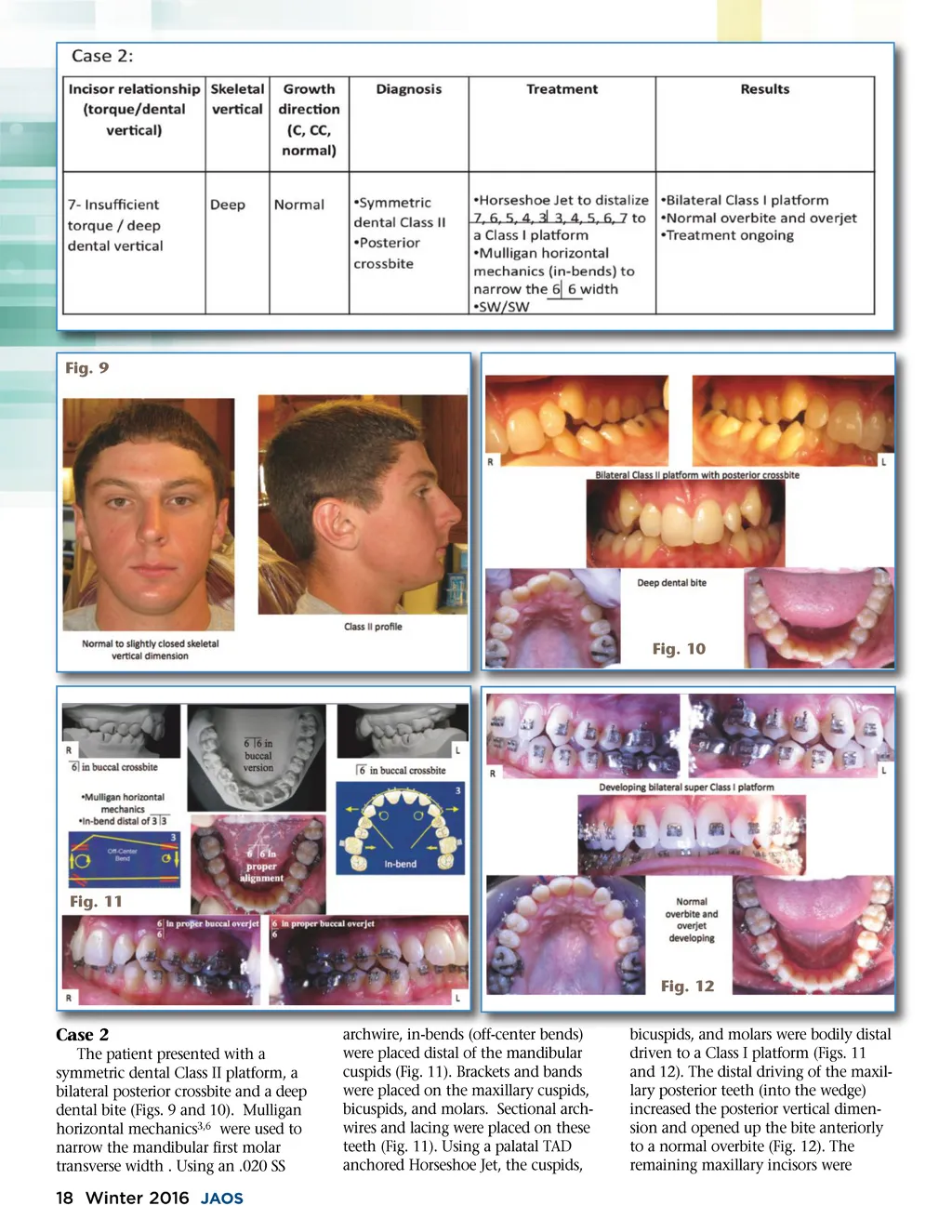
Fig. 9 Fig. 10 Fig. 11 Fig. 12 Case 2 The patient presented with a symmetric dental Class II platform, a bilateral posterior crossbite and a deep dental bite (Figs. 9 and 10). Mulligan horizontal mechanics 3,6 were used to narrow the mandibular first molar transverse width . Using an .020 SS archwire, in-bends (off-center bends) were placed distal of the mandibular cuspids (Fig. 11). Brackets and bands were placed on the maxillary cuspids, bicuspids, and molars. Sectional arch-wires and lacing were placed on these teeth (Fig. 11). Using a palatal TAD anchored Horseshoe Jet, the cuspids, bicuspids, and molars were bodily distal driven to a Class I platform (Figs. 11 and 12). The distal driving of the maxil-lary posterior teeth (into the wedge) increased the posterior vertical dimen-sion and opened up the bite anteriorly to a normal overbite (Fig. 12). The remaining maxillary incisors were 18 Winter 2016 JAOS
Journal of the American Orthodontic Society Winter 2016: Page 18